FREE TRAFFIC TO YOUR SITE

FREE TRAFFIC TO YOUR SITE
free youtube traffic

Tuesday, 1 October 2019

How I Beat Google’s Core Update by Changing the Game

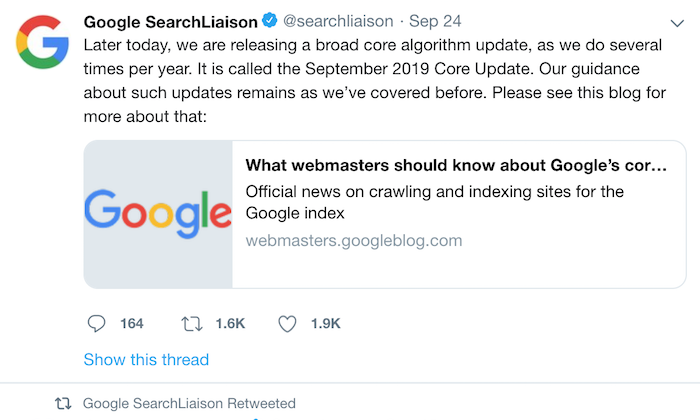
Google released a major update. They typically don’t announce their updates, but you know when they do, it is going to be big.

And that’s what happened with the most recent update that they announced.

A lot of people saw their traffic drop. And of course, at the same time, people saw their traffic increase because when one site goes down in rankings another site moves up to take its spot.

Can you guess what happened to my traffic?

Well, based on the title of the post you are probably going to guess that it went up.

Now, let’s see what happened to my search traffic.
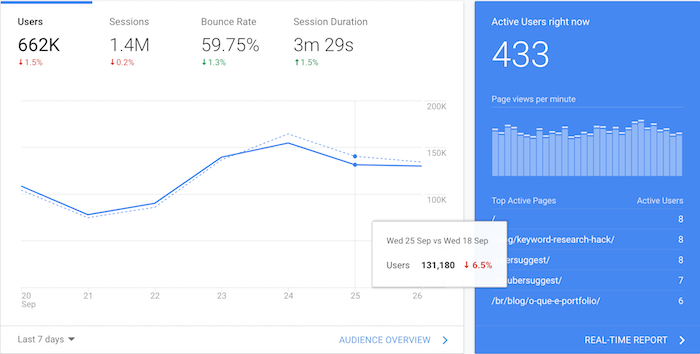
My overall traffic has already dipped by roughly 6%. When you look at my organic traffic, you can see that it has dropped by 13.39%.
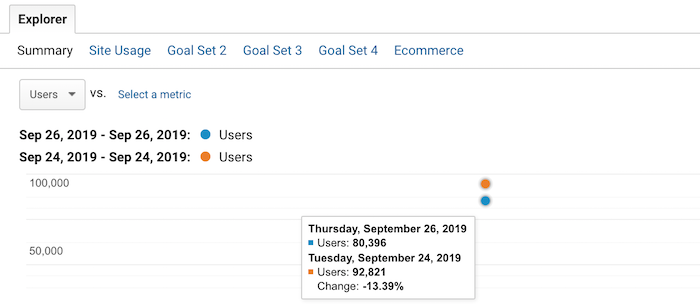
I know what you are thinking… how did you beat Google’s core update when your traffic went down?

What if I told you that I saw this coming and I came up with a solution and contingency strategy in case my organic search traffic would ever drop?

But before I go into that, let me first break down how it all started and then I will get into how I beat Google’s core update.

A new trend

I’ve been doing SEO for a long time… roughly 18 years now.

When I first started, Google algorithm updates still sucked but they were much more simple. For example, you could get hit hard if you built spammy links or if your content was super thin and provided no value.

Over the years, their algorithm has gotten much more complex. Nowadays, it isn’t about if you are breaking the rules or not. Today, it is about optimizing for user experience and doing what’s best for your visitors.

But that in and of itself is never very clear. How do you know that what you are doing is better for a visitor than your competition?

Honestly, you can never be 100% sure. The only one who actually knows is Google. And it is based on whoever it is they decide to work on coding or adjusting their algorithm.

Years ago, I started to notice a new trend with my search traffic.
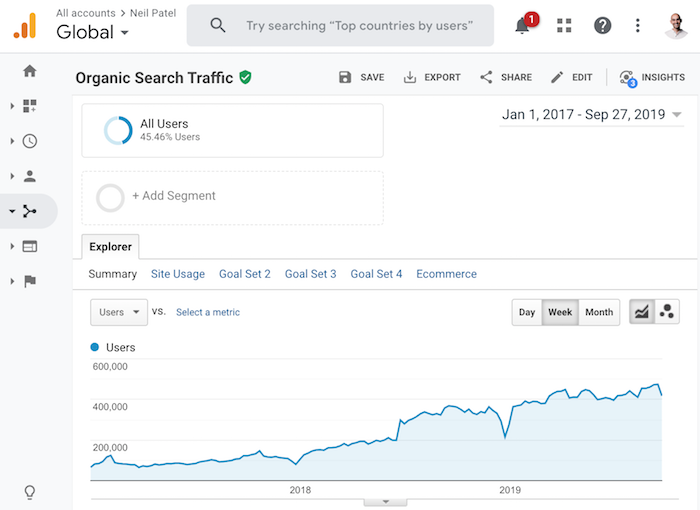
Look at the graph above, do you see the trend?

And no, my traffic doesn’t just climb up and to the right. There are a lot of dips in there. But, of course, my rankings eventually started to continually climb because I figured out how to adapt to algorithm updates.

On a side note, if you aren’t sure how to adapt to the latest algorithm update, read this. It will teach you how to recover your traffic… assuming you saw a dip. Or if you need extra help, check out my ad agency.

In many cases after an algorithm update, Google continues to fine-tune and tweak the algorithm. And if you saw a dip when you shouldn’t have, you’ll eventually start recovering.

But even then, there was one big issue. Compared to all of the previous years, I started to feel like I didn’t have control as an SEO anymore back in 2017. I could no longer guarantee my success, even if I did everything correctly.

Now, I am not trying to blame Google… they didn’t do anything wrong. Overall, their algorithm is great and relevant. If it wasn’t, I wouldn’t be using them.

And just like you and me, Google isn’t perfect. They continually adjust and aim to improve. That’s why they do over 3,200 algorithm updates in a year.

But still, even though I love Google, I didn’t like the feeling of being helpless. Because I knew if my traffic took a drastic dip, I would lose a ton of money.

I need that traffic, not only to drive new revenue but, more importantly, to pay my team members. The concept of not being able to pay my team on any given month is scary, especially when your business is bootstrapped.

So what did I do?

I took matters into my own hands

Although I love SEO, and I think I’m pretty decent at it based on my traffic and my track record, I knew I had to come up with another solution that could provide me with sustainable traffic that could still generate leads for my business.

In addition to that, I wanted to find something that wasn’t “paid,” as I was bootstrapping. Just like how SEO was starting to have more ups and downs compared to what I’ve seen in my 18-year career, I knew the cost at paid ads would continually rise.

Just look at Google’s ad revenue. They have some ups and downs every quarter but the overall trend is up and to the right.
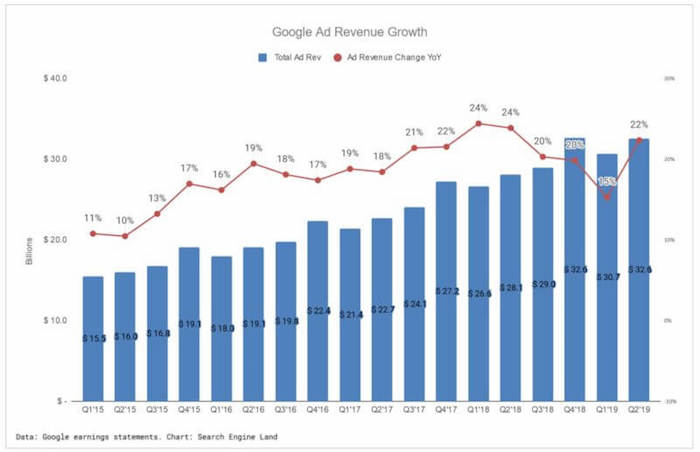
In other words, advertising will continually get more expensive over time.

And it’s not just Google either. Facebook Ads keep getting more expensive as well.
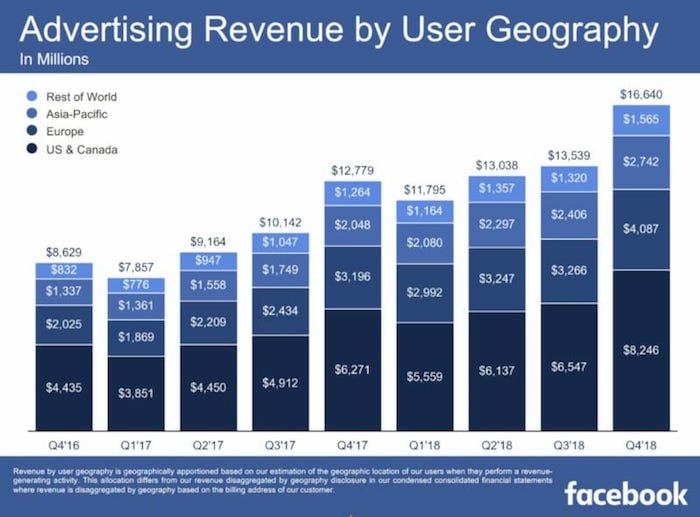
I didn’t want to rely on a channel that would cost me more next year and the year after because it could get so expensive that I may not be able to profitably leverage it in the future.

So, what did I do?

I went on a hunt to figure out a way to get direct, referral, and organic traffic that didn’t rely on any algorithm updates. (I will explain what I mean by organic traffic in a bit.)

I went on my mission

With the help of my buddy, Andrew Dumont, I went searching for websites that continually received good traffic even after algorithm updates.

Here were the criteria that we were looking for:

  • Sites that weren’t reliant on Google traffic
  • Sites that didn’t need to continually produce more content to get more traffic
  • Sites that weren’t popular due to social media traffic (we both saw social traffic dying)
  • Sites that didn’t leverage paid ads in the past or present
  • Sites that didn’t leverage marketing

In essence, we were looking for sites that were popular because people naturally liked them. Our intentions at first weren’t to necessarily buy any of these sites. Instead, we were trying to figure out how to naturally become popular so we could replicate it.

Do you know what we figured out?

I’ll give you a hint.

Think of it this way: Google doesn’t get the majority of their traffic from SEO. And Facebook doesn’t get their traffic because they rank everywhere on Google or that people share Facebook.com on the social web.

Do you know how they are naturally popular?

It comes down to building a good product.

That was my aha! moment. Why continually crank out thousands of pieces of content, which isn’t scalable and is a pain as you eventually have to update your old content, when I could just build a product?

That’s when Andrew and I stumbled upon Ubersuggest.

Now the Ubersuggest you see today isn’t what it looked like in February 2017 when I bought it.
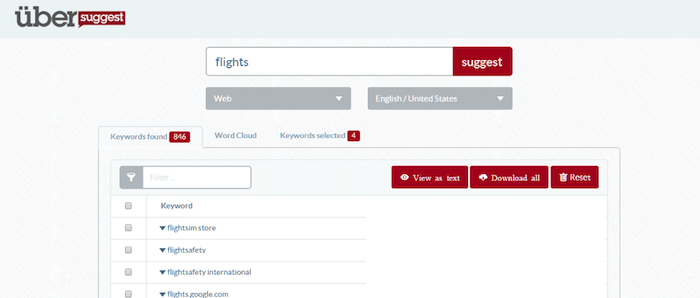
It used to be a simple tool that just showed you Google Suggest results based on any query.

Before I took it over, it was generating 117,425 unique visitors per month and had 38,700 backlinks from 8,490 referring domains.

All of this was natural. The original founder didn’t do any marketing. He just built a product and it naturally spread.

The tool did, however, have roughly 43% of its traffic coming from organic search. Now, can you guess what keyword it was?

The term was “Ubersuggest”.

In other words, its organic traffic mainly came from its own brand, which isn’t really reliant on SEO or affected by Google algorithm updates. That’s also what I meant when I talked about organic traffic that wasn’t reliant on Google.

Now since then I’ve gone a bit crazy with Ubersuggest and released loads of new features… from daily rank tracking to a domain analysis and site audit report to a content ideas report and backlinks report.

In other words, I’ve been making it a robust SEO tool that has everything you need and is easy to use.

It’s been so effective that the traffic on Ubersuggest went from 117,425 unique visitors to a whopping 651,436 unique visitors that generates 2,357,927 visits and 13,582,999 pageviews per month.
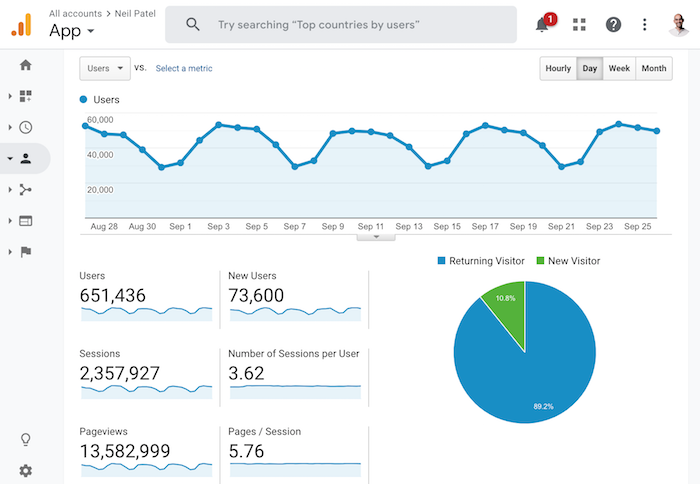
Best of all, the users are sticky, meaning the average Ubersuggest user spends over 26 minutes on the application each month. This means that they are engaged and will likely to convert into customers.
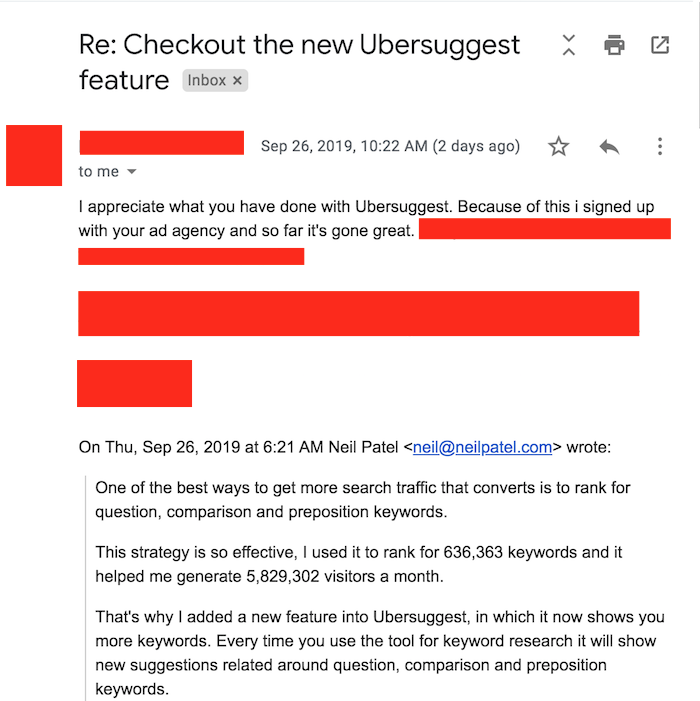
As I get more aggressive with my Ubersuggest funnel and start collecting leads from it, I expect to receive many more emails like that.

And over the years, I expect the traffic to continually grow.

Best of all, do you know what happens to the traffic on Ubersuggest when my site gets hit by a Google algorithm update or when my content stops going viral on Facebook?

It continually goes up and to the right.
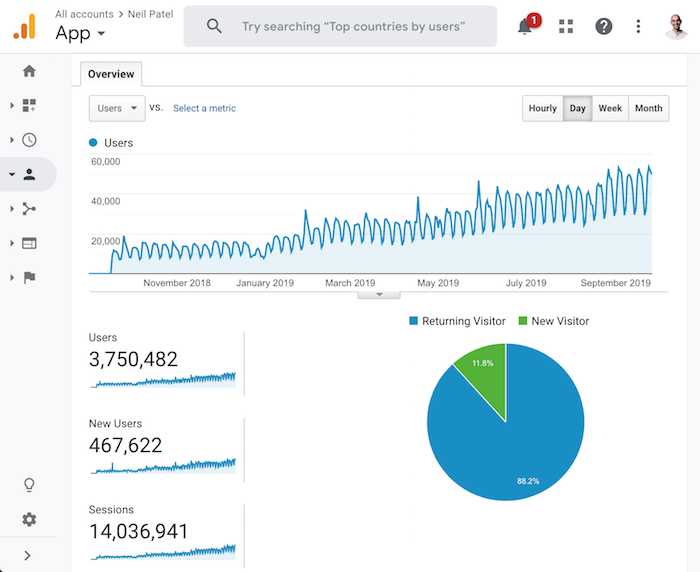
Now, unless you dump a ton of money and time into replicating what I am doing with Ubersuggest, but for your industry, you won’t generate the results I am generating.

As my mom says, I’m kind of crazy…

But that doesn’t mean you can’t do well on a budget.

Back in 2013, I did a test where I released a tool on my old blog Quick Sprout. It was an SEO tool that wasn’t too great and honestly, I probably spent too much money on it.
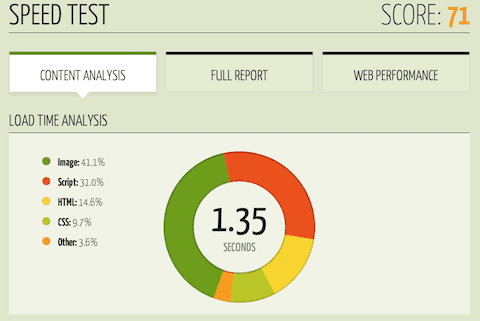
Here were the stats for the first 4 days of releasing the tool:

  • Day #1: 8,462 people ran 10,766 URLs
  • Day #2: 5,685 people ran 7,241 URLs
  • Day #3: 1,758 people ran 2,264 URLs
  • Day #4: 1,842 people ran 2,291 URLs

Even after the launch traffic died down, still 1,000+ people per day used the tool. And, over time, it actually went up to over 2,000.

It was at that point in my career, I realized that people love tools.

I know what you are thinking though… how do you do this on a budget, right?

How to build tools without hiring developers or spending lots of money

What’s silly is, and I wish I knew this before I built my first tool on Quick Sprout back in the day, there are tools that already exist for every industry.

You don’t have to create something new or hire some expensive developers. You can just use an existing tool on the market.

And if you want to go crazy like me, you can start adding multiple tools to your site… just like how I have an A/B testing calculator.

So how do you add tools without breaking the bank?

You buy them from sites like Code Canyon. From $2 to $50, you can find tools on just about anything. For example, if I wanted an SEO tool, Code Canyon has a ton to choose from. Just look at this one.
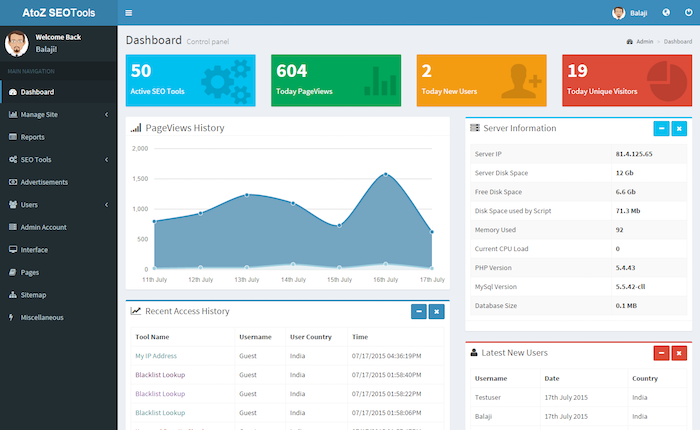
Not a bad looking tool that you can have on your website for just $40. You don’t have to pay monthly fees and you don’t need a developer… it’s easy to install and it doesn’t cost much in the grand scheme of things.

And here is the crazy thing: The $40 SEO tool has more features than the Quick Sprout one I built, has a better overall design, and it is .1% the cost.

Only if I knew that before I built it years ago. :/

Look, there are tools out there for every industry. From mortgage calculators to calorie counters to a parking spot finder and even video games that you can add to your site and make your own.

In other words, you don’t have to build something from scratch. There are tools for every industry that already exists and you can buy them for pennies on the dollar.

Conclusion

I love SEO and always will. Heck, even though many SEOs hate how Google does algorithm updates, that doesn’t bother me either… I love Google and they have built a great product.

But if you want to continually do well, you can’t rely on one marketing channel. You need to take an omnichannel approach and leverage as many as possible.

That way, when one goes down, you are still generating traffic.

Now if you want to do really well, think about most of the large companies out there. You don’t build a billion-dollar business from SEO, paid ads, or any other form of marketing. You first need to build an amazing product or service.

So, consider adding tools to your site, the data shows it is more effective than content marketing and it is more scalable.

Sure you probably won’t achieve the results I achieved with Ubersuggest, but you can achieve the results I had with Quick Sprout. And you can achieve better results than what you are currently getting from content marketing.

What do you think? Are you going to add tools to your site?

The post How I Beat Google’s Core Update by Changing the Game appeared first on Neil Patel.


from Blog – Neil Patel https://ift.tt/2mxCEHg

Thursday, 26 September 2019

9 Mobile Marketing Trends You Can’t Ignore

As we become more and more reliant on using smartphones, mobile marketing becomes more critical for modern brands.

Certain trends have become obvious, and ignoring them puts a serious damper on our branding results. Here are mobile marketing trends that you absolutely have to pay attention to, and should consider implementing before we hit 2020.

1. Omnichannel Marketing

You have to keep in mind that not all mobile interactions start or end on your smartphone. Users are navigating from multiple devices. Their buying journey may start through voice search on a smart assistant and continue on a mobile device.

Browsing the web has become very fragmented and harder to monitor. There are no longer linear sales funnels any more because interactions have become faster and scattered across devices.

There are gaming platforms, smart TVs, and even smart home devices. We are living in an age where you can stream television through a smart fridge. Times are changing. Your marketing efforts need to reflect that.

Here’s a detailed omnichannel marketing guide and how to implement it in your overall marketing strategy:

omnichannel marketing

2. Visual Search

Ok, some of marketing trends really start resembling sci-fi movies. These days you can point your phone camera to any object around you to associate web search!

Google Lens is an image recognition technology developed by Google, designed to bring up relevant information related to objects it identifies using visual analysis based on a neural network.

visual search

If you haven’t got serious about visual marketing yet, this trend should have encouraged you to!

3. Ever Evolving Instagram Ads

Traditionally mobile-only, Instagram is growing by the day, and they have been getting into the advertising game for awhile as their user base increases. Some bigger brands have been getting on board with the platform and started marketing from there, but the crowd is still pretty thin.

Instagram is adding new and new advertising options every year. This year they are introducing ads inside their Explore section where users would go to discover new content and feeds:

ads in explore

That makes it a great place to start setting your own ads, with great returns. Of course that means you should be putting a good amount of focus on your overall Instagram marketing strategy. If you haven’t launched one, it is a good time to start.

4. Augmented Reality

Augmented reality (AR) works by overlaying virtual objects on top of a real-world environment (usually by using the camera on a smartphone).

If you experienced the hubbub of Pokemon Go, you witnessed augmented reality in action. Other examples include IKEA Place offering you to virtually “place” IKEA products in your room and Timberland building a virtual fitting room (known as magic mirror).

Augmented Reality

5. Video Ads

Video ads are a little bit controversial right now. The data still isn’t in on how effective they are, and different sources report wildly different success rates. But there is no denying that more brands are using them, including on mobile marketing.

Platforms like YouTube are especially reliant on the advertising form. You may want to consider jumping on the bandwagon and trying it for yourself.

6. Mobile Apps In Google Search Results

google apps in Google search

Google started blending their first-page search results to include mobile apps a couple of years ago. Where you would normally see ads or universal search results in the top spots, you could find Google Play and iTunes recommendations right on the first page.

These days Google is also showing the whole section filled with related Google Apps including average ratings and price. Advertisers are also welcome to advertise their official app right inside their sponsored listing.

Apps already make up a huge chunk of mobile usage these days. Even if you don’t have an app yet, it is worth making one just to take advantage of their popularity, and Google’s new promo guidelines.

7. Social Commerce

As mentioned, ecommerce is becoming increasingly omni-channel, i.e. unifying every sales channel to create a single commerce experience has recently become the only way to go.

It has also become highly cross-platform: Driving sales from Google only is no longer sustainable. These days of mobile apps and social media ads, you can monetize your social media presence and create multiple marketing channels.

With Facebook focusing more on “buy now” buttons, and platforms like Instagram and Pinterest really pushing the ecommerce side, we are now seeing a socialization of online consumerism.

The line between shopping cart and social media has been blurred, and it is time to take advantage of that. Not only can you begin to use social platforms for direct sales and lead building (which works great via mobile devices), but you can make your own site more social. The early, creative birds get the worms here.

8. New Payment Systems

Payment systems are seriously changing. Samsung has a payment platform that can be used almost anywhere, in spite of whether they are optimized for it or not.

Services like PayPal are being accepted from big names like Walmart. Smartphones have their own wallets, such as through Apple Pay. It is no longer an option to ignore these new ways to pay, because customers would rather go with a brand that offers the choice.

9. Customized Lifestyle Apps

What can we learn from products like the FitBit? That apps are no longer accessories, they are lifestyles.

People use mobile devices to reflect and enhance the way that they live, such as through fitness apps (FitBit, MyFitnessPal), financial assistance (Mint, Mint Bills), and even smart homes (iSmartAlarm). You can promote your services by creating a lifestyle based app of your own.

Have you noticed any hot mobile trends in marketing lately? Let us know in the comments!

The post 9 Mobile Marketing Trends You Can’t Ignore appeared first on Internet Marketing Ninjas Blog.


from Internet Marketing Ninjas Blog https://ift.tt/2m6zLNv
via IFTTT

Tuesday, 24 September 2019

How I Ranked For 636,363 Keywords Using This Simple Hack

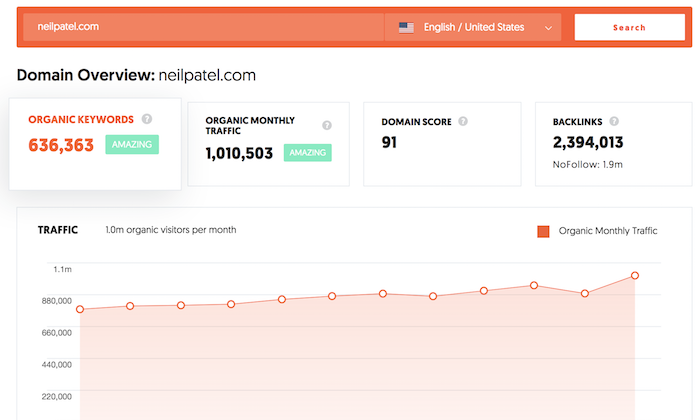
When I started doing SEO on NeilPatel.com I used this advanced formula to rank for 477,000 keywords.

Over time, my traffic started to flatline and I wasn’t ranking for many more keywords, even though I was continually creating more content.

But then I figured out a simple hack that took me from 477,000 keywords to 636,363 keywords as you can see in the image above.

So, what was this hack?

Well, it’s so effective that I just updated Ubersuggest so that includes the hack.

So how did I do it?

When someone does a Google search, what are they typically doing? They are trying to find a solution to their problem, right?

So how can you easily identify these problems people are searching for?

Typically, you want to look for 3 types of keyword phrases:

  1. Questions – people type in questions because they are looking for answers. And if your product or service helps answer those questions, you’ll see a boost in conversions.
  2. Comparisons – when someone is searching for comparison keywords such as “MailChimp VS Converkit” there is high buyer intent, even if your company isn’t mentioned in the search phase. (I’ll go into how to leverage this in a bit.)
  3. Prepositions – when keywords contain a preposition, they tend to be more descriptive. If you aren’t sure what a preposition is, simple prepositions are words like at, for, in, off, on, over, and under. These common prepositions can be used to describe a location, time, or place.

But how do you find these keywords?

Well, I just updated Ubersuggest to now show you questions, comparisons, and prepositions.

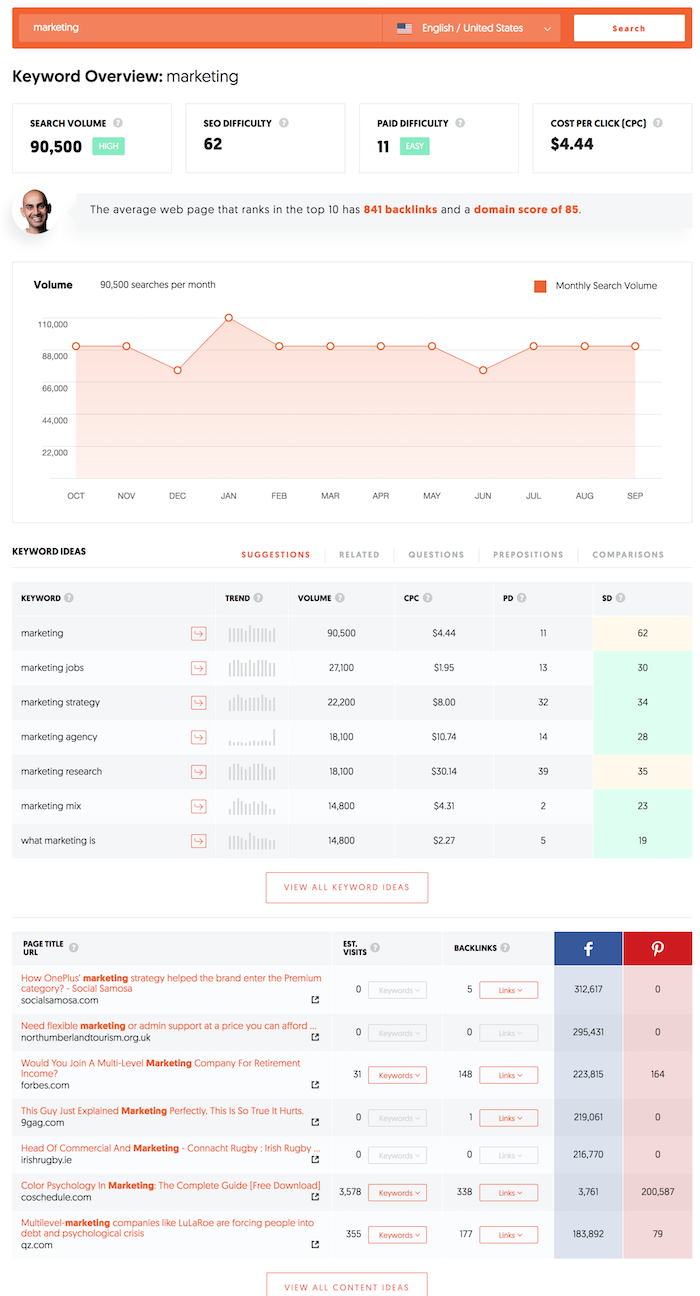
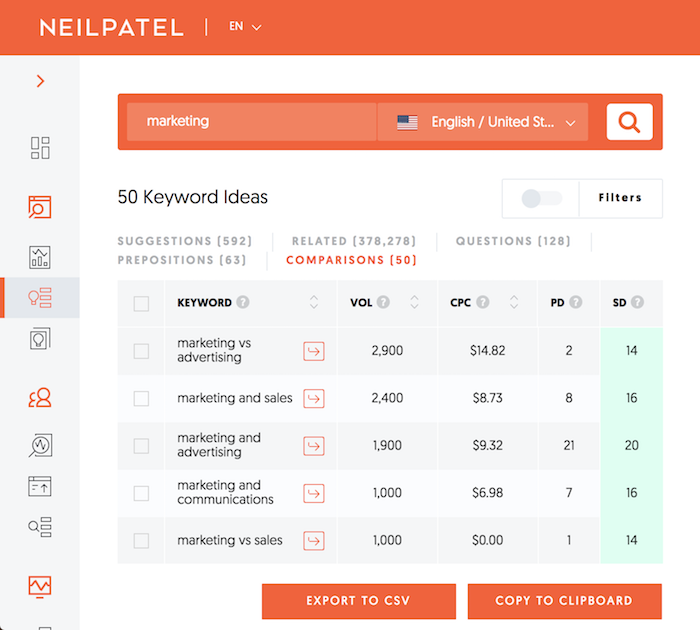
Just head over to Ubersuggest and type in a keyword that you want to go after. For this example, I typed in the word “marketing”.

Then as you scroll down, in the keywords ideas table you’ll see tabs for questions, prepositions, and comparisons.

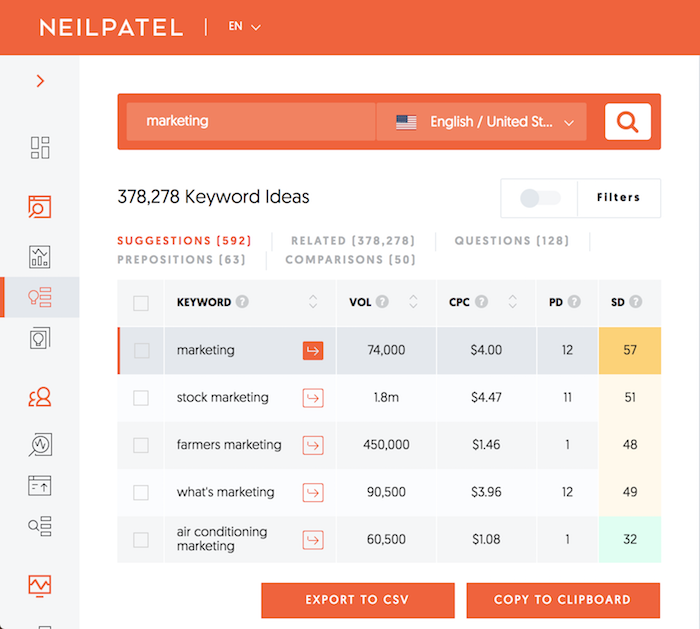
I want you to click on the “view all keyword ideas”.

You’ll now be taken to the keyword ideas report that looks like this:

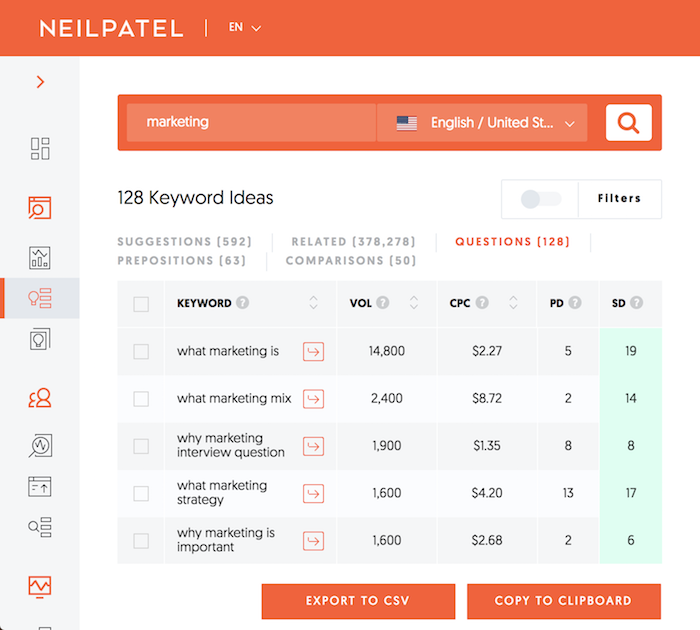
Now, click on the tab labeled “questions”. It will adjust the keyword recommendations to show you all of the popular questions related to the main keyword you just researched.

You’ll then see some suggestions that you could consider going after. Such as:

  • Why is marketing important?
  • What marketing does?
  • How marketing works?

But as you scroll down, you’ll find more specific questions such as:

  • Why a marketing plan is important?
  • How marketing and sales work together?
  • How many marketing emails should you send?

Now that you are able to see these questions people are typing, in theory, you can easily rank for them as most of them have an SEO difficulty score of 20 or so out of a 100 (the higher the number the more competitive it is).

More importantly, though, you can create content around all of those phrases and sell people to your product or service.

For example, if you created an article on “why a marketing plan is important,” you can go into how you also can create a marketing plan. From there you can transition into describing your services on creating a marketing plan and how people can contact you if they want your help or expertise in creating one.

You can do something similar with the “how marketing and sales work together” article in which you can break down how to make each department work together. From there, you can either be an affiliate for software solutions that help merge the two departments like HubSpot or sell your own software if you offer one. You can even pitch your consulting services that help tie sales and marketing together.

And as for the “how many marketing emails should you send,” you can create content around that and have an affiliate link to popular email tools that have high deliverability and offer automation. Or you can promote your own email product.

Now imagine all of the extra keywords you can rank for by going after question-related keywords. What’s amazing about this is most of these keywords are competitive and they have extremely high search intent.

Can it get any better?

Speaking of search intent, I want you to click on the comparisons tab.

You’ll see a list of ideas just like you did with the questions tab. But what I love doing here is typing in a competitor’s brand name here.

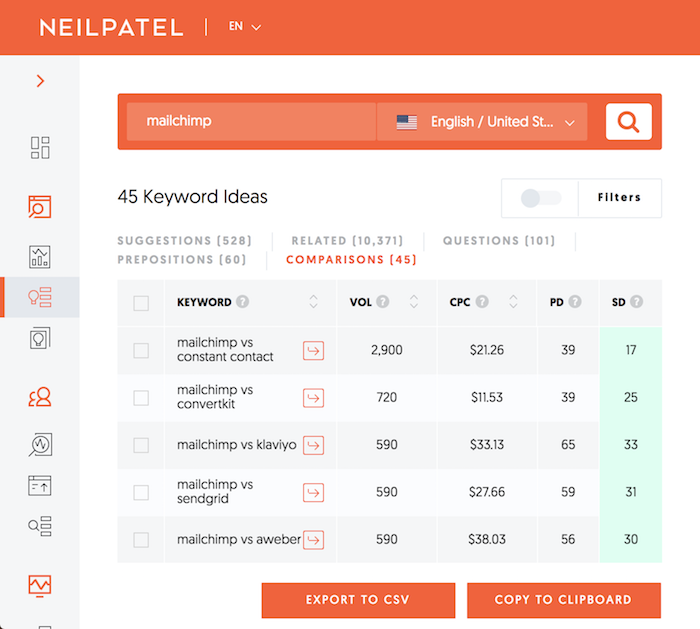
Let’s say I am offering an email marketing tool. I could type in “Mailchimp” and see what comparison ideas Ubersuggest comes up with.

Now for this example, I want you to imagine that you have an email company called Drip and Drip isn’t really mentioned in any of these keyword comparison ideas.

What’ll you want to do is create articles on all of the popular comparison terms like “Mailchimp vs Constant Contact” or “Mailchimp vs Convertkit” and within those articles break down the differences and also compare them with your own tool Drip.

Be honest when writing the comparisons. Show off which is the best solution using facts and data and break down how you are different and in what ways your own solution is better than the two solutions the reader is comparing.

This will bring awareness to your solution and you’ll find that people will start purchasing it even though they were comparing two of your competitors.

If you want a good example of how to create a neutral comparison type of blog post, check out this article comparing web hosts.

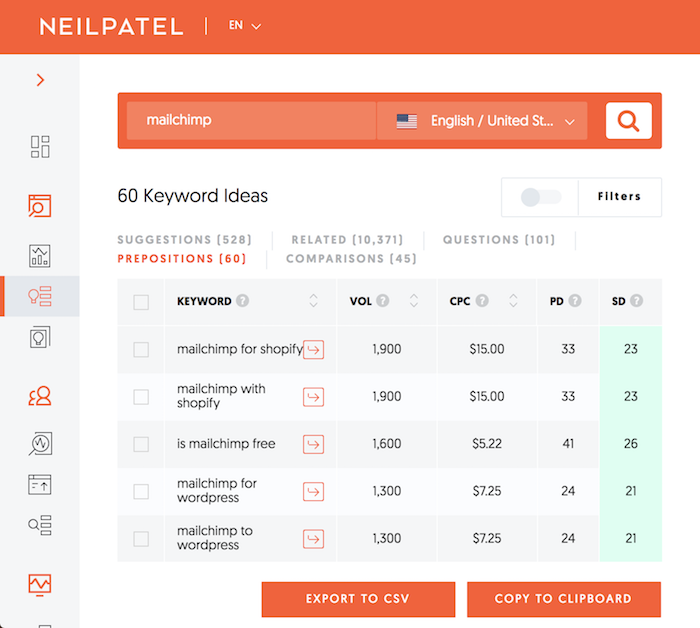
And if you want to take it one step further, you can click on the “prepositions” tab to find even more ideas.

Sticking with the Mailchimp example, you can see that people are curious about Shopify and WordPress integrations.

You can write articles related to integrations and also push your own product and break down how it differs from the others.

If you want to take it one level deeper, it will give you ideas on how to modify your business. For example, if I created an email marketing tool, I would create a Shopify, WordPress, Woocomerce, and Squarespace integration based on the ideas I got from the prepositions tab.

So how did I rank for 636,363 keywords?

I didn’t use all of the examples above on NeilPatel.com because I am not really trying to sell a product and I don’t have the time to write thousands of new blog posts.

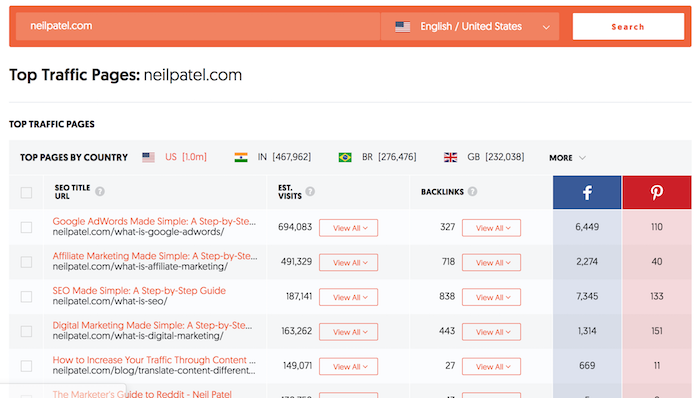
But I did type in my domain name into Ubersuggest and then headed over to the top pages report.

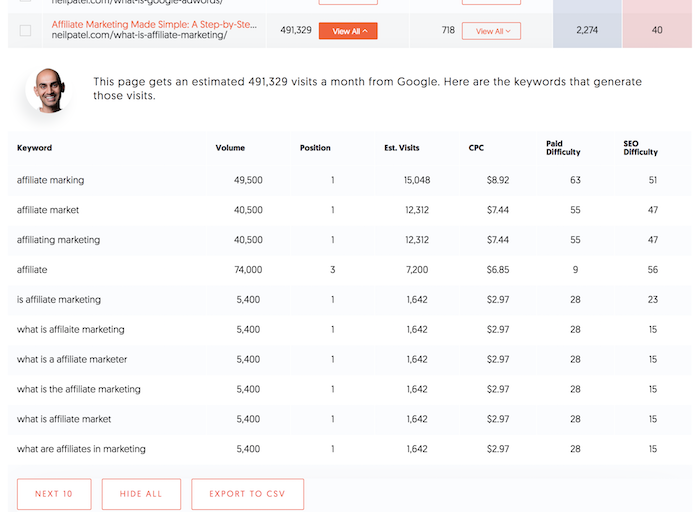
From there I looked at the pages that are already ranking well on Google and clicked on the “view all” button to see the exact keywords each page ranks for.

As you can see from that page I rank for questions like “what is affiliate marketing” as well as popular prepositions and comparisons.

How did I do this?

Well, that top pages report shows you keywords each of your pages already ranks for. So all you have to do is research each of those terms through Ubersuggest and find popular questions, prepositions, and comparisons.

Conclusion

The natural instinct for any SEO or marketer is to rank for popular terms that have a lot of search traffic.

But there is an issue with that strategy. It takes a lot of time, it’s extremely competitive, and many of those search phrases don’t cause a ton of conversions as they are super generic.

So, what should you do instead?

Focus on solving people’s problems. The way you do this is by creating content around the questions, prepositions, and comparisons people are searching for in Google.

What do you think about the new Ubersuggest feature?

The post How I Ranked For 636,363 Keywords Using This Simple Hack appeared first on Neil Patel.


from Blog – Neil Patel https://ift.tt/2lahe2w

Thursday, 19 September 2019

International SEO FAQ: Multi-Lingual and/or Multi-Regional Optimization

Lots of online businesses and digital publication are going global these days and we have to thank the Internet for giving us this incredible opportunity.

Yet, even though it has been around for years now, international SEO is also unbelievably confusing.

There are a lot of “it depends” in this area, so I did my best to collect clear answers to a few possible cases.

How to optimize for multiple regions and multiple languages?


Google clearly lists all the options we have:

multiple regions and multiple languages

[To add to this, in both #1 and #2 cases, it can be quite difficult to build up the domain authority, so it’s another serious con Google is not including in the chart.]

A few DOs and DON’Ts here though:

Country-specific domain

  • DO try and keep content on each domain unique and localized (including generic pages like “About us”). It does take a bit of work but it’s just safer
  • DO choose this option if you sell different products in each country
  • DO choose this option if you have enough resources to build the domain authority for each country
  • DON’T use “International targeting” tool inside Google’s search console. That feature is only useful if you have a generic TLD or a local subdomain targeting a specific country

Overall Google says that a country-specific top-level domain is the strongest signal you can send (another strong signal is the language, obviously). If you go this route, Google won’t need any more hints.

Beware that Google treats some seemingly localized domains as generic. Here’s the full list:

Perceived as generic domains by Google Perceived as localized domains by Google
  • .com
  • .org
  • .edu
  • .gov
  • .eu
  • .asia
  • .ad
  • .as
  • .bz
  • .cc
  • .cd
  • .co
  • .dj
  • .fm
  • .io
  • .la
  • .me
  • .ms
  • .nu
  • .sc
  • .sr
  • .su
  • .tv
  • .tk
  • .ws
Here’s the full list of country code top level domains

Page level targeting

  • DO use hreflang tag OR XML sitemaps to point Google to where you are targeting which region (mind that only Google and Yandex support hreflang tags)
  • DO ensure your site consistent performance globally. Using a Content Delivery Network is probably the most reliable way to do that. Besides, you can use Pingdom to monitor performance in your important countries.
  • DO choose this option if you have enough resources to build the domain authority for each country
  • DON’T use automated redirects or IP identification: Let your users choose their language
  • DON’T use automated translation for each page

Subdomain targeting

  • DO use use “International targeting” tool inside Google’s search console
  • DO try and keep content on each subdomain unique and localized (including generic pages like “About us”). It does take a bit of work but it’s just safer
  • DO ensure your site performance in all important countries
  • DON’T use automated redirects or IP identification: Let your users choose their language
  • DON’T use automated translation for each page

What if the language is the same but the countries are different?


This is a common issue. Lots of businesses target multiple countries that speak the same language, so how to optimize for each one without running into duplicate content issues?

Use the best possible combination of the following:

  • For each local entity, create unique localized content (using localized spelling, slang, etc.)
  • For page-level targeting, use Hreflang tags
    or localized HTML sitemaps
  • Use localized keyword optimization (all the English language is not made the same: UK keywords may be different from US keywords. Use tools that can localize your keyword research, like Serpstat and similar tools)
  • If possible, use localized NAP info (Name, Address, Phone Number),
  • Use local currencies,
  • Verify local Google My Business profiles
  • Localize navigation and home page features that cater to specific audiences
  • Localize images and image info (alt tags and file names)
  • Obtain links from local resources and news outlets

What if the country is the same but languages are different?


This is another confusing issue that brings more questions that answers:

  • Most countries include huge audiences that speak a different language: there’s Spanish in the United States and French in Canada
  • Those localized alternative languages may be different from their original countries: e.g. US Spanish is said to be quite different from Spanish in Spain

So what to do?

Generally speaking, this type of targeting is similar to any multi-lingual optimization minus regional targeting. This basically means:

  • Page-level targeting is mostly the only option (it doesn’t make sense to buy a local domain, since the locality is the same)
  • There’s no setting Geo-targeting inside Search Console as Google states it pretty well:

Don’t use this tool if your site targets more than a single country. For example, it would make sense to set the target as Canada for a site about restaurants in Montreal; it would not make sense to set the target as Canada if it also targets French speakers in France, Canada, and Mali.


What you can do:

  • Create each language version
  • Give your users a clear way to switch from your site primary language
  • Focus the alternative-language version on that audience’s needs, e.g. mention which is the best method for that language support.
  • Localize keywords and images
  • Use hreflang annotations to help Google search results link to the correct language version of a page.

Finally, to validate your hreflang tags, do use Screaming Frog. Hreflang tags are incredibly easy to mess up.

The post International SEO FAQ: Multi-Lingual and/or Multi-Regional Optimization appeared first on Internet Marketing Ninjas Blog.


from Internet Marketing Ninjas Blog https://ift.tt/32UdfHy
via IFTTT