FREE TRAFFIC TO YOUR SITE

FREE TRAFFIC TO YOUR SITE
free youtube traffic

Tuesday, 12 May 2020

Google’s May 2020 Core Update: What You Need to Know

On May 4th, Google started to roll out a major update to its algorithm. They call it a “core” update because it’s a large change to their algorithm, which means it impacts a lot of sites.

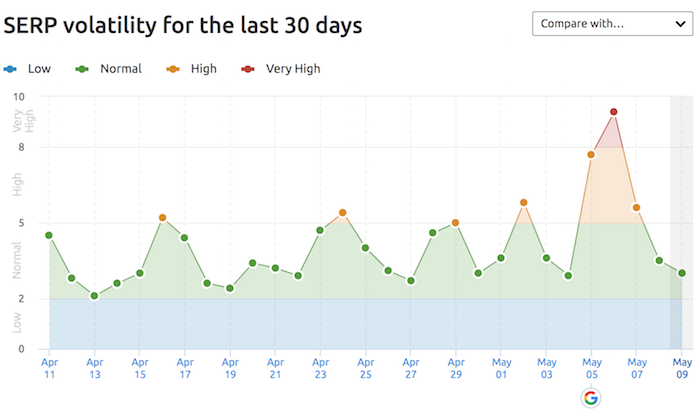
To give you an idea of how big the update is, just look at the image above. It’s from SEMrush Sensor, which monitors the movement of results on Google.

The chart tracks Google on a daily basis and when it shows green or blue for the day, it means there isn’t much movement going on. But when things turn red, it means there is volatility in the rankings.

Now the real question is, what happened to your traffic?

If you already haven’t, you should go and check your rankings to see if they have gone up or down. If you aren’t tracking your rankings, you can set up a project on Ubersuggest for free and track up to 25 keywords.

You should also log into your Google Analytics account and check to see what’s happening to your traffic.

Hopefully, your traffic has gone up. If it hasn’t, don’t panic. I have some information that will help you out.

Let’s first start off by going over the industries that have been most impacted…

So what industries were affected?

Here are the industries that got affected.
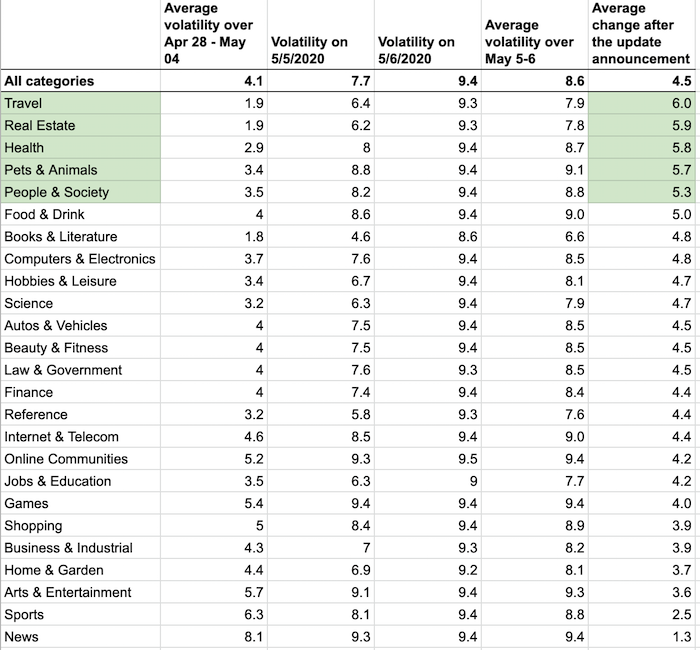
As you can see, travel, real estate, health, pets & animals, and people & society saw the biggest fluctuations with rankings.

Other industries were also affected… the ones at the bottom of the list were the least affected, such as “news.”

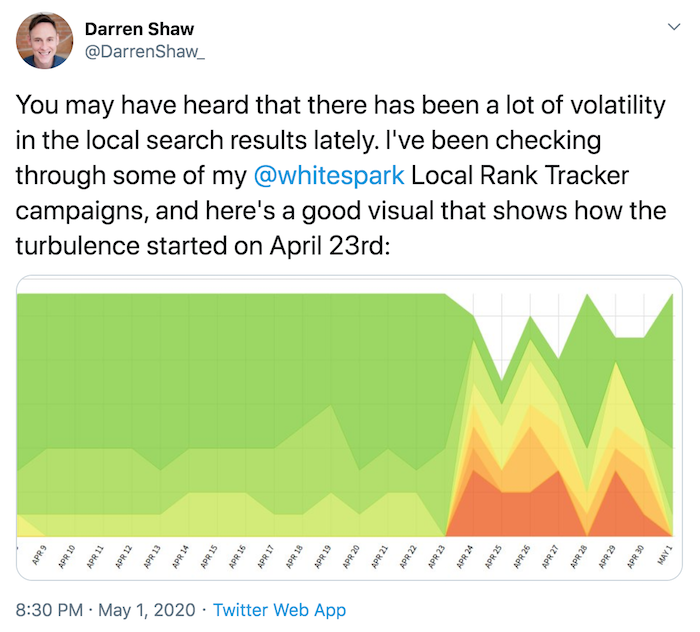
There was also a shakeup in local SEO results, but that started before the core update.
One big misconception that I hear from people new to SEO is that if you have a high domain authority or domain score (if you aren’t sure what yours is, go here and put in your URL), you’ll continually get more traffic and won’t be affected by updates. That is false.

To give you an idea, here are some well-known sites that saw their rankings dip according to our index at Ubersuggest:

  • Spotify.com
  • Creditkarma.com
  • LinkedIn.com
  • Legoland.com
  • Nypost.com
  • Ny.gov
  • Burlington.com

More importantly, we saw some trends on sites that got affected versus ones that didn’t.

Update your content frequently

I publish 4 articles a month on this blog. Pretty early every Tuesday like clockwork, I publish a new post.

But do you know how often I update my old content?

Take a guess?

Technically, I don’t update my own content, but I have 3 people who work for me and all they do is go through old blog posts and update them.

On any given month, my team updates at least 90 articles. And when I say update, I am not talking about just adjusting a sentence or adding an image. I am talking about adding a handful of new paragraphs, deleting irrelevant information, and sometimes even re-writing entire articles.

They do whatever it takes to keep articles up to date and valuable for the readers. Just like how Wikipedia is constantly updating its content.

Here’s an interesting stat for you: We know for certain that 641 sites that we are tracking are updating old content on a daily basis.

Can you guess how many of them saw a search traffic dip of 10% or more?
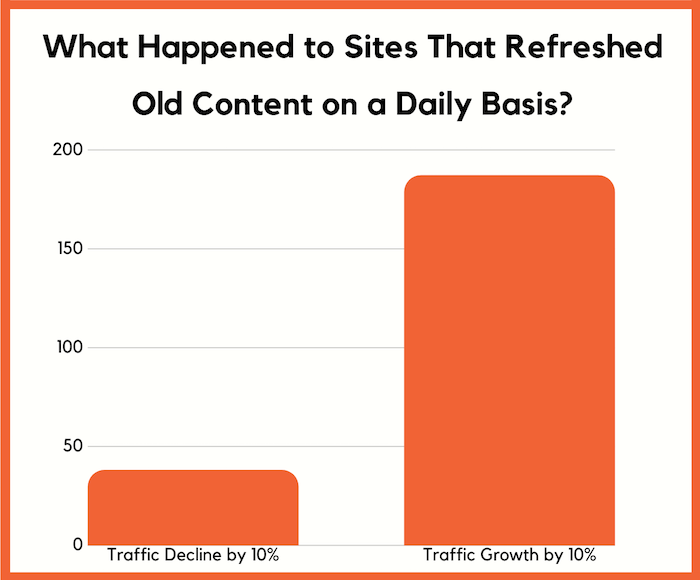
Only 38! That’s 5.92%, which is extremely low.

What’s crazy, though, is that 187 sites saw an increase in their search traffic of 10% or more.

One thing to note is when we are calculating organic search traffic estimates, we look at the average monthly volume of a keyword as well as click-through rates based on ranking. So holidays such as May 1, which is Labor Day for most of the word, didn’t skew the results.

To clarify, I am not talking about producing new content on a daily or even weekly basis. These sites are doing what I do on NeilPatel.com… they are constantly updating their old content.

Again, there is no “rubric” on how to update your old content as it varies per article, but the key is to do whatever it takes to keep it relevant for your readers and ensure that it is better than the competition.

If you still want some guidance on updating old content, here is what I tell my team:

  1. If the content is no longer relevant to a reader, either delete the page and 301 redirect it to the most relevant URL on the site or update it to make it relevant.
  2. Are there ways to make the content more actionable and useful? Such as, would adding infographics, step-by-step instructions, or videos to the article make it more useful? If so, add them.
  3. Check to see if there are any dead links and fix them. Dead links create a poor user experience.
  4. If the article is a translated article (I have a big global audience), make sure the images and videos make sense to anyone reading the content in that language.
  5. Look to see the 5 main terms each article ranks for and then Google those terms. What do the pages ranking in the top 10 do really well that we aren’t?
  6. Can you make the article simpler? Remove fluff and avoid using complex words that very few people can understand.
  7. Does the article discuss a specific year or time frame? If possible, make the article evergreen by avoiding the usage of dates or specific time ranges.
  8. If the article covers a specific problem people are facing, make sure you look at Quora first before updating the article. Look to see popular answers on Quora as it will give you a sense of what people are ideally looking for.
  9. Is this article a duplicate? Not form a wording perspective, but are you pretty much covering the exact same concept as another article on your site. If so, consider merging them and 301 redirect one URL to the other.

Fix your thin content

Here’s another interesting stat for you. On average, Ubersuggest crawls 71 websites every minute. And when I mean crawl, users are putting in URLs to check for SEO errors.

One error that our system looks at is thin content (pages with low-word counts).

On average, 46% of the websites we analyze have at least one page that is thin in content. Can you guess how many of those sites got impacted by the latest algorithm update?

We don’t have enough data on all of the URLs as the majority of those sites get very little to no search traffic as they are either new sites or haven’t done much SEO.

But when we look at the last 400 sites in our system that were flagged with thin content warnings for pages other than their contact page, about page, or home page, and had at least 1,000 visitors a month from Google, they saw a massive shift in rankings.
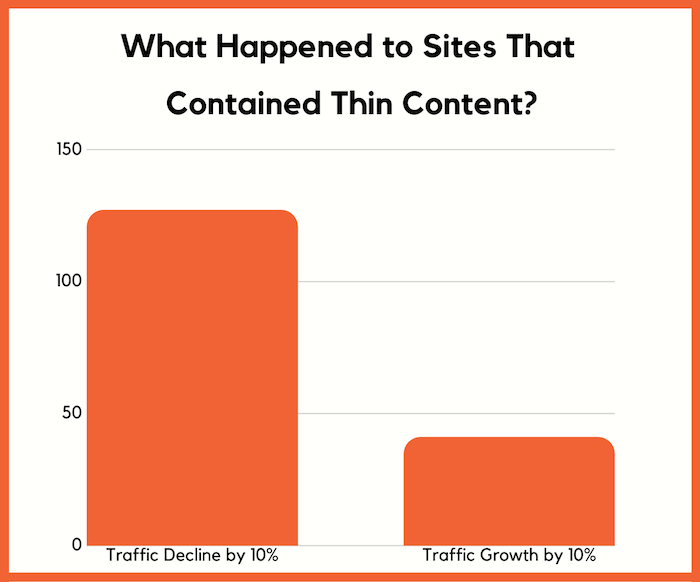
127 of the sites saw a decrease in search traffic by at least 10% while 41 saw an increase in search traffic by at least 10%.

Sites with thin content saw a roughly 3 times higher likelihood of being affected in a negative way than a positive one. Of course, the majority of the sites with thin content saw little to no change at all, but still, a whopping 31.75% saw a decrease.

If you don’t know if you have thin content, go here and put in your URL.

You’ll see a report that looks something like this:
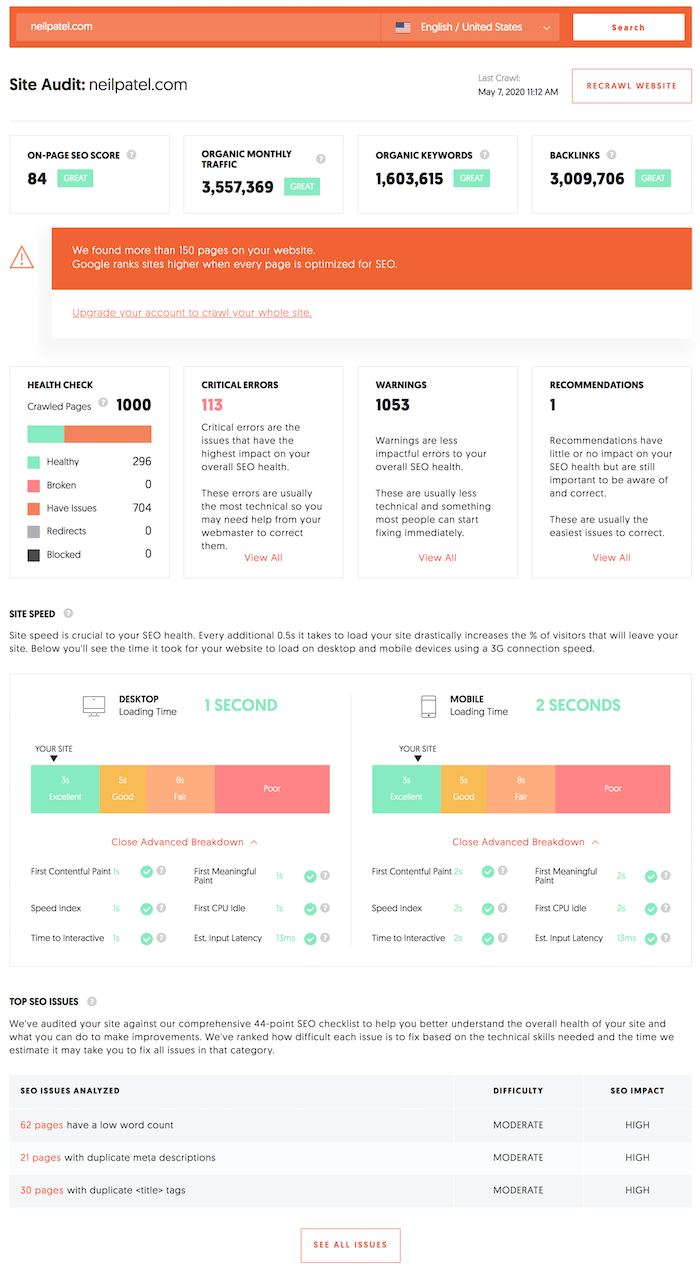
I want you to click on the “Critical Errors” box.

You’ll now see a report that looks like:
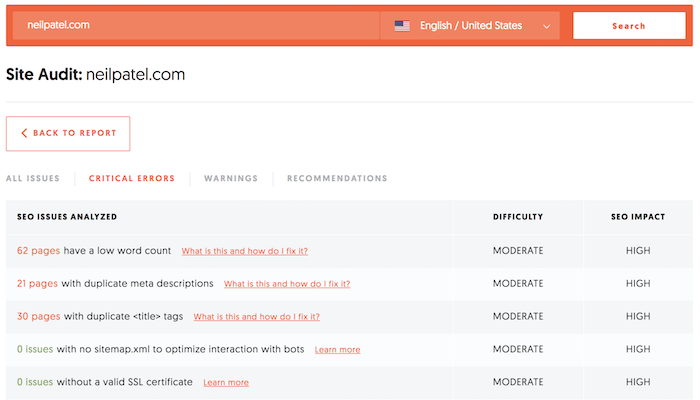
Look to see if there are any “low word count” errors. If there is, click on the number and it will take you to a page that shows you all of the pages with a low word count.
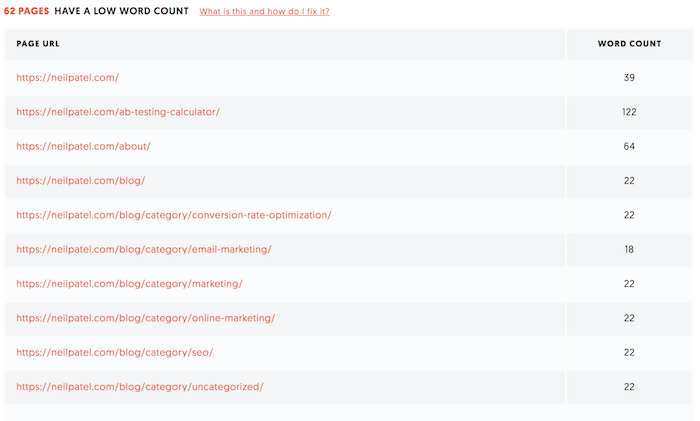
You won’t be able to fix them all, as some pages like your contact page or category pages, which may not need thousands of words.

And in other cases, you may be able to get the point across to a website visitor in a few hundred words or even through images. An example would be if you have an article on how to tie a tie, you may not have too many words because it’s easier to show people how to do so through a video or a series of images.

But for the pages that should be more in-depth, you should fix them. Here are the three main questions to consider when fixing thin content pages:

  1. Do you really need to add more words – if you can get the message across in a few hundred words or through images or videos, it may be enough. Don’t add words when it isn’t needed. Think of the user experience instead. People would rather have the answer to their question in a few seconds than to wait minutes.
  2. How does your page compare to the competition – look at similar pages that are ranking on page 1. Do they have more content than you or less? This will give you an idea if you need to expand your page, especially if everyone who ranks on page 1 has at least a few thousand words on their page.
  3. Does it even make sense to keep the page – if it provides little to no value to a reader and you can’t make it better by updating it, you may want to consider deleting it and 301 redirect the URL to another similar page on your site.

Fix your SEO errors

Another interesting finding that we noticed when digging through our Ubersuggest data is that sites with more SEO errors got impacted greatly.

Now, this doesn’t mean that if you have a ton of SEO errors you can’t rank or you are going to get hit by an algorithm update.

More so it was one type of error that hurt sites more than others. It was sites with duplicate title tags and meta descriptions.

One thing to note was that many sites have duplicate meta tags, but when a large portion of your pages have duplicate meta tags, it usually creates problems.

So we dug up sites that contained duplicate meta tags and title tags for 20% or more of their pages.

Most of these sites didn’t get much traffic in general, but for the 363 that we could dig up that generated at least 1,000 visits a month from Google, 151 saw a decrease in traffic by at least 10%.
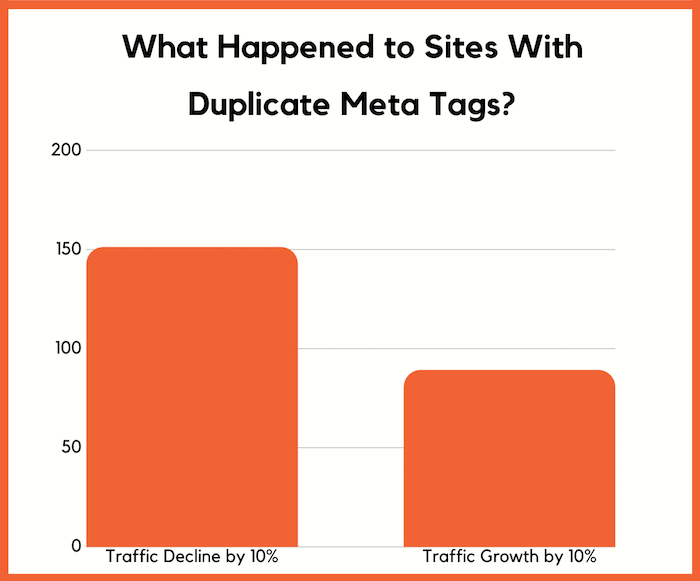
89 of them also saw increases in traffic by 10% or more, but still, 41.59% of sites with duplicate meta tags saw a huge dip. If you have duplicate meta tags you should get this fix.

To double check if you do, put your URL in here again. It will load this report again:

And then click on the critical errors again. You’ll see a report that looks like this:

Look for any errors that say duplicate meta description or title tag. If you see it, click on the number and it will take you to a page that breaks down the duplicates.
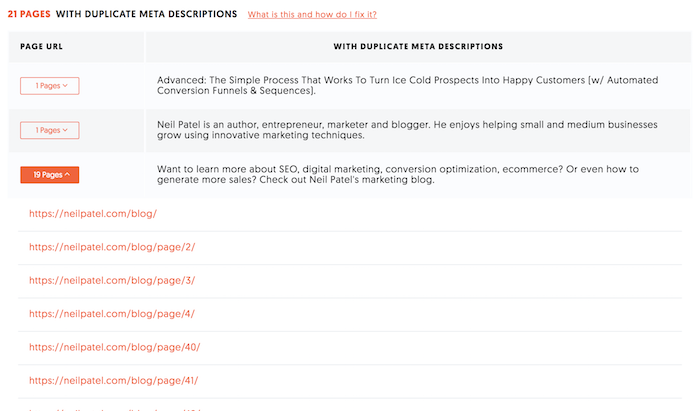
Again, your site doesn’t have to be perfect and you’ll find in some cases that you have duplicates that don’t need to be fixed, such as category pages with pagination.

But in most cases, you should fix and avoid having duplicate meta description and title tags.

Conclusion

Even if you do everything I discussed above, there is no guarantee that you will be impacted by an algorithm update. Each one is different, and Google’s goal is to create the best experience for searchers.

If you look at the above issues, you’ll notice that fixing them should create a better user experience and that should always be your goal.

It isn’t about winning on Google. SEO is about providing a better experience than your competition. If that’s your core focus, in the long run, you’ll find that you’ll do better than your competition when it comes to algorithm updates.

So how was your traffic during the last update? Did it go up or down, or just stay flat?

The post Google’s May 2020 Core Update: What You Need to Know appeared first on Neil Patel.


from Blog – Neil Patel https://ift.tt/35TLq4T

Tuesday, 5 May 2020

Welcome to SEO Unlocked: Your Free SEO Training Course

I learned SEO by starting my own website and just testing a lot of different tactics out.

Some of these tactics worked well and others didn’t. But the way I’ve learned SEO isn’t right for everyone.

Some people prefer learning by practicing like me. Others prefer learning by reading dozens of different strategies and tactics.

And if you don’t have the time, you can learn SEO by creating a project on Ubersuggest.

But what if there was another way to learn… one that was step by step and involved hand-holding to ensure that you are really learning SEO, so much so that your traffic starts going up?

Introducing SEO Unlocked

Over the next 7 weeks, I’m going to be teaching you SEO.

I’ve released a free course called SEO Unlocked.

Eventually, it will live on the training section of this site. But for now, it is going to be published on YouTube every Monday, Thursday, and Saturday for the next 7 weeks.

Here’s the first video which is a welcome video the course.

Make sure you watch it as I also give you 2 homework assignments. But don’t worry, they are easy. I even provide the worksheets and PDF templates here so you can get them done with ease.

I’ve also released the second video that goes over the fundamentals of SEO and why it is important.

Again, this video also contains some homework assignments, so make sure you watch it and follow everything step by step.

How can I follow along during the 7 weeks?

As I mentioned above, it’s a 7-week course. You’ll see videos released every Monday, Thursday, and Saturday.

The videos are roughly 10 to 15 minutes in length on average so it will only take 30 to 45 minutes of your time each week to watch them.

The homework assignments are easy as well. The reason I will give you worksheets, PDF templates, and spreadsheets is so you can do the homework assignments faster.

The homework assigns should take you 30 to 45 minutes a week to complete.

In total, I’m asking you to commit an hour to an hour and a half each week, which really isn’t much.

Once you go through the whole course, you’ll know the formula for getting traffic to your website.

If you want to make sure you don’t miss a lesson because I won’t be blogging about each lesson, make sure you subscribe to my YouTube channel as I will be uploading the lessons there.

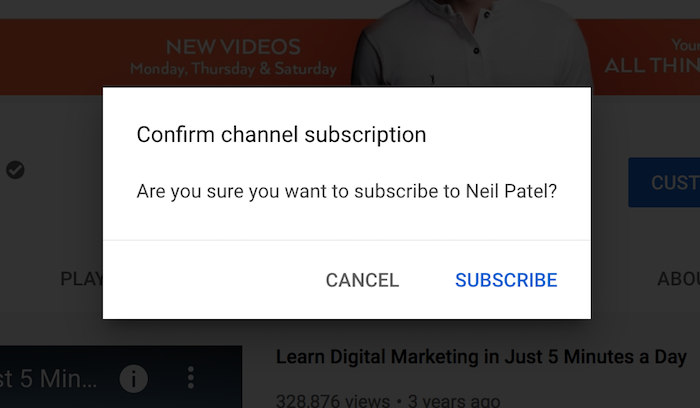
Once you click the link above, you’ll see a subscription box on YouTube… just click the “SUBSCRIBE” button.

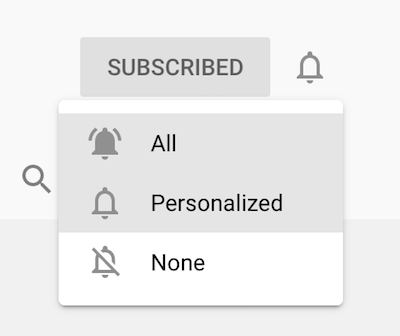
And once you click “subscribe” on my channel, you’ll notice a bell image next to the subscribe button.

When you click on the bell, you’ll be given a few options.

Click on the “all” option. Once you do that, you’ll notice that next to the “subscribe” button your bell icon should look something like this:

This will make it where YouTube notifies you when I release a new SEO Unlocked lesson.

Conclusion

If you really want more search traffic and you want to take SEO seriously, this is your chance.

There is no excuse for not having the financial resources because the course is free. If you put in the time, my team and I are here to teach and train you on everything you need to know.

And don’t worry, we aren’t going to bore you with every Google algorithm factor or anything like that. Instead, we are going to teach you the main concepts and strategies of SEO that drive the majority of the results as we know that you don’t have 40 hours a week to dedicate to SEO.

That’s why the videos are short and you should be able to watch all of them and get your homework assignments done in less than 90 minutes per week.

That’s all I am asking for you.

So, are you ready to learn SEO?

The post Welcome to SEO Unlocked: Your Free SEO Training Course appeared first on Neil Patel.


from Blog – Neil Patel https://ift.tt/35yOFOG

Friday, 1 May 2020

The SEO Plugin You Have Been Waiting For

Google search results are getting richer and harder to deal with. You cannot copy URLs of search results until you click them. It is impossible to copy the list of URLs ranking on page 1. You cannot do much when trying to analyze search result pages.

To make SERP analysis doable, we have come with a new Greasemonkey plugin helping you make sense of Google search engine result pages and easily copy anything you need: Get URLs from Search Results Plugin

To Install the SEO Plugin:

Keep these options unchecked for the best results:

Keep these options unchecked

The SEO Plugin for Google SERPs

As soon as you install the plugin, make sure Greasemonkey is active in your browser and head to Google’s search. There you will immediately notice several improvements:

Numbered Search Results

The SEO plugin will display all organic search results at the bottom, numbered and easy to copy-paste anywhere you need:

The plugin makes it easy to figure out the actual organic position of any page ranking for your target search query. You can also easily obtain the full list of your organic competitors

There will be as many links as you have your search results to show within one page. If you have 50 (like me), the plugin will list all 50, conveniently numbered.

All links in the list are direct, so you can copy any without having to open the link.

People Also Ask Results

If you have this plugin running you’ll be able to easily copy-paste “People Also Ask” results that appear for your target query, as well as see the featured URL:

An easy way to copy questions from Google’s “People Also Ask” search element

Related Searches and Brands

Google shows a lot of types of search suggestions these days prompting its users to dig deeper into the topic. These educational search elements driving users deeper into all kinds of search results include:

  • Searches Related To
  • Related topics
  • Related entities (similar brands or places), etc.

This SEO plugin will give you a good overview of all of those:

These are great for content development and SEO research purposes: Find which entities, categories and keywords Google deems your target query relates to

Video Carousel Results

You can also access links to top video results which made to Google’s carousels:

Direct links to video results from inside the Google’s video carousel

Knowledge Graph Links

The plugin will also extract links from Google’s Knowledge Graph and list them below the search results. For example, for a navigational queries, it will look something like this:

Google’s Knowledge Graph links for the search query [amazon]

And for an informational queries, it will display all data sources Google is using to create an info box:

Google’s Knowledge Graph data sources for the search query [pizza]

Finally, while you can easily copy-paste any block, there’s also an Excel expert for you to play with.

The implications of this plugin are truly limitless as it makes any SEO task much easier and faster. Use it for competitive research, reputation management, SERP analysis and more.

The post The SEO Plugin You Have Been Waiting For appeared first on Internet Marketing Ninjas Blog.


from Internet Marketing Ninjas Blog https://ift.tt/2xtBC4K
via IFTTT
Tuesday, 28 April 2020

3 Simple Steps to Get Your First 10,000 Visitors from Google

Today’s going to be fun.

I’m going to make a bet with you that if you follow the 3 steps below, and you really follow them, you can get 10,000 visitors from Google.

I promise it won’t be hard, but it will take time.

And if you follow my steps and don’t get the results, hit me up and I will personally help you with your marketing.

All I ask is you do it for 3 months straight. You may not get to 10,000 visitors from Google in 3 months as some niches are really tiny, but most of you should get there or be well on your way.

Again, if you prove to me that you followed everything below and you don’t achieve the results, you can get in touch and I will personally help you with your marketing for free.

Ready?

Step #1: Finding the right keywords

If you pick the wrong keywords, you’ll find yourself with little to no traffic and, even worse, you’ll find yourself with little to no sales.

So, before we get you on your way to more search traffic, let’s find you the right keywords.

I want you to head to Ubersuggest and type in your competitor’s domain name.

Now, I want you to click on the “Keywords” navigational option in the sidebar.

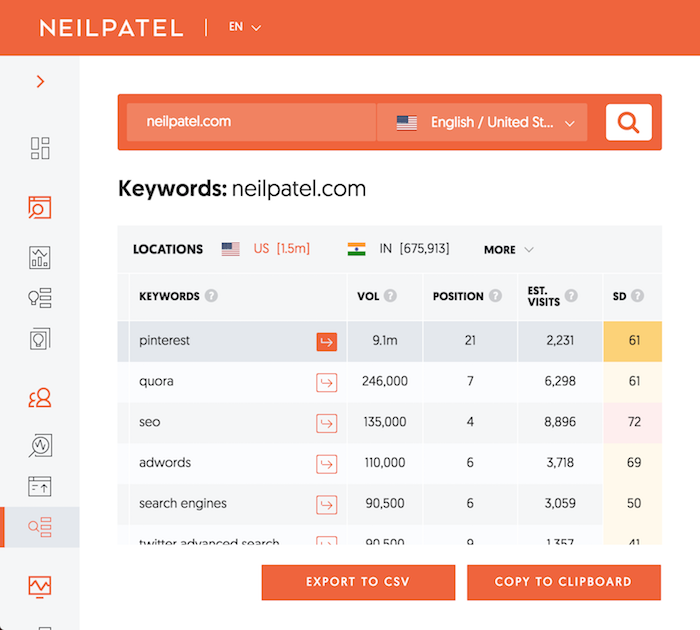
This report will show you all of the keywords that your competition is ranking for.

If you don’t see a list of thousands of keywords, that means you didn’t type in a big enough competitor. And if you don’t know who a big competitor is, just do a Google search for any major term related to your industry. The sites at the top are your major competitors.

I want you to go through the list of keywords and look for all of the keywords that are related to your business and have an SEO Difficulty (SD) score of 40 or less. The higher the number, the harder the keyword is to rank for. The lower the number, the easier it is to rank for.

In addition to an SD score of 40 or lower, I want you to look for keywords that have a volume of 500 or more.

Volume means the number of people that search for the keyword on a monthly basis. The higher the number, the more potential visitors that term will drive once you rank for it.

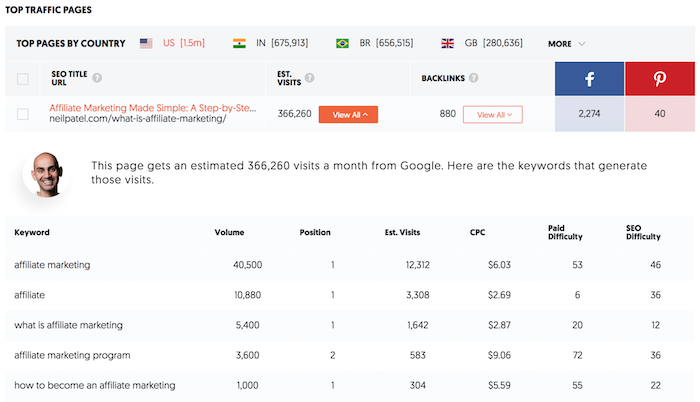
Next up, I want you to click on “Top Pages” in the navigation.

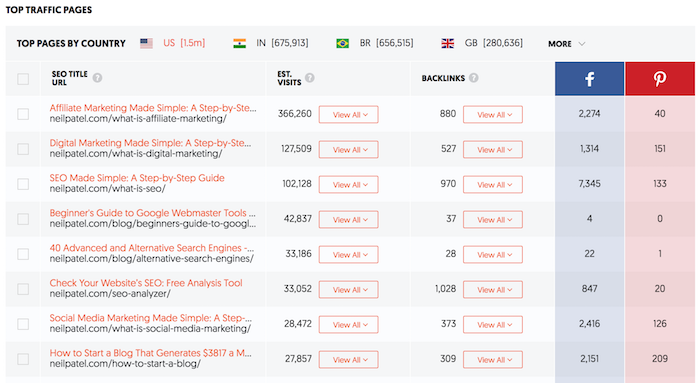
This will bring you to a report that looks like this:

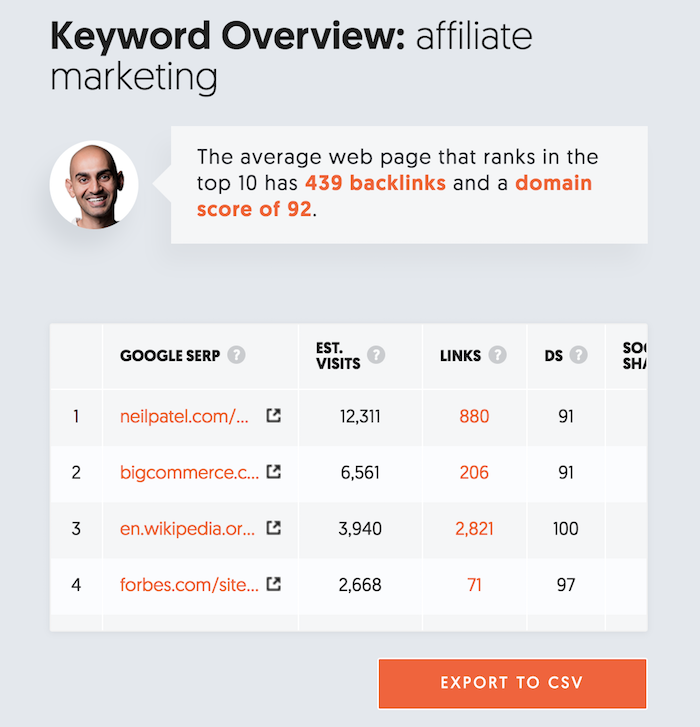
This report shows you the most popular pages on your competitor’s site.

Now, under the Est. Visits (Estimated Visits) column, I want you to click on “view all” for the first few results.

Every time you do that it shows you all of the keywords that drive traffic to that page.

Just like you did with the keywords report, I want you to look at the keywords that have an SD of 40 or lower and a volume of 500 or more.

The one difference though, is that I want you to check out some of the URLs on the Top Pages report.

Click on over to the site so you can see the type of content they are writing. This is important because it will give you an idea of the types of content that Google likes to rank.

When you create similar pages (I will teach you how to do this shortly), it will allow you to get similar results to your competition over time.

Now that you have a handful of keywords, I want you to expand the list and find other related keywords.

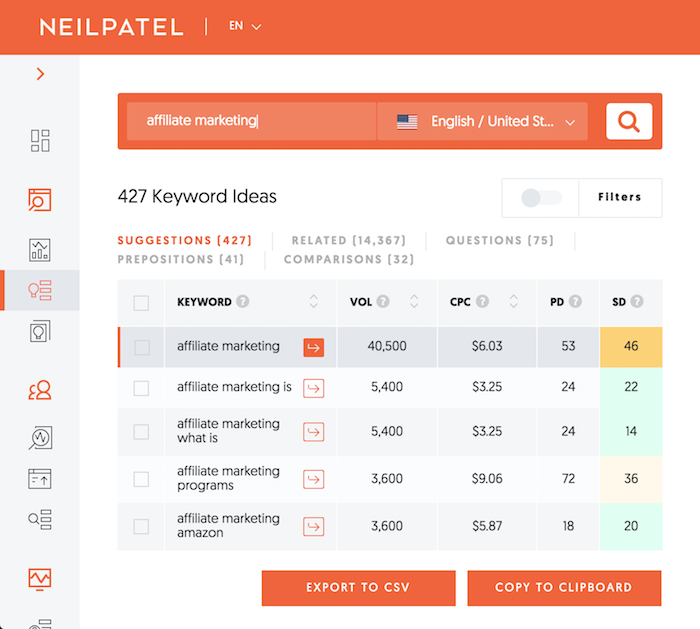
In the navigation menu, click on “Keyword Ideas.”

When you type in one of the keywords you are thinking of going after in this report, it will give you a big list of other similar keywords.

This is important because it will show you all of the closely related terms.

For example, let’s say you came up with a list of keywords of a handful of keywords, such as:

  1. Dog food
  2. Cat food
  3. Dog bed
  4. How to clean your cat
  5. What do birds eat

You can’t just take all of those keywords and write one article and shove all the keywords in because they aren’t similar to each other. Someone looking for “dog beds” is probably not interested in reading about what birds eat.

So by typing in a keyword into the Keyword Ideas report, it will show you all of the other similar keywords that you can include in a single article.

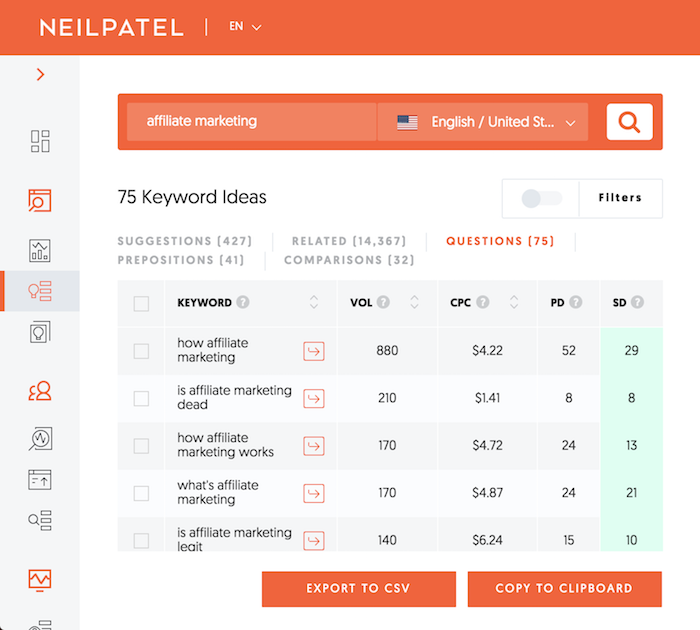
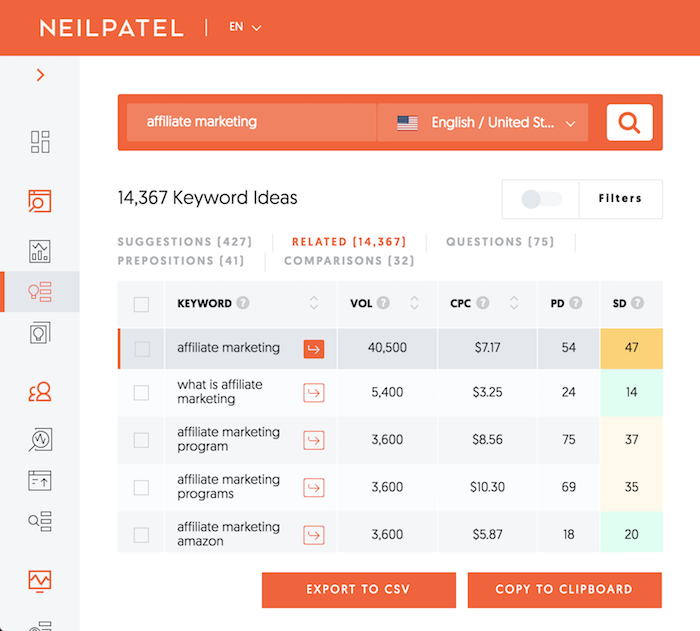
When you are on the Keyword Ideas report you’ll notice some tabs: Suggestions, Related, Questions, Prepositions, and Comparisons.

I want you to go through each of those tabs. They will show you a different group of similar keywords that you may be able to include in your article (we will go over how to write the article in step 2).

Just take a look at the Questions tab:

You can see the keywords are drastically different than the Related tab:

Again, you’ll want to look for all keywords that have an SD score of 40 or lower. But this report looks for keywords that have a volume above 200.

I know 200 may seem like a small number, but if you find 100 good keywords that all have a volume of 200 or more, that adds up to 20,000 potential visitors per month. Or better yet, 240,000 per year.

Now it’s rare that you are going to get all of those people to come to your site, but you can get a portion of them. Even 10% would add up… especially if you did this with a handful of articles.

Your goal should be to have a list of at least 100 keywords that are very similar. You’ll want to do this at least five times. For example, remember that list of five keywords I mentioned above wasn’t too similar to each other…

  1. Dog food
  2. Cat food
  3. Dog bed
  4. How to clean your cat
  5. What do birds eat

You’ll want to make sure that for each main keyword you use the Keyword Ideas report to find another 100 that can accompany each keyword.

Step #2: Write content

At this point, you should have a list of keywords. If your list of keywords isn’t at least 100 keywords per group, go back to step 1 and keep at it.

It’s not that hard to get to 100 similar keywords that you can include in one article. It just takes some time to continually search and find them.

In general, as a rule of thumb, I can find 100 keywords in less than 8 minutes. It may take you a bit longer than me at first, but once you get the hang of it, it’ll be easy.

With your newly found keywords, I want you to write an article.

All you have to do is follow this tutorial step-by-step to write your first article.

Or, if you prefer a video tutorial, watch this:

As for your keywords, naturally place them into the article when it makes sense.

What you’ll quickly learn is that you probably won’t be able to “naturally” include all 100 keywords within your article. And that’s fine.

The last thing you want to do is stuff in keywords because you aren’t writing this article for just search engines, you are writing it for people… and the secondary benefit is that search engines will rank it because it contains the right keywords.

Before you make your article live on your site, I want you to keep a few things in mind:

  1. Keep your URLs short – Google prefers shorter URLs.
  2. Include your main keyword in your headline – by having your main keyword in your headline, you’ll be more likely to rank higher.
  3. Include your three main keywords in your meta tags – whether it is your title tag or meta description, include at least three main keywords in them. You won’t fit as many in your title tag, and that’s fine, but you should be able to within your meta description tag.

There are a lot of other things you can do to optimize your articles for SEO, but my goal is to keep this simple. Again, if you just follow these three steps, you’ll hit the 10,000-visitor mark.

So, for now, let’s just keep things simple and once you hit your goal, then you can get into the advanced stuff.

Step #3: Promoting your content

Writing content is only half the battle. Even if you include the right keywords in your article, if you don’t promote, it’s unlikely that it would be read or rank on Google.

So how do you make sure your content is read and ranks well?

Well, first you need to get social shares, and second, you need to get backlinks.

Yes, search engines don’t necessarily rank pages higher when they get more Facebook shares or tweets, but the more eyeballs that see your page the more likely you are to get backlinks.

And the more backlinks you get, generally, the higher you will rank.

So here’s how you get social shares…

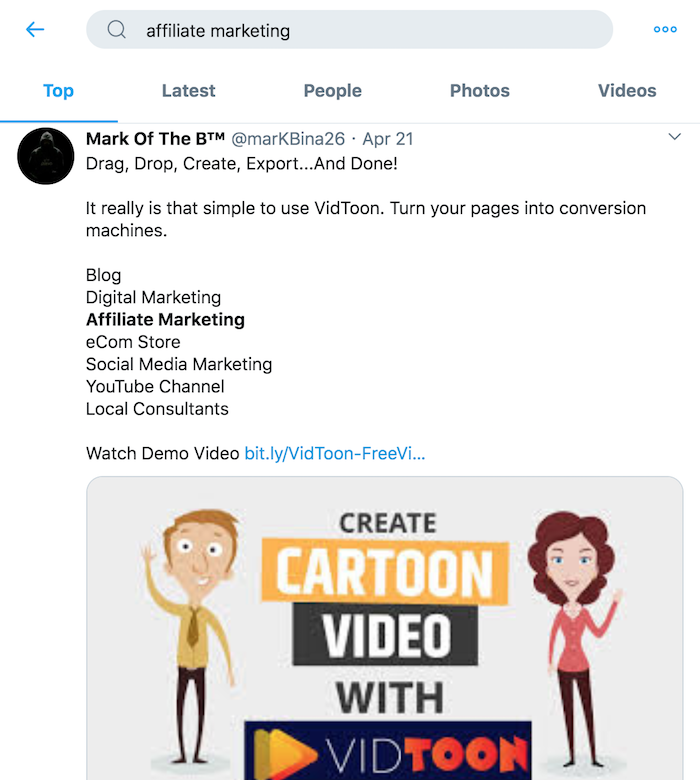
First, I want you to go to Twitter and search for keywords related to your article.

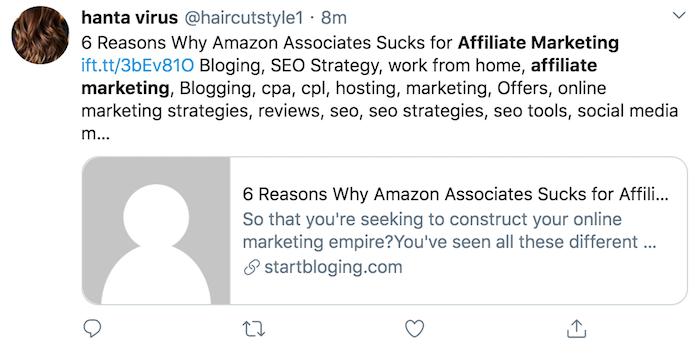
As you scroll down, you’ll see thousands of people tweeting about stuff related to your keywords. Some of them will just be general updates but look for the members sharing articles.

And…

Now what I want you to do is click on their profile and see if they mention their contact information or their website. If they mention their email you are good to go. If they mention their website, head to it, and try to find their contact information.

You won’t be able to find everyone’s contact information, but for the people you do, I want you to send them this email:

Subject: [insert the keyword you searched for on Twitter]

Hey [insert their first name],

I saw that you tweeted out [insert the title of the article they tweeted]. I actually have an article that I recently released on that subject.

But mine covers [talk about what your article covers and how it is unique].

[insert link to your article]

If you like it, feel free to share it.

Cheers,

[insert your name]

PS: Let me know if you want me to share anything for you on Twitter or any other social network.

What you’ll find is a large percentage of the people will be willing to share your content because they already are sharing related content and, of course, you offered to share their content, which helps out too.

If you send out 30 to 40 emails like this, you’ll start getting traction on the social web.

Now that you have social shares, it’s time to build backlinks. Instead of giving you tons of link building methods as there are many that work, I am just going to start you off with one that works very well.

I want you to head back to the Keyword Ideas report on Ubersuggest.

Once you get there, type in some of the keywords that you are trying to go after.

On the right side of the report, you’ll see a list of sites that rank and the number of backlinks that each of the ranking URLs has.

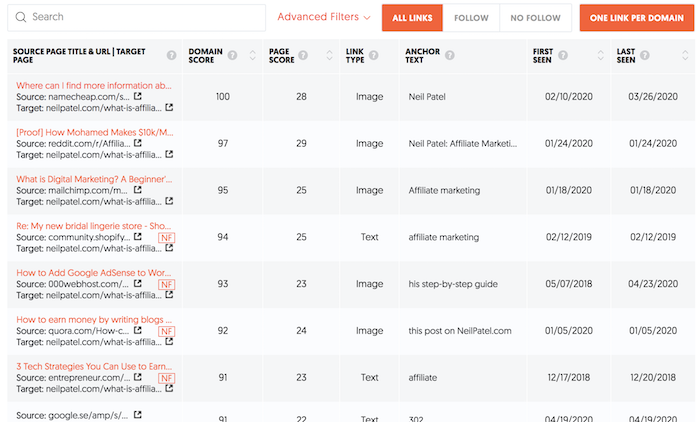
Click on the “Links” number. For each result, it will take you to the Backlinks report, which looks something like this:

This will give you a list of all the sites linking to your competitor’s article.

I want you to go to each of those URLs, find the site owner’s contact information, and shoot them an email that looks like this:

Subject: [name of their website]

Hey [insert their name],

I noticed something off with your website.

You linked to [insert your competitor that they linked to] on this page [insert the page on their site that they are linking to them from].

Now you may not see anything wrong with that, but the article you linked to isn’t helping out your website readers that much because it doesn’t cover:

[insert a few bullet points on how your article is better and different]

You should check out [insert your article] because it will provide a better experience for your readers.

If you enjoyed it, feel free to link to it.

Cheers,

[insert your name]

PS: If I can ever do anything to help you out, please let me know.

I want you to send out 100 of those emails for each article you write.

Conclusion

Yes, it takes work to get 10,000 visitors but once you do it you’ll continually generate traffic and, more importantly, sales.

To achieve 10,000 visitors, I want you to do the steps above five times. In other words, you will be writing five pieces of new content following the steps above.

It’s actually not that bad because you can just do 1 a week. So, within 5 weeks you would have done your job.

So, are you going to accept the challenge? If you do everything and don’t see the results over time, you can hit me up and I’ll help.

The post 3 Simple Steps to Get Your First 10,000 Visitors from Google appeared first on Neil Patel.


from Blog – Neil Patel https://ift.tt/2yMHF4L