FREE TRAFFIC TO YOUR SITE

FREE TRAFFIC TO YOUR SITE
free youtube traffic

Thursday, 17 February 2022

15 Content Trends for SEO Success in 2022

As an agency, we consult with new prospects and clients on a regular basis.

One area that consistently “needs improvement” during our initial review is tailoring a website’s content strategy for new opportunities and a current-day approach to optimization.

Below are 15 common mistakes, best practices, and trends for 2022. Let’s get into it!

1. Meeting User Intents

We’ll start with the obvious, but a lot of webmasters are still stuck in the “write for Google” mentality. Rather than optimizing pages solely at the keyword level, it’s time to revisit your keyword research and bucket targeted phrases into user intents instead.

Giving users the experience they expect can help with conversions and SEO performance, creating a dual-benefit from the effort.

Often times, restructuring your content efforts to an intent-based approach requires migrating some of the existing copy throughout your website to other areas, providing different ways users can find and ultimately engage with you. The good news is better serving your users contributes to SEO lifts, which brings us to #2…

2. Moving “SEO” content off Ecommerce category pages

I know this one will be a little divisive, but old school SEOs hear me out. A user searching for “party dresses” most likely has transactional intent if the SERPs for the query are any indication.

A good result meeting the user intent would be a category page with different party dresses for sale, with filters for size, color, and other features, perhaps with a blurb of text about why the user should buy your party dresses.

While the SEO in you may want to add 1,000 words at the bottom of the category page and keyword research may suggest there’s a lot of demand for supplementary content about the phrase, that content is better reserved for an informational blog post or resource article elsewhere on your site.

Having extra content about the “best party dresses” or other secondary topics on the category page doesn’t meet the user intent, but you can still capture traffic about those topics with pages elsewhere in your site.

Instead, focus on making the page functional from a UX perspective, allowing users to easily sort and filter items to find what they’re looking for.

3. Formatting content for more search exposure

SERP features like Google’s “People Also Ask” drop-downs continue to appear in an increasing amount of search results. Often times, capturing this visibility requires a reformatting of your existing content with proper headings and presentation of your content into easily digestible formats.

Review the results for your target keyword phrases. Is Google showing SERP features with bullet points, numbered lists, or other formats? If so, this presents an opportunity to restructure your content to make it more digestible for users and more Google-friendly as well.

Take cues from who is already getting this additional exposure, follow their lead when reformatting your content, and apply the practice on new content initiatives moving forward.

FAQ rich snippets are another SERP feature which leverage schema to show answers to related questions within search results, creating the opportunity for more click-thru traffic to your website.

When crafting content where the user intent is informational, make sure there is a questions & answers section on the page to highlight at least two answers to common questions and capture additional search traffic from the effort.

4. Leveraging content for internal and external linking opportunities

Internal linking is an effective, easy way to tie related pages (both informational and transactional) together throughout your website. Often overlooked, it presents a strong opportunity to diversify anchor text pointing to key SEO landing pages within your website, increasing their keyword visibility for mid and long-tail keyword phrases.

If you’re investing in content but aren’t incorporating a strategic internal linking plan, or if you always use the same anchor text to link to pages internally, now is a good time to go through and better take advantage of internal linking opportunities. When properly optimized, it can really make a difference in the quantity of phrases you rank for in Google.

Equally important, there’s no need to be shy when linking out. Your link neighborhood is composed not only of who links to you, but who you choose to link out to.

Associate yourself with resources and experts within your industry, linking out to industry publications, organizations, government and educational websites, and other trusted places on the web where they make sense for the user. External linking helps establish relevancy and trust, and is of primary importance when improving “E-A-T” signals as well, especially for “YMYL” websites.

5. Incorporating Authorship

Authorship is another “E-A-T” signal, especially for “YMYL” sites. Ensuring your content is written by an expert in their field, and reviewed or edited by another expert as needed can give you an advantage in the SERPs.

Some websites may take this a bit too far, having content which is authored by Expert A, reviewed by Expert B, and fact-checked by Expert C, but for good reason – they know that proving expert authorship will help drive more SEO traffic and improve trust with their readers.

If you’re writing about a variety of topics, you may need multiple subject-matter experts to act as authors across your website. Each author should have their own biography page within your site, listing their experience, content within your site, and links out to social media profiles and other areas on the web which feature their work.

This is something Google can algorithmically pick up on, and is part of their Quality Rater Guidelines as well.

If your content is authored by “Staff” or “Admin”, you’ll need to make slight edits to these pieces and retroactively apply authorship to each page. It’s also a good opportunity to bring outdated pieces up-to-date as discussed in #6 below.


6. Maintain content freshness

For certain user intents, there is a benefit of ensuring content is up-to-date and relevant for the query. A user searching for “best TVs” shouldn’t land on a page written 3 years ago, as technology has evolved and the content would no longer be relevant for the query or beneficial for the user.

This isn’t always the case – there are certainly evergreen and factual topics which don’t need this extra attention, but it’s good to review during a content audit to find where improvements are needed.

When revisiting your existing pages to find opportunities to update the content, be sure to add a current date to the article (which you’ll need to regularly maintain every so often), ensure there is proper authorship associated with the page, and incorporate other optimization techniques outlined in this article. It’s easy to ignore old pages, but small updates can help boost their visibility in the SERPs once again.

7. Pay extra attention to your H1 tags

One trend we’ve seen from Google over the past year is rewriting title tags in search results if they believe a page’s title tag is (a) very long, (b) over-optimized, or (c) their rewritten title would create more engagement and better serve the user.

Often, Google will use part of a page’s text when it includes the user’s search query when rewriting a title tag. This is often a H1 tag, especially if it contains all or part of the keyword the user searched for.

Whether Google decides to show your title tag or display one of their own, consider giving users a reason to click on you instead of the other results. Highlighting your company’s unique selling propositions throughout your copy (“free shipping”, “best prices”, “5 star reviews”) can help earn a click-through you may have otherwise missed out on.


8. Reconsider low-quality pages

As sites grow, they often become bloated with excess pages that receive no traffic, no citations in the form of links or mentions, and no longer remain relevant present-day. A yearly content audit (especially for larger sites) can help identify low-performing pages that have no backlinks, get no SEO traffic, and are irrelevant to your current audience.

Depending on each circumstance, these pages can be removed, de-indexed, redirected, or rewritten & improved to maintain overall site authority.

Doing so can lift domain-level quality & help boost the visibility of your other pages, but be careful when making content removal decisions as it’s easy to nix strong pages, especially ones with natural backlinks if you don’t fully understand the potential value of each page.

9. Diversifying content efforts for a variety of purposes

Many webmasters consistently churn out conversion-based content and miss out on opportunities to create content that informs, positions them are an authority in their industry, earns backlinks and brand mentions, and creates goodwill. I can’t begin to tell you how many client publications I’ve reviewed where each post is something about their products with “buy now” messaging.

Creating content for a variety of purposes is the foundation of a well-rounded strategy, and content created for different purposes often has different formats, audiences, and tone. Outside of traditional keyword research, a good place to look for ideas is Google’s own Google Suggest drop-down recommendations for your keyword phrases. This will give you insight into additional topics you can write about which pertain to your business that people are actively searching for.

Further, branded content often gets overlooked but is an important part of any SEO content strategy. Branded content helps build trust & authenticity, creates knowledge panel opportunities, and can insure against any online reputation management issues should they arise in the future as well.

Detailed “About Us” and “Contact Us” pages with clear & consistent contact information is a required “E-A-T” signal and is further highlighted in the Google Quality Rater Guidelines. You can also leverage your brand’s story for corporate social responsibility initiatives and create goodwill with your users and community.


10. Repurpose content across other channels

There’s often opportunity to repurpose content across search, social, email, paid media, and other channels, but it’s rarely done. Often, different teams manage different channels with no insight into what the other teams are working on and it creates missed opportunities.

Data from an ebook or white paper originally meant to generate leads can be visualized and shared across social media channels to selected audiences. Excerpts from it can be sent to your email list, and a blog post could be made with a summary of the findings.

Collaboration amongst stakeholders can help you leverage these cross-channel opportunities and maximize your content investment across your digital presence.


11. Including visual media

Pictures, videos, audio clips – they’re all great ways to provide additional context to a piece of content, break up text, and increase engagement on a page. Incorporating various media on a page can help increase conversions too, building further trust with your visitors and bringing them deeper into your conversion funnel.

There’s a big traffic upside here as well with Google Images acting as the “#2” search engine and YouTube the “#3”. Always make sure efforts with images & video are properly optimized to encourage visibility within those platforms.

When choosing to incorporate additional media, make it’s appropriately sized and properly embedded to ensure page speed isn’t affected. Page Experience rolls out to desktop results this month, so site speed and Core Web Vitals are always something to keep an eye on.

12. “Near me” Optimization

Recent polls and studies within the SEO community suggest adding “near me” to your content can help it rank better for “near me” phrases and other locally-based queries.

I won’t say much more here except this should be done responsibly, honestly, and where it makes sense for the user… but the “near me” radius is up to you 🙂

13. Long-form & link-worthy content

Where appropriate, taking an in-depth dive into a topic can produce greater keyword visibility and more organic SEO traffic to a page. It can also help the page become more link-worthy and act as a “link magnet” that people can’t help but cite.

We’re often asked by new clients how they can become THE expert in their field, and deploying these linkable assets on a regular basis is an effective way to cross the finish line. In-depth resources can help position you as an industry thought leader, especially if you’re able to incorporate proprietary data and original research into the efforts (hint: survey your existing users & email list).

Long-form content isn’t necessary in all instances and we generally recommend shying away from minimum word counts (remember: write to meet the user intent), but we consistently find better performance with long-form pages when the topic warrants a lengthy article.

Examples of this are “Ultimate Guides”, long lists (“50 places to…”), and topics where you can visualize data in infographic or video format.

In addition to helping you rank better and attract backlinks, long-form and in-depth pages improve engagement and create internal linking opportunities to funnel link equity to your key SEO landing pages, encouraging them rank better in Google and ensuring your SEO performance throughout 2022 is the best it can be.

Need help with your content planning from here?

Internet Marketing Ninjas has been a “content first” link building & SEO agency since 1999. Let our proven strategies help grow your business and website traffic today. www.imninjas.com

The post 15 Content Trends for SEO Success in 2022 appeared first on Internet Marketing Ninjas Blog.


from Internet Marketing Ninjas Blog https://ift.tt/z2wuKa6
via IFTTT

Monday, 14 February 2022

Do Links from Guest Posts Even Work? Here’s What We Learned from Analyzing 1,091 Sites That Accept Guest Posts.

Do Links from Guest Posts Even Work? Here’s What We Learned from Analyzing 1,091 Sites That Accept Guest Posts.

It’s frowned upon to build links through guest posts.

If you do, they should be nofollowed and ideally, you should be guest posting for brand awareness and referral traffic.

Even though that’s what I follow, it doesn’t mean others do.

Plus, I get hundreds of emails a day asking me if I accept guest posts, hence I know it’s still a popular link building method (although I ignore all those emails).

What Kind of Sites Did We Analyze?

First off, not all blogs accept guest posts. So, if a blog didn’t accept a guest post, we clearly didn’t include it in our study.

Second, we looked at sites that clearly labeled content as a guest post or as a post written by a guest author or guest contributor.

Third, we looked at sites that used dofollow links in the guest posts (even though they should have been nofollowed) to see if they had an impact on rankings.

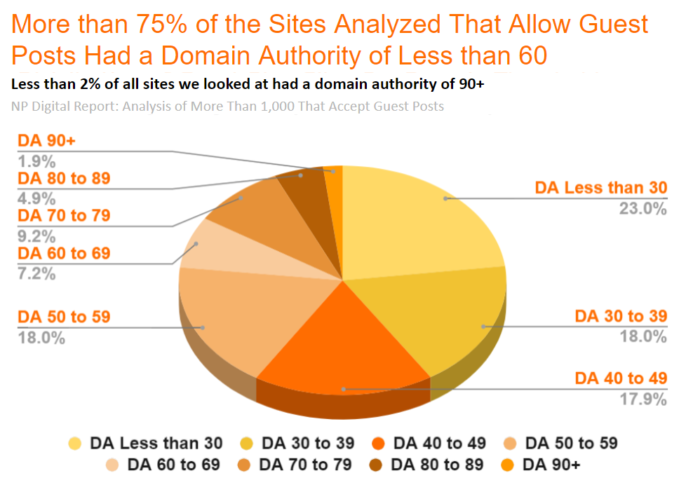
1,000-guest-blog-sites-analyzed-distribution-by-domain-authority

As you can see from the graph above, we looked at sites across different domain authority levels. We wanted to see what impact it had on whether a guest post received traction or not.

We also looked at sites with varied traffic ranges to see where posts might perform best.

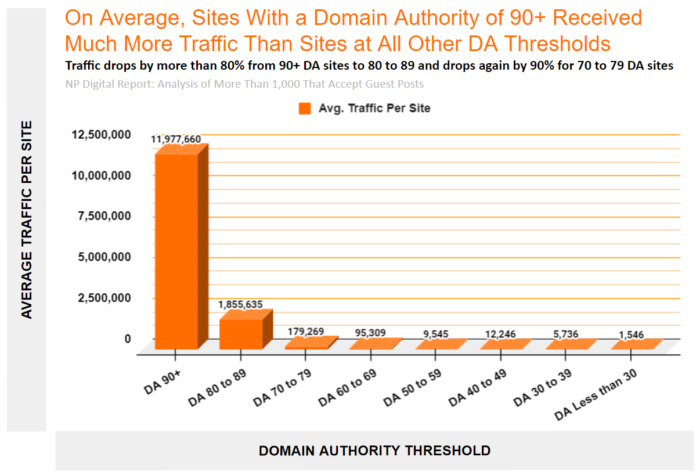
1,000-guest-blog-sites-analyzed-distribution-of-traffic-by-domain-authority

As you can see, targeting sites with a domain authority above 90 will likely lead to more traffic. At the same time, those are also the sites that will be hardest to get links from.

So, What Did We Learn?

The short answer: guest posts links kind of work and kind of don’t.

I know that isn’t a clear answer, but it is if you read the rest of the post. Because there are certain types of guest post links that work and there are others that don’t.

Here are some more insights…

Too Many External Links Is Bad

Some guest posting sites link out a lot.

Some don’t link out too much.

Although you shouldn’t be focusing on how many times you do or don’t link out, you should be focusing on providing the best user experience to your audience. If that means including a relevant link to another site in your article, by all means, link out.

If it doesn’t make sense, then you shouldn’t.

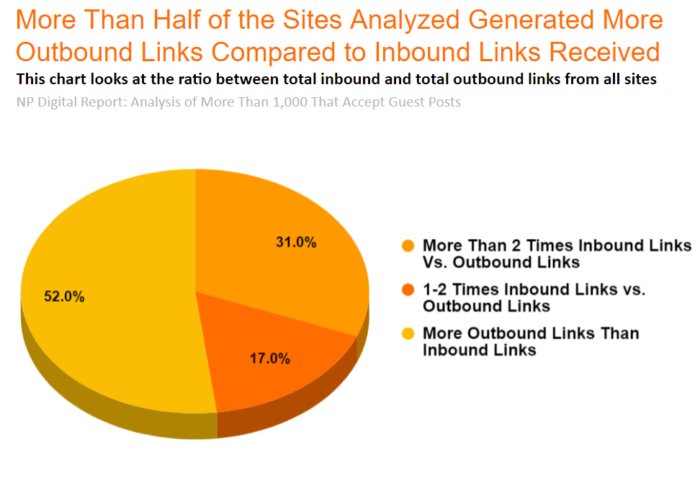
Look at this chart.

1,000-guest-blog-sites-analyzed-ratio-inbound-links-vs-outbound-links

Now, it’s hard to know for sure if a link received from a guest blog site with more outbound links than inbound links is effective since websites don’t just have 1 backlink. Most websites can have hundreds and, in some cases, millions of them.

Just look at my site NeilPatel.com. Sadly some spammy websites link to me (scrapper sites) and some high authority websites link to me. It’s hard to know for sure what the impact a spammy site link has on my rankings compared to the ones received from high domain authority sites.

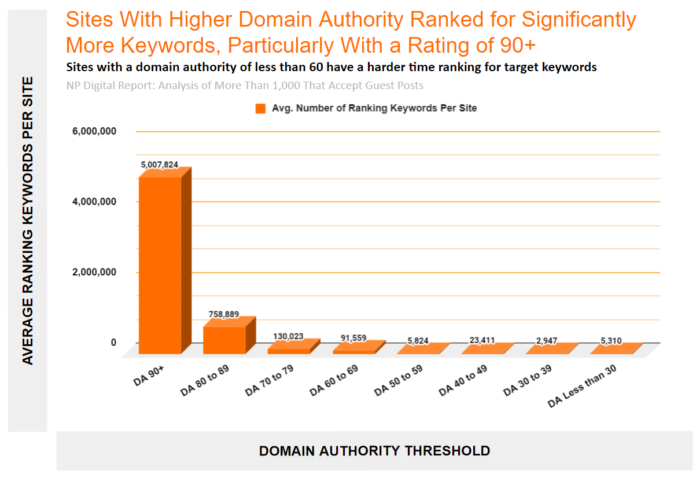
Instead, what we could do is look at the number of keywords a guest posting site ranks for. In theory, the more keywords a site ranks for, the better they are since they are liked by Google. I would think that a link from them would be more favorable.

1,000-guest-blog-sites-analyzed-ranking-keywords-per-DA-threshold

What you’ll notice is, generally speaking, the higher domain authority a site has, the more keywords it ranks for. But we already knew that.

When looking at the domain authority range from 0 to 59, you’ll notice that there isn’t a consistent upward trend. That’s because many of the domains from our analysis in this range tended to be sites that were expired or bought-out and are mainly used for guest posting purposes.

Even more interesting. The guest posting sites that had more external links than inbound links all had a domain authority of less than 60.

From this one insight, someone could infer that you should aim to get links from sites that have more inbound links than external links. As in, sites that have higher domain authority.

You should also avoid guest posting sites that exist for the sole purpose of linking out to other sites. These can be considered spam links.

The Right Links Help

From all of the guest posting sites we analyzed, we found 14 businesses that were exclusively receiving links from some of the sites we looked at. Of these 14 businesses, six of them only received links from guest posting sites with a domain authority of less than 60.

In other words, they didn’t have links from any other sites.

So, we dove into their rankings and traffic.

What’s funny is that these six businesses had little to no rankings or traffic.

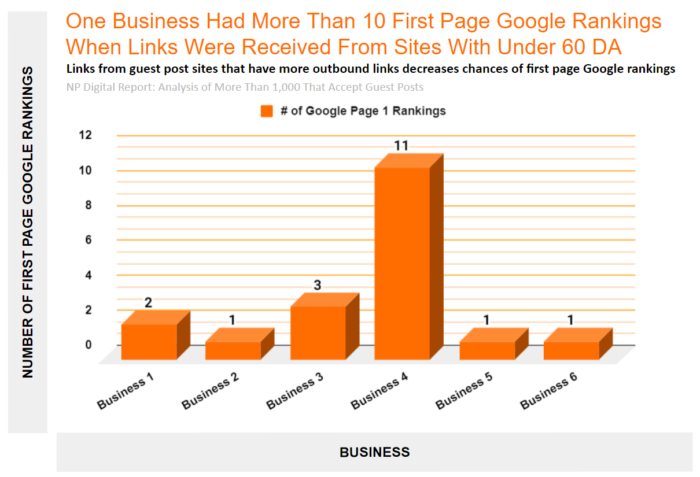
Let’s look at the number of page 1 Google rankings they had.

1,000-guest-blog-sites-analyzed-number-of-page-1-google-rankings-under-60-DA-only

Since these six businesses only received links from spammy guest posting sites, we know that each of those sites had more outbound than inbound links. It’s clear that those sites didn’t really serve a purpose other than for guest posting.

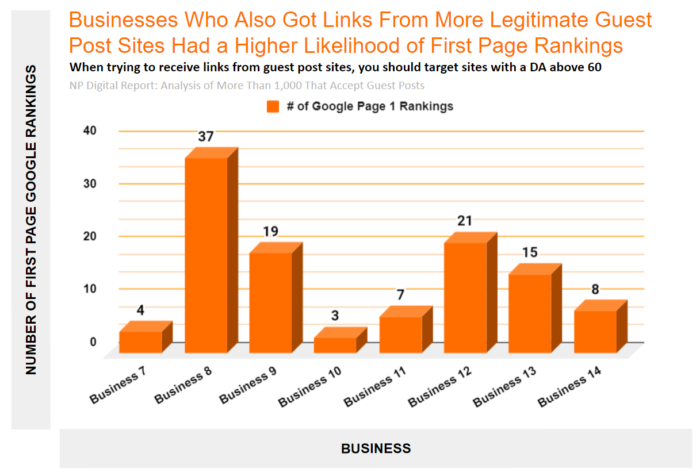
The remaining 8 businesses we looked at also had links from spammy guest posting sites but also received links from more legitimate guest posting sites as well. As in, guest posting sites that had more inbound links than outbound links.

1,000-guest-blog-sites-analyzed-number-of-page-1-google-rankings-all-DA-sites

The businesses that built links from the spammy guest posting sites had, on average, 3.16 page 1 rankings on Google. On the other hand, businesses that also built links from the higher quality guest posting sites as well had, on average, 14.25 page 1 rankings on Google.

Keep in mind some industries are easier to rank for than others and some keywords drive less traffic than others, so not all page 1 rankings are created equal.

At the same time, this trend shows that if you target links from higher-quality guest post sites, there is a better chance of ranking on the first page.

Conclusion: Do Links From Guest Posts Work?

When I originally said guest posting links can or can’t help it’s because the quality of the link really matters.

When you get links from spammy sites, as in sites whose sole purpose is to link out and don’t get as many links coming in, search engines know this. If this is a practice you have been doing, don’t expect your rankings to go up as much.

On the flip side, if you generate links from higher-quality guest post sites, you are going to be much better off.

The goal of this post was to figure out if links from guest posts really help and now we know the answer. However, if you’re going to build links from guest posts then they should be nofollowed and you should be doing it primarily for branding and referral traffic purposes.


from Neil Patel's Digital Marketing Blog https://ift.tt/mn1zEGr

15 Conversion Rate Optimization Tips to Boost Your Rankings

15 Conversion Rate Optimization Tips to Boost Your Rankings

Conversion rate optimization, or CRO, is the process of optimizing your website to increase the completion of a specific action. In most cases, the desired action is an actual sale, but not always.

Desired actions could include demo sign-ups, downloading an asset from your website, trying out a new tool, or signing up for your newsletter. If it helps you grow your business, it’s a conversion—and it can be optimized.

The beauty of these conversion rate optimization tips is they work regardless of your intended conversion method.

CRO Tip 1: Add Site Search to Your Website

Up to 30 percent of visitors will use a search box if it’s offered. Unfortunately, nearly 84 percent of companies don’t optimize their on-site search to meet user expectations.

This means if your website doesn’t already include a site search, it’s time to consider adding it.

The main benefit of site search is user experience. However, data from search results can provide valuable insights into user behavior by showing you exactly what they’re searching for.

This information can help you tailor content to meet those needs or add new pages to your site to fill any gaps.

You may even be able to identify users in different parts of the funnel based on the search terms they use. This information can help you to narrow your customer’s most common questions and pain points, helping you tailor the website experience to their needs.

If you use WordPress, you can add a site search using a widget. If you use Webflow, they’ll actually let you customize it. Wix and Squarespace make it easy to add site search as well.

CRO Tip 2: Ensure Forms Are Easy to Fill Out

The average form abandonment rate is 68 percent—which means most people won’t finish filling out your form.

Website forms serve many purposes, including newsletter signup, lead magnet acquisition, and product/service inquiry.

Keep in mind: the easier a form is to fill out, the higher your expected conversion rates.

According to Hubspot research, a typical form has about 5 fields on average—and forms that are A/B tested get about 10 percent higher conversion rates.

In my experience, simple is better.

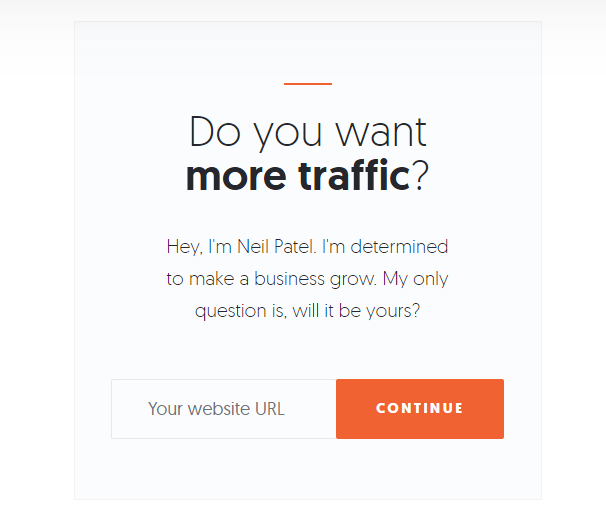
conversion rate optimization tip for forms

This is an example of a simple form I use on my blog. All the user needs to do is enter their website’s URL and the action is complete. It doesn’t get much simpler than that.

A few ways to ensure your forms are easy to fill out:

  1. make form names clear
  2. use proper HTML formatting
  3. use relevant sample placeholder text (I used “Your website URL” in the example above)
  4. have a distinct and easy-to-local submission button

CRO Tip 3: Improve your CTAs

If you want to improve conversions, CTAs are low-hanging fruit. The average CTA click-through rate is just 4.23 percent, but many factors can impact what helps your CTA convert.

For example, if you include more personalization in your CTAs, conversion rates can improve more than three times as much.

That’s why you should continually test CTAs to see what works and what needs improvement. You’d be surprised at how quickly user preference can change!

Start by testing these CTA elements:

  • copy
  • colors
  • placement
  • button shape
  • button size
  • page placement

Consider testing different types of CTAs as well. Here’s how CTA types convert, according to a study by Vye Agency:

  • button CTAs have an average CTR of 5.31 percent
  • text CTAs have an average CTR of 2.06 percent
  • designed CTAs have an average CTR of 3.53 percent

When it comes to branding, consistency is key. However, using colors outside of your branding palette for CTAs is worth trying. Colors within your palette might blend in too well with the rest of your site, making them easy for website visitors to overlook.

CRO Tip 4: Run User Testing

Poor usability can kill your business. 70 percent of online businesses fail because of poor usability.

If you’re in e-commerce, your conversion rates could increase by 35 percent by just improving the design and flow of the user checkout process.

User testing is the way to get valuable data that can help you get more conversions across your website. So it’s important to get this process started as quickly as possible.

One of the most common ways to run UX testing is with heat maps, which show how users navigate your site and what interactive elements they’re clicking on.

You’ll see if they’re looking at your links, navigation bar tabs, CTAs, and so on. Some heat maps even incorporate eye-tracking software to show where your users look first.

Conversion Rate Optimization Tips - Hotjar heat map

There are several heat mapping tools on the market, but my favorites are Crazy Egg and Hotjar. If you decide to use Hotjar, the process for setting them up is very simple and straightforward.

CRO Tip 5: Add More (Better) Social Proof

More consumers than ever read social proof. In fact, 77 percent of users say they always or regularly read online reviews before buying.

You want to leverage customer loyalty as often as you can. Why? It’s free marketing and brand exposure. Even better, reviews can drive revenue.

According to Womply, businesses with more than average reviews across earn 54 percent more in annual revenue

It is also easy to create.

Social proof is a simple and great way to leverage user-generated content for your brand. This can include positive reviews and ratings, creative social media posts about your brand shared by customers and influencers, user-submitted content like photography, and more.

The benefit of adding more social proof to your website is it shows other users that other people trust you. Trust and credibility play a big factor in getting more conversions.

To add more social proof, try:

  1. Send a follow-up email asking for reviews.
  2. Host a contest with a branded hashtag on social media.
  3. Include a card with a branded hashtag when shipping physical products.

If you want to do it on a larger scale, consider automated tools like HotFomo and OptinMonster.

CRO Tip 6: Add Chatbots or Live Chat

If you have a question, wouldn’t you rather get the answer fast? That’s the idea behind chatbots. No matter how great your customer service is, sometimes call queues get long.

The good news? Users like chatbots. The average satisfaction rate of chatbots is 87.58 percent. They can also reduce customer service costs. One study predicts chatbots will save businesses $8 billion in customer service costs by 2022.

These tools help your brand build an instant connection with customers, making them more likely to purchase your product or service. Here are a few ways to leverage chatbots;

  • answer FAQ
  • qualify leads
  • suggest related products
  • troubleshoot common issues
  • share information about new products
  • increase your email list

With so many chatbot options available, it can be challenging to find the right one. I recommend focusing on native channel integrations to narrow your search.

If you want an app with widespread integration options, consider Landbot, which offers chat features through web, WhatsApp, Facebook Messenger, and API.

Perhaps you just need to integrate with Facebook Messenger? In that case, Chatfuel is an affordable solution.

Make sure that whatever chatbot you choose aligns with your business goals.

CRO Tip 7: Review Customer Persona and Adjust Your Messaging

A customer persona is a fictional snapshot of your ideal customer. Personas are commonly used by marketing agencies and businesses to give their target audience a human face. They can help drive leads, increase conversions, and shorten the sales cycle.

According to MarTech, creating a persona can increase email CTR by 14 percent—and conversion rates by 10 percent.

The gap between who you think your ideal customer is and your actual customers may be more significant than you think.

For example, if your personas are businesswomen in their early 30s but your customer base is primarily homemakers in their 50s, there’s going to be a massive disconnect in how you approach your target audience.

Here are six steps you can take to make sure you are targeting the right customer personas:

  1. Make a list of your highest value customers.
  2. Use a customer persona template to create a new persona.
  3. Start adding details from your highest value customers. Start with demographics like location, age, budget, education, etc.
  4. What channels do your highest value customers use to find you? Add that to your persona as “methods of communication.”
  5. Look at the content they consume—what does that tell you about their motivations? Add those to your template.
  6. Repeat the process for every product or service you offer.

It’s important to realign your customer personas with your messaging, sometimes as frequently as every two or three months. In some cases, this could mean tailoring your brand approach altogether to connect with the new target audiences working.

CRO Tip 8: Use Targeted Lead Magnets

Lead magnets are a free resource (like an ebook or guide) given away in exchange for user data. The most common lead magnets are PDFs or videos, but there are plenty of media types to use.

The best part? They work.

Fifty percent of marketers say lead magnets increase their conversion rates.

The more targeted your lead magnets, the more effective they are likely to be. The key is to get creative with your targeting.

You could even consider creating some more interactive lead magnets like quizzes or online calculators. According to LeadQuizzes, the average quiz has a lead capture rate or 31.6 percent.

The way you target your magnet will depend on your product or service. For example, if you serve a geographical area, it may make sense to target leads based on location. Other websites might target leads based on industry or how they got to the site.

Here are a few other targeting options:

  • time on page
  • type of content
  • whether they’ve purchased before
  • industry
  • customer persona
  • location
  • time period (for example, a pop-up for an upcoming event)

Not sure how to add targeting to your lead magnet strategy? These lead magnet tools can help.

Whatever type of lead magnet you decide to create, be sure it aligns closely with your intended customer. Since the goal of lead magnets is to collect user data, you want to make sure the offer is valuable to your intended audience as well as your business.

CRO Tip 9: Use Pop-Ups Carefully

Pop-ups have an average conversion rate of 3.09 percent, which makes them ripe for CRO.

I have a love/hate relationship with pop-ups because they walk such a fine line between being beneficial (for you and your customer) and incredibly annoying. However, when done right, pop-ups can be an invaluable conversion tool.

In fact, Marketing 112 increased their conversion rates by 62 percent by adding a pop-up to its website.

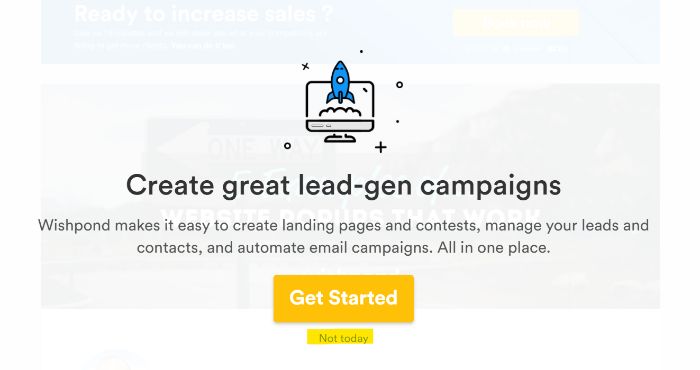
First and foremost, your pop-ups should respect universal UX rules. These include fast load times, visible exit options (like the example from Wishpond below), and platform-appropriate size.

There should also be limits as to how often users see the pop-up. For example, a user who bypasses the pop-up once shouldn’t be bombarded with it on each page of your site they navigate.

Conversion Rate Optimization Tips - Use Popups Carefully

When it comes to conversions, keep the messaging short with minimal effort to take the desired action.

You can also implement A/B testing to see how users interact with different versions of the pop-up. This is important for optimizing conversion rates across the board.

CRO Tip 10: Check Your Site Speed

If your site loads slowly, all of the conversion rate optimization tips in the world won’t make a difference. In fact, website conversion rates drop by 4.2 percent for each additional second your site takes to load.

Even more surprising? More than 80 percent of sites don’t meet acceptable speeds.

Fortunately, there are plenty of free sites and tools that let you test your site speed and troubleshoot common issues.

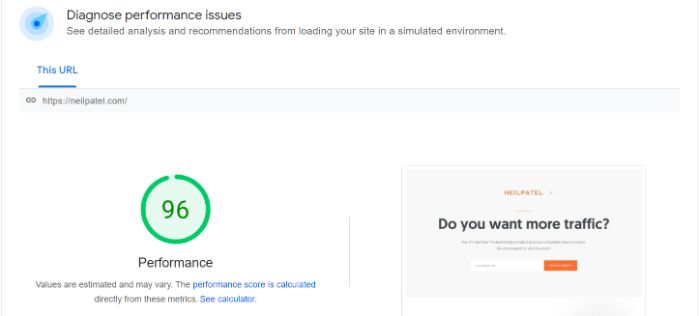
PageSpeed Insights and Pingdom are two of the industry leaders in this domain. These tools have been around for years and offer the most in-depth testing and troubleshooting. They first look at contentful paint, time to interactive, and total blocking time to calculate your overall score.

Conversion Rate Optimization Tips - Check Your Site Speed

What are some of the most common issues that slow down site speed?

  • render-blocking JavaScript
  • poorly optimized CSS
  • large media files
  • bulky code

While some of these may require a database engineer or developer to resolve, you can usually start to tackle some issues (like large media files) on your own.

CRO Tip 11: Recover Lost Sales by Following up on Abandoned Carts

According to the Baymard Institute, the average cart abandonment rate is 69.82 percent. That rate is even higher on mobile where the average shopping cart abandonment rate is 85.65%.

Recovering just a fraction of those missed sales could do wonders for your conversion rate.

If the main benefit of CRO is converting users already on your site, then abandoned cart users are the cream of the crop. They actively started the transaction but didn’t complete the purchase.

There may be some obvious reasons for this, such as a discount code no longer being valid or high shipping rates. Whatever the reason, you should always aim to recover the lost sales using (almost) any means necessary.

In fact, if e-commerce sites just fixed checkout usability issues in their process, they could increase conversion rates by 35.26 percent. This translates into more than $200 billion in recovered sales from the e-commerce industry alone.

Here are some other ways you can recover abandoned carts:

  • automated email flows
  • on-site push notifications
  • retargeting ads
  • personal outreach
  • automated social outreach

You don’t want to harass potential customers who have abandoned carts, but you do want them to feel wanted. Sending just one email could help you recover up to 29.9 percent of these sales.

You may want to play with your outreach timelines to find the right approach for your customer base.

CRO Tip 12: Make Sure Landing Pages Match Your Messaging

The average landing page converts just 2.35 percent of the time across all industries. If you want to be a top performer in your sector, you should be aiming for conversion rates above 10 percent.

So, how do you increase your landing page conversion rate?

One way is to ensure the messaging on your landing page matches the ad or copy that brought them there in the first place. This creates a more cohesive experience, showing users that your page is the right fit for what they want. It will also help improve your PPC quality score.

Here’s how to match your messaging:

  • use similar language in your landing page and ad (especially the main keywords)
  • keep branding consistent (include your logo and use brand colors)
  • use a clear CTA on both your ad and landing page

Just imagine how off-putting two distinct messaging styles can be to the user. Imagine if you agreed to a job interview for a tech company and found out it was a restaurant when you arrived. It would feel like a bait and switch, right?

While a difference in messaging between an ad and landing page isn’t quite as off-putting, it’s close. The differences can be jarring and steer users away.

When creating your landing pages and ad copy, make sure you have a clear focus in mind for. This would start with your keyword research when you select the target phrase for the page. You can include some secondary keywords on the landing page as well if you plan to use them in your ad copy.

CRO Tip 13: Target High Intent Users

High intent users are very close to making a buying decision. According to a report by the CMO Council, 87 percent of B2B buyers say that online content has a major or moderate impact on the vendor they choose.

That means there’s an extremely high opportunity to improve your content to convert these users.

How can you target high-intent users?

As previously mentioned, looking at the internal search terms users interact with on your site is one way to get an idea of content that works. Someone at the bottom of the funnel might be trying to distinguish between different options, so they’ll be looking more closely at shipping timeframes and return policies.

Here are a few other strategies:

  1. Add high-intent keywords to your ads and landing pages. Use the information from your internal search to gauge what keywords are and how your customer base interacts with them.
  2. Build content that targets customer pain points. You can often identify these pain points with SERP analysis of high-intent keywords.
  3. Pay attention to intent data. Contact users who visit your pricing page, return to your site several times, or book a demo but don’t follow up.

High intent users are ready to convert, so don’t leave them hanging.

CRO Tip 14: Optimize Your Content

If your content isn’t performing well, it’s time to re-evaluate and optimize it. The first thing to check is title tags.

According to Backlinko’s research of more than 11 million Google search results, sites that include the main keyword in their title tag are far more likely to rank higher.

Content optimization looks at a number of factors including:

  1. making sure the keyword is used several times
  2. content length variance (add or remove content)
  3. check image optimization, such as size and alt tags
  4. add stats and new research
  5. check meta and SEO titles
  6. add keywords to more headings
  7. add a frequently asked questions section
  8. make sure you aren’t cannibalizing traffic from other content on your site

For time and efficiency, you don’t have to do all of the above. Instead, research the top 10 results on Google for your target keyword and see how they are structuring their content.

Their approach is clearly having an impact on their ranking and can provide a path for you to improve your search engine rankings.

CRO Tip 15: Before You Make Changes, See What Works Now

It’s easy to see all of the things that need to be improved, but what about the things that are working?

There are likely some areas of your website that are already working. For those, look for patterns in what the data is telling you, determine what the essential parts that led to the results might be, and come up with an approach to replicate this across your site.

If you aren’t sure how to approach this yourself, you can hire a professional to audit conversions across your website and highlight what is working well. This process alone could uncover a lot of great things you’ve been doing but probably don’t realize.

The last thing you want to do is a major content overhaul that loses conversions from pages or strategies that are already working.

Frequently Asked Questions About Conversion Rate Optimization Tips

What is conversion rate optimization?

Conversion rate optimization (CRO) is the process of increasing the conversion percentage for a website or mobile application. The aim is to increase the number of people taking the desired action in relation to the number of visits by improving customer experience and testing interactive elements.

What is the most effective CRO strategy?

There’s no one way to approach conversion rate optimization. However, a good CRO strategy will focus on user experience optimization, customer journey analysis, and website performance.

Is CRO different for ecommerce?

The benefits of CRO are the same whether they’re being implemented for an ecommerce site or not. However, the processes may differ slightly. When it comes to ecommerce, the conversion funnel has a larger part to play than it might on a non-ecommerce site.

How can conversion optimization affect your return on investment?

In simplest terms, CRO aims to make the most of the site traffic you already have. By increasing the conversion of your existing traffic, you have the potential to lower your customer acquisition costs.

Conclusion: Conversion Rate Optimization Tips

When you consider the fact that customer acquisition is more than half of the battle, it makes sense to focus heavily on conversion rate optimization.

After all, converting more of your existing website traffic could drastically reduce customer acquisition costs.

You’ll notice most CRO tips focus on improving the user experience and enhancing the customer journey. That’s because they tend to have the most significant impact. However, you don’t have to implement all of these CRO strategies immediately. Think about which will have the most significant impact and test those first.

Which of the CRO tips above do you think will have the most impact on your conversion rate?


from Neil Patel's Digital Marketing Blog https://ift.tt/PhozqIY

Thursday, 10 February 2022

Essential SMS and Email Tips: 5 Strategies You Can Implement Now [Free Webinar on February 15th]

Essential SMS and Email Tips: 5 Strategies You Can Implement Now

How important are SMS and email for a company’s success in 2022? Very.

78 percent of marketers say email is an important part of a company’s success.

And texting is quickly becoming another way for businesses to succeed. In fact, a 2021 survey found the majority of marketers reported increased revenue from SMS efforts.

If you are looking for new and innovative ways to engage your customers, adapting custom email and SMS strategies might be the solution you need to grow subscriber lists and improve the customer experience.

Join us on Tuesday, February 15th at 8 am PST for a FREE webinar on 5 No-Brainer SMS and Email Marketing Strategies You Should Implement Today!

Why Having an SMS and Email Strategy is Important?

By 2024, an estimated 4.5 billion people will use email. When done correctly, email marketing can increase traffic to your website, conversions, and revenue.

What do we mean by “correctly?” We mean following trends, using the latest tools, and relying on data to optimize your emails for opens and conversions.

SMS is also becoming a more effective communication channel. Texts can be used for marketing, to increase revenue, or even to offer quick customer service. In fact, close to 60 percent of consumers check their text messages within 1-5 minutes so they are a great way to get people’s attention.

The click-through-rate of SMS is also very high at 19.3 percent, better than email which has a CTR of 4.2 percent, or Facebook ads, which have a 0.05 percent CTR.

You may be wondering how can you get such a high click-through-rate with SMS as well, turning those opens into conversions and revenue? Attend our webinar to find out!

Who Will Benefit from Attending the Webinar?

  • Marketers who want to learn insider tips so they can expand their email and SMS skills.
  • Small business owners who want help launching or improving their email and SMS efforts.
  • Blog writers who want to grow their subscriber list.
  • Anyone who wants to improve their SMS or email click-through and conversion rates.

What Businesses Will Benefit from New Email and SMS Tips?

Marketers, small businesses, e-commerce companies, and B2B organizations alike will all benefit from this webinar. Need proof?

SMS is becoming just as important for all these business models. How it is used ranges from appointment confirmations, to sales promotions, to customer service, and everything in between. In case you need more convincing:

  • About 33 percent of marketers expect to prioritize mobile loyalty programs over the next year.
  • 85 percent of customers say they prefer receiving text messages over a phone call or email.
  • 64 percent of consumers think that companies who text value their time and are more progressive.

The email and SMS strategies covered in this webinar can be applied to any business model.

What You’ll Learn in This Webinar

In this webinar, we’ll first go over some of the top email and SMS trends we see coming in 2022. We will explain what each of them mean as well as the impact they can have for you and your business.

Next, we’ll provide five detailed email and SMS tips. For each tip, we’ll discuss why we think it could be a game changer for your business in 2022 and also provide some examples of how each can be used.

Finally, we’ll walk you through some step-by-step processes you can take to implement each tip and start seeing results right away.

By following the tips you will learn in this webinar, you’ll be in prime position to grow your subscriber list, create a cohesive email and SMS strategy, and get more conversions from each communication you send. We look forward to seeing you on February 15th!


from Neil Patel's Digital Marketing Blog https://ift.tt/bKP4cMF

Wednesday, 9 February 2022

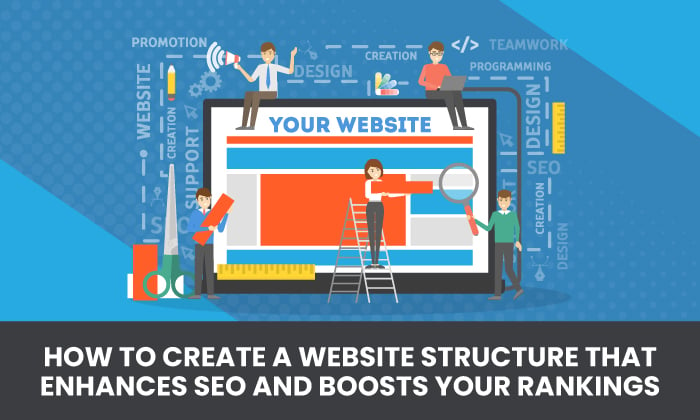
How to Create a Website Structure That Enhances SEO and Boosts Your Rankings

How to Create a Website Structure That Enhances SEO and Boosts Your Rankings

The better and more logical your site structure, the greater UX, SEO, and other benefits you’ll see. Deciding how your website should be structured takes time and careful thought.

In this guide, you’ll learn what website structures are and why they’re important. We’ll dive into the four types of website structures and how you can choose the right one for your site.

Finally, we’ll show you just how to design and develop the right structure for your site.

What Is Website Structure?

Website structure refers to how information is laid out on your site, the way it is designed, and how the pages connect with one another.

Some of the top reasons why visitors leave a website is due to poor site structure. 73.1 percent of people said they leave a site with a non-responsive design and and 34.6 percent said it was due to poor content structure.

Websites have a short window to make an impression otherwise visitors will go somewhere else.

Many elements go into a good website structure which includes taxonomies, internal links, breadcrumbs, navigation, and schema.

Why Is Your Website Structure Important?

There are three major reasons your website structure is important.

First, a logical and well-planned structure is ideal for User Experience (UX). 88 percent of online consumers say they are less likely to return to a site after a bad experience. Websites that are easy to navigate create a seamless experience for your audience without frustrations.

Second, and perhaps of the same importance as the first point, is Search Engine Optimization (SEO). More than 25 percent of SEO professionals believe structured data is an emerging SEO factor and 36.6 percent believe Google’s Core Web Vitals update is going to become one of the most important components to an SEO strategy in the future.

Making sure your website is well-laid-out, easy for search engines to crawl, and mapped properly will make it easier for your content to be indexed.

Lastly, an intentional structure helps prevent keyword cannibalization. This means content that covers similar topics will be distinguished and organized from one another, giving users and crawl bots a clear idea of the intention for each piece.

Top-Down Vs. Bottom-Up Website Structures

The four types of website structures fall into two categories: top-down or bottom-up.

Different structures satisfy different goals and there are pros and cons of each approach.

A challenge with top-down structures is everything needs to be planned out from the start. Once it is established, it’s impossible to change the overall flow and website setup.

On the flip side, this logical structure will make it easier for both users and search engine crawlers to navigate your pages.

As for the bottom-up website structure, its main strength is that it can be built over time and let you continue making adjustments. Even though these structures are better for a website owners, they might make the experience more difficult for users and search engines.

The 4 Types of Website Structure

Below is a breakdown of the four main types of website structures used today with use cases on when each one is more appropriate.

1. Hierarchical

A hierarchical structure, sometimes referred to as a tree structure, is the most popular website structure. It moves from larger, more general category pages into smaller, individual pages.

An example of this is with e-commerce websites that have high-level product categories (e.g., shirts) that flow into smaller categories (e.g., t-shirts, blouses, knits) that flow into individual product pages.

Hierarchical structures are great for websites with large amounts of data like e-commerce. First, you would establish your informational pages and other categories that would be important to your visitors. A good place to start is with the pages that receive the most traffic.

From there, you would determine how the rest of your pages fit amongst those categories. Always make sure you approach this in a way that makes sense for users and crawl bots since it will be very challenging to change this later.

2. Sequential

A sequential, or linear, website structure is one that follows a simple page-to-page path. These are more common for simple websites or when creating a campaign with multiple landing pages.

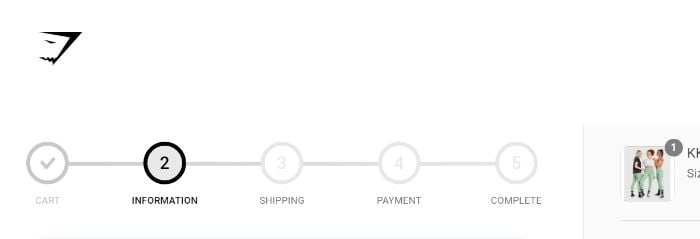
If you’re a startup or a small business, you probably only have a few essential pages you want to display so this approach would make sense. This would even make sense for large website checkout experiences like Gymshark or KKW Beauty have done:

website-structure-gymshark

The best use for this structure is when you want your content to have a chronological order. For example, an online course or sales funnel. A sequential website structure will ensure users go through the steps as you intend to make the process as straightforward as possible.

To get started with this structure, look for areas of your website where having a logical sequence would help improve the user experience. This could be through your checkout process, highlighting benefits of your offerings, or for specific content topics.

3. Database

A database structure is one of the most complex website structure types using a bottom-up approach.

This approach requires special attention to tagging and metadata in order to create a searchable database for users to access. Site search is becoming more and more popular and can be a valuable tool for increasing conversions.

About 30% of people who visit a website will use the site search at some point. Another previous study from eConsultancy found that when site search works well, those visitors convert almost twice as much.

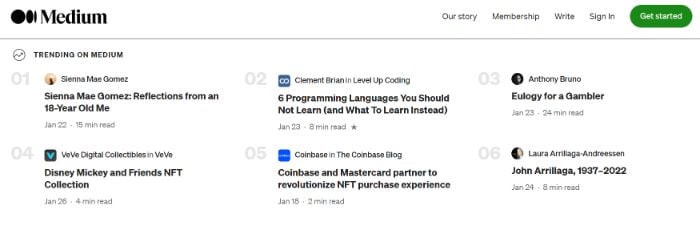
An example of a database structure is Medium:

website-structure-medium

A big advantage from a database structure is that it can be personalized to meet your needs. It can also be built over time since it is bottom-up so you don’t need to worry about making it perfect right away. As your website grows, your previous database files will become part of their own dataset under the new, larger structure.

One challenge with a database structure is you will need someone on your team with extensive programming knowledge. This is an important part to make sure nothing gets lost in translation.

The first thing you should consider is the level of data your website has before using this structure. If there’s a fit, find an experienced website programmer who can help guide you in the right direction and start strategizing categories.

4. Matrix

A matrix structure is one of the oldest structure types on the internet. It’s complex and non-traditional that is best navigated using search and internal links.

Wikipedia is a prime example of a matrix structure. There are seemingly endless possibilities for the next steps a user can take and with more than 80 percent of their traffic coming from organic searches, it works.

Following a wiki-style approach is the most obvious use of a matrix structure. It lets you present a large amount of data and information in a word cloud-like format. You don’t need to worry as much about a parent-child relationships for pages or navigation. The next step in the sequence would depend on each user.

This structure should mainly be considered when a website has a narrow focus as broad topics might be overwhelming for users. For example, this would make sense as a training database for company systems or fan-based websites for popular TV shows.

To get started, list all the pages that might connect with each other and look for logical opportunities where you can link between them.

How to Pick Which Type of Website Structure Is Right for Your Website

The website structure you choose will largely depend on the type of website you’re building. While you can choose whatever structure you’d like for your website, it is best to choose one that aligns with your core ideas and how visitors expect to interact with your site.

For websites that have a lot of data and where clear categories exist, then a hierarchical or database structure might be your best bet.

If you want to deliver bite-sized chunks of data in chronological order, then the sequential structure is an easy choice.

As for the matrix structure, following a wiki-style approach is really the best solution. This makes the most sense for sites with a lot of content or links that can connect together.

7 Tips for Designing and Developing Your Website Structure

Before we get into the steps you should take to create a great website structure, we’re going to touch on some of the nuances of design and development.

This is important to consider from a user experience perspective.

1. Optimize Your Site for People, Not Bots

In recent years, there is less of a gap between website optimization best practices for people and bots than ever before. Some website owners are still more focused on optimizing for crawl bots instead of people though. While this is never a bad idea, keep in mind you are trying to keep people engaged in order to increase conversions.

Almost 40 percent of people will stop engaging with a website if the content or layout is too confusing.

2. Keep Links on Any Given Page to a Reasonable Number

It’s crucial to balance on-page time and link interactions. You want users to be engaged by the content of a current page, but you also want to encourage them to go deeper into your site.

The key to this balance is keeping links to a reasonable number and also make sure the link connects with the topic at hand.

So what is the ideal number? This topic has been debated endlessly in the SEO community. A safe number to aim for is three to five links per 1,000 words to get started. The important part is not overloading each page.

3. Utilize Heading Hierarchy

The structure of your website is important, but so is the structure of individual web pages.

When you utilize a heading hierarchy, you create a logical structure for your web pages that both humans and bots can understand.

A heading hierarchy helps you organize on-page content using different heading elements (e.g., H1, H2, H3, H4). These elements are fairly simple to implement and easy to organize while improving the readability of each page.

You can also test different header types to see what sort of impact they have on individual page engagement.

4. Keep Navigation Depth Shallow

No matter what kind of site you have, your users should be able to find what they need in as few clicks as possible. According to Google’s John Mueller, click depth carries more weight for SEO than the URL structure.

While there’s no hard-and-fast rule on the exact number of clicks, try to keep the navigation depth to four clicks or less.

5. Show Breadcrumbs

Speaking of navigation, you want to make it as easy for customers to navigate backwards as forward. The best way to do this is with breadcrumbs.

According to research from the Baymard Institute, breadcrumbs do a lot of the heavy lifting on mobile sites yet 36 percent of sites that use them fail to include the full category hierarchy on mobile product pages.

At the same time, 20 percent of desktop sites and a massive 65 percent of mobile sites don’t use breadcrumbs at all on their product pages. This is a pretty big gap that can confuse users since they don’t know where they are on the site or how to navigate from there.

Breadcrumbs make it a lot easier for users to navigate back to higher-level category pages or even your homepage in just a few clicks.

6. Keep up on Keyword Research

If there’s one thing equally important as the website structure, it’s content.

In order to produce content that resonates with your audience, you need to perform keyword research at each stage of the development process to ensure all pages are optimized.

According to Ahrefs, close to 95 percent of all keywords get 10 searches or less per month. It is very important to choose the right ones if you want to get traffic.

Where do you begin? Use a keyword tool like Ubersuggest to choose the right terms. It offers extensive keyword data, insights to improve traffic and backlinks opportunities. 

7. Include Schema Markup

To take your website’s architecture to the next level, consider using structured data.

Structured data includes tags, JSON code, and rich data which was created for and understood by search engines. Using structured data has been recommended by Google since 2014. It can drastically improve website visibility with some sites reporting as much as 400 percent increase in rich result organic traffic.

If you’re looking for the most bang, then start with schema markup. This can be implemented quite easily compared to JSON, and there are plenty of schema markup guides to get you started.

How to Plan a Website Structure

What goes into the development and design of a website structure? Below is a step-by-step guide to planning your website’s structure.

Step #1 – Perform Market Research

There’s nothing wrong with innovating how you approach your website structure. However, it should be an intentional decision.

Pay attention to how similar websites in the market structure their sites before you choose your own. This can be a signal for what user expectations are and you don’t want your site to confuse them.

Before you begin planning, select the top five to 10 competitors in your market, go through their websites to see what structure they use, and identify the strengths and weaknesses of their setup.

Step #2 – Develop and Analyze Your Target Audience

Even more important than the competition is your target audience. Before making a decision, you should know who your audience is, what sites they visit, and what they expect from the user experience on your site.

Don’t rush this step of the planning process. This is the greatest opportunity to learn how your visitors navigate through competitor sites. Once you have identified the strengths and weaknesses, you can make improvements so your website delivers a much better experience.

Steph #3 – Choose Your Website Structure and Hierarchy

Now is the moment of truth. It’s time to use the information you received from your market and audience research to pick the right structure type for your website.

This would also be the right time to bring an experienced UX/UI designer into the mix if you’re still not sure which structure makes sense. They can provide valuable insights to your internal developers even if they aren’t a part of the entire project.

Step #4 – Choose a URL Structure

The best URL structure will closely mimic the website structure you chose. What does this mean?

Let’s say you chose a hierarchical structure for your website. Within it there are high-level category pages, low-level category pages, and product pages. A simple and effective URL structure would look like:

https://ift.tt/Dg90Kol

This URL structure offers a logical path for users to follow. It’s very similar to the breadcrumb navigation that many hierarchical websites use.

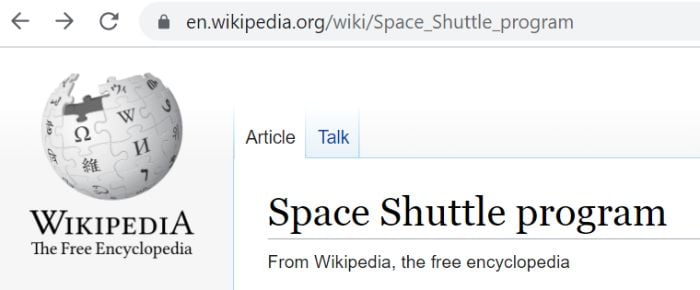
What about the URL structure for a matrix-style website structure? With so many internal links, it would be impossible to create a logical URL structure like the one shown above. In these cases, a workaround would be using a simple direct link to the page topic. Here’s an example of how Wikipedia does it:

website-structure-wikipedia

Step #5 – Develop an Internal Linking Strategy

Think of internal links as a way to tell a cohesive story on a particular topic, with the added bonus of giving users another way to navigate your site.

As mentioned before, there should be a purpose behind each internal link you use and not overdo it. The goal is to provide value to users, not bombard them with more information.

Step #6 – Create a Sitemap File

If you want search engines to crawl your website quickly and efficiently, you need a sitemap.

A sitemap file is a map search engines can use to navigate your website. It tells crawl bots which pages are important and how they are connected to each other.

Fortunately, the process for creating and submitting your sitemap is quick—it usually takes less than 20 minutes. 

Step #7 – Run User Testing

The job’s not done once the website is live. In fact, the journey is just beginning.

Running regular tests can help you uncover issues with your current setup. While this step won’t necessarily impact the website structure you chose, it can highlight key areas you should revisit.

This will help you answer questions like:

  • Where are users getting stuck in the journey?
  • Are there certain elements (e.g., navigation, site search) users find difficult?
  • What steps in the customer journey can be improved?
  • Does your current setup have any bottlenecks?

It’s not uncommon to run user testing several times as you implement changes to your website based on user feedback. Keep testing and keep optimizing.

Website Structure Frequently Asked Questions

What is a linear website structure?

A linear website structure displays content in sequential order from one page to the next. The best example of this is the checkout process on sites like KKW Beauty.

Which is the best type of website structure for SEO?

When it comes to SEO, the best website structure is hierarchical. This is a logical structure that is easy for search engine bots to crawl.

How many types of website structures are there?

There are four main website structures: hierarchical, sequential, database, and matrix.

Who is qualified to design a website's structure?

A website developer is your best bet when it comes to designing and developing a website’s structure. They may work alongside other professionals, like UX/UI designers.

Conclusion: Website Structure

Website structure impacts your UX and SEO, which means it’s crucial for getting traffic and your overall online success. With a lot of planning and thoughtful organization, you can create a website structure that enhances SEO and boosts your rankings. 

The best structure is the one that works for you and your audience’s needs. Whether you choose hierarchical, sequential, database, or matrix, make sure to keep user experience, SEO, and market research in mind. 

Which of the above tips for designing and developing your website structure did you find most helpful?


from Neil Patel's Digital Marketing Blog https://ift.tt/WLpG2QV