FREE TRAFFIC TO YOUR SITE

FREE TRAFFIC TO YOUR SITE
free youtube traffic

Thursday, 6 October 2022

SEO Is Never Truly Done, Here are 7 Reasons Why

You’ve established your initial web presence and have an SEO strategy in place. There’s some steady traffic, and you’re even picking up some leads. Your job’s done, right? Not quite.

You see, it’s not that simple. Effective SEO is an ongoing process that takes consistent work.

Even if you’ve hit your key milestones and you’re where you want to be in the SERPs, that doesn’t mean there isn’t still room for improvement and that you don’t need to adapt. Especially when the competitive landscape is ever-changing.

Semantically-related keywords, image optimization, predictive search, and Google Analytics 4 are just some of the factors shaping SEO as we know it. In addition to these trends and developments, there are many other reasons why you should keep working on your SEO strategy.

In this piece, I detail why SEO is a continuous process. It’s not something that you can afford to ignore once you start seeing results.

Let’s get started with the first reason.

1. There’s More Than One Type of Effective SEO Strategy

There’s more than one type of SEO, and an effective SEO strategy covers each type. In digital marketing, we divide SEO into four separate categories:

  • On-page SEO optimizes a website’s content and structure to rank higher in the SERPs. On-page SEO includes optimizing the title and header tags, meta descriptions, images, and other elements affecting how a website ranks.
  • Off-page SEO includes building backlinks to your site from other websites. The more high-quality backlinks a website has, the higher it ranks in SERPs, increasing your website’s authority and standing.
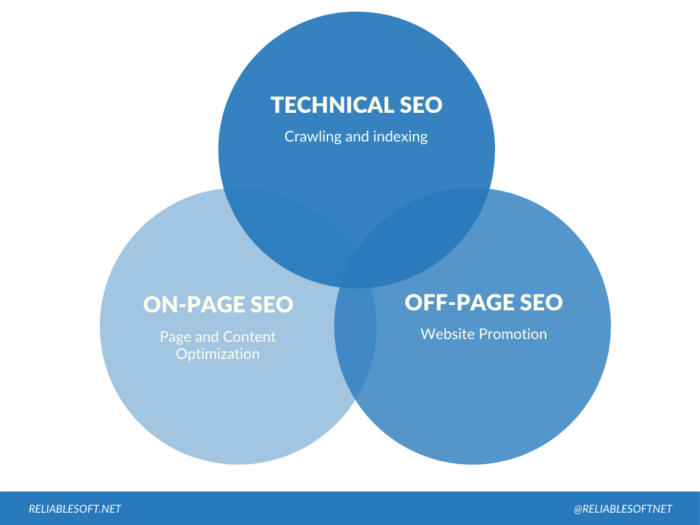
A venn diagram for technical seo, on-page seo, and off-page seo.
  • Local SEO helps to ensure that your website appears near the top of search engine results pages for relevant queries in your area. You can do several things to improve your local SEO, such as filling out your Google My Business profile. This free service from Google allows businesses to create and manage their business listing on Google.com and other Google services such as Maps and Search.

A great example of local SEO is the legal firm, Hasbrook & Hasbrook. It’s got a first-page ranking in the SERPs, attracting nearly 10,000 monthly searches for Oklahoma-centered keywords. It’s done this by using local keywords in its page titles and website URL, publishing local law content, and optimizing its Google My Business page.

A personal injury law firm page used as an example of SEO.
  • Enterprise SEO is a large-scale method of SEO. It considers your business goals, target audience, and competition. It uses multiple optimization strategies and usually covers websites with high volumes of transactions or large amounts of published data.

Even if you don’t have time for a complete SEO overhaul, you can implement a minimalist SEO plan by following these six simple steps.

2. Your Competitors Aren’t Stopping

If you’re thinking about giving up on your SEO strategy, you can guarantee your competitors aren’t.

Effective SEO takes time. You might see an initial boost in your SERPs when you begin putting your plan into action. However, for the most part, you’re in it for the long haul, and you won’t see results instantly.

Your competitors understand this, and they keep testing. If you’re not doing the same, you’re giving your competitors an open way to outrank you.

Additionally, to ensure their SEO strategy is as effective as possible, you can bet your rivals are tweaking and implementing new processes as the search engines update and evolve, leading me nicely to the next section.

3. Google’s Algorithm Changes and Evolves

Google is constantly changing and evolving its algorithm.

As seen with the helpful content update that has started rolling out in August of 2022.

Some of these changes are small, while others are more significant. Remember Panda and Penguin? These two updates sent many website owners into a tailspin when Google introduced them.

Panda emphasized quality content, while Penguin penalized sites using shady backlinking techniques and keyword stuffing. Inevitably, however, many legitimate website owners got caught up in this, causing them to lose out in the SERPs.

Then, another update, Hummingbird, considered searchers’ intent, while the Pigeon update impacted local SEO.

However, it’s not just the major updates you need to consider. It’s the constant tweaking, up to twice a day, you need to be aware of.

While not all these ever-evolving algorithms significantly impact SERPs, staying up-to-date on the latest Google algorithm news is essential so you can adjust your SEO strategy accordingly.

4. New Content You Create Still Needs Optimization

You know that awesome fresh content you keep creating? Well, it’s not enough on its own.

If you want your articles to attract organic results and reach your ideal customers, then you need to optimize each piece.

While there’s no denying the part social media plays in getting traffic to your pages, search engines deliver much more. One survey shows that Google drives eight times more traffic than all the social media sites combined, and the average top blog gets 66.47 percent of traffic from search engines.

With content optimization, what should you focus on the most?

Aside from keywords, an assessment of content using the Semrush SEO Writing Assistant tool showed that the top-performing articles measured a perfect score for:

  • SEO
  • Tone of voice
  • Readability
  • Originality

You can further optimize your content with:

  • Interlinking
  • Managing keyword density and including semantically-related keywords
  • Focusing on technical elements like meta tags
  • And covering topics in-depth

Let’s move on to search intent.

5. Search Intent Can Change Over Time

Searchers’ intent can change over time, significantly impacting how your website ranks on in the SERPs.

When John Shehata, VP of Condé Nast, asked Google’s John Mueller what the search engine views as a valid query, Mueller came back with this :

A tweet from John Mu.

From that, let’s go with the theory that search intent can often be seasonal.

Now, imagine you’re a hotel owner.

It’s summer, your business is booming because people are looking for somewhere to stay near the beach during their vacations. So naturally, they search for something like a ‘beach hotel (location).’ In all likelihood, they’re looking for a place to stay close to the beach in their chosen hotel.

However, come wintertime, your business slows down because people aren’t looking for beach getaways. An effective SEO strategy considers these seasonal changes in search intent and adapts its plan accordingly. For example, you might change your keywords to ‘seasonal short breaks’ (location) or similar.

Obviously, you would do some keyword research to determine the exact phrases to use, and I’ve got a tool to help you with that to give me some ideas to run with:
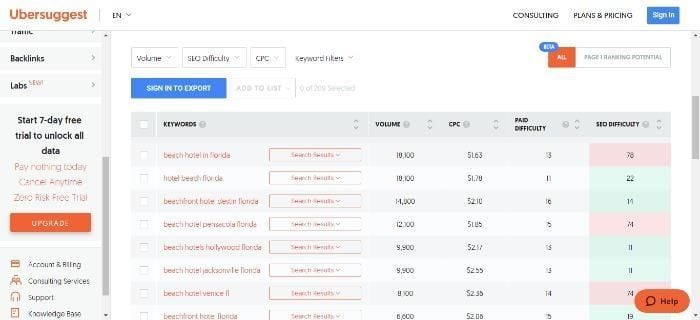
Ubersuggest's keyword research.

6. Effective SEO Compliments Paid Marketing and Other Efforts

You shouldn’t just think about SEO in isolation.

Effective SEO is part of an overall strategy designed to optimize your results. When you use SEO alongside paid marketing, outreach, and other efforts, you get a balanced online marketing plan that delivers short-term and long-term results.

Ideally, you want to use SEO alongside PPC advertising. Here’s why:

  • SEM instantly boosts your traffic through targeted ads, while SEO is a slow-burner, taking up to a year to pay off.
  • SEO can increase the effectiveness of your PPC campaigns by targeting the right audience and increasing click-through rates.
  • By improving your website’s ranking in search engine results pages (SERPs), you can drive more qualified traffic to your site.
  • SEO can help you target users who are already interested in what you have to offer, resulting in a higher conversion rate.
  • Paid search and SEO work together to create a comprehensive online marketing strategy to help you achieve your business goals.
  • SEO can help you create quality content that attracts attention online. This content can be used for paid advertising campaigns, resulting in more leads and sales.

7. Effective SEO Still Drives Results

You can find countless articles online declaring ‘SEO is dead.’ Some of these articles go back to 2012 and beyond, and they’re all saying the same thing. However, I can tell you something with confidence: They’re wrong!

SEO is alive and well, but like everything else, it’s ever-changing, so you need to keep working at it if you want your SEO to be effective.

I’m not the only one that thinks SEO is still worthwhile. Search Engine Journal thinks SEO is more relevant than ever.

Then there are the marketers who still swear by SEO. Let’s take the IT sector as an example.

A recent Deloitte report notes that the industry has thrived over the past few years. Looking forward, evolving technologies like cloud computing, the move towards hybrid working, and a need to build sustainable futures are just some factors paving the way for an even brighter future.

How are companies in this sector building their visibility? As a forward-thinking industry, the IT sector is having to prepare for rapid change, and to help achieve this, they’re consistent investors in SEO.

According to a survey by Tech Behemoths, 80 percent of businesses surveyed were familiar with SEO tools, and 67 percent employed a dedicated SEO manager.
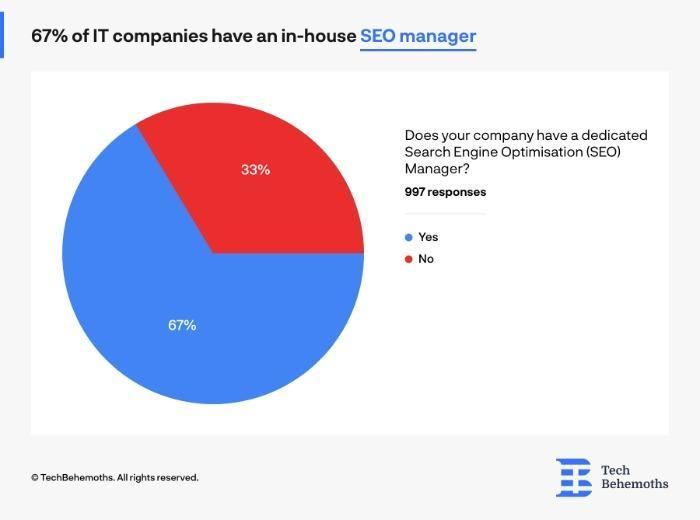
A pie chart showing IT companies with an in-house SEO manager.

Further, 89.3 percent said they’d conducted an SEO audit in the last year, and perhaps the most telling result of all, 78 percent use SEO for leads.

Whatever sector you’re in, SEO can work for you, getting you fresh leads and improving conversions, and taking your business to the next level.

Conclusion

If you’ve ever wondered whether SEO is a continuous process or a once-off project, this article should leave you with no doubt that you need to keep working on it if you want your SEO to be effective.

There are many factors to consider when optimizing a website. While the necessary changes may vary from site to site, the key to success is continually optimizing for SEO.

New trends and developments, changing search intent, and evolving algorithms are some of the main reasons to consider when developing an effective SEO strategy.

By following best practices and keeping up with the latest trends, you can increase the chances that your site ranks highly on search engine results pages, bringing more visitors and potential customers your way.

What’s the best way to implement and update an effective SEO strategy? Share your tips below.


from Neil Patel's Digital Marketing Blog https://ift.tt/WzXtfnN

What Is Find Places Through Reviews?

What Is Find Places Through Reviews?

If you’re a local business that wants nearby customers to find you, then you know local SEO and Google Business Profile is where it’s at. Combined with tools like featured snippets, these are essential to getting your content in front of local customers.

As a small business owner, you also understand that good reviews are imperative to winning new customers.

Now, it looks like Google is planning a new SERP feature to get your products/services in front of keen customers called find places through reviews.

According to SEO consultant Brodie Clark on Twitter, the carousels are getting tested in various regions, and on mobile, too.

How would it work, and what does it mean for your business? Well, all that remains unclear for the moment. However, I can share what we know and explain why reviews are vital to your business.

Let’s get started.

What Do We Know About Find Places Through Reviews So Far?

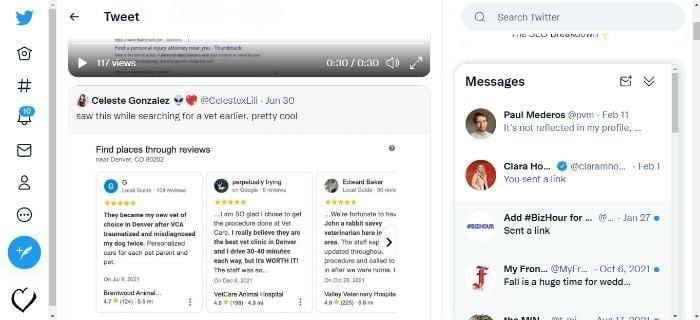
Speculation about find places through reviews began when local SEO specialists Andy Simpson and Celeste Gonzalez spotted the feature and posted the images on Twitter.

Gonzalez stated that the image appeared when she was looking for a local vet. As you can see, find places through reviews does pretty much what it says on the label.

Twitter reviews.

You’d enter the search term, and relevant reviews from local companies appear.

The tweets soon got picked up by Seoroundtable.com.

There is speculation that it would be similar to search Google for nearby places, which now appears to be going under the new name of find places through photos.

Sounds great, doesn’t it?

I can certainly see the advantages of putting a search term in Google, getting instant reviews, and then clicking through to my preferred business/service, can’t you?

Now, assuming the find places through reviews become a firm feature, what does this mean for your business, and what can you do to prepare for it?

Well, it would put the focus on online reviews, and by that, I mean positive reviews.

How Could This Change Impact Your Google Business Profile Reviews?

First, let’s look at what Google has to say about customer reviews:

‘When you reply to reviews, it shows that you value your customers and their feedback. High-quality, positive reviews from your customers can improve your business visibility and increase the likelihood that a shopper will visit your location.’

I’ll look more at the importance of answering reviews later, but let’s just park that there for now.

Second, let me share a stat with you.

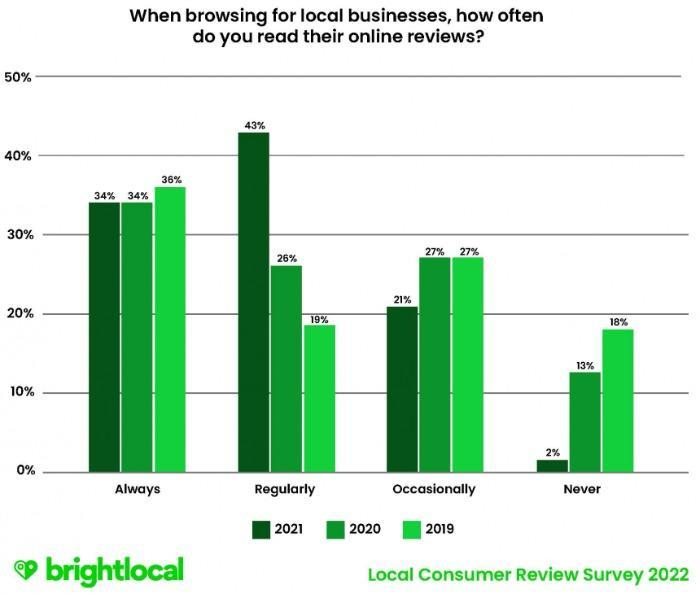
98 percent of people occasionally read reviews online. That’s an astonishing stat, right? Well, here’s another one: 77 percent of consumers always or regularly read reviews.

A bar graph showing how often people read online reviews when looking for local businesses.

If you’ve ever wondered whether reviews matter to your business, Brightlocal’s research should leave you in no doubt, especially considering the role Google plays.

Here are some more stats to get your head around.

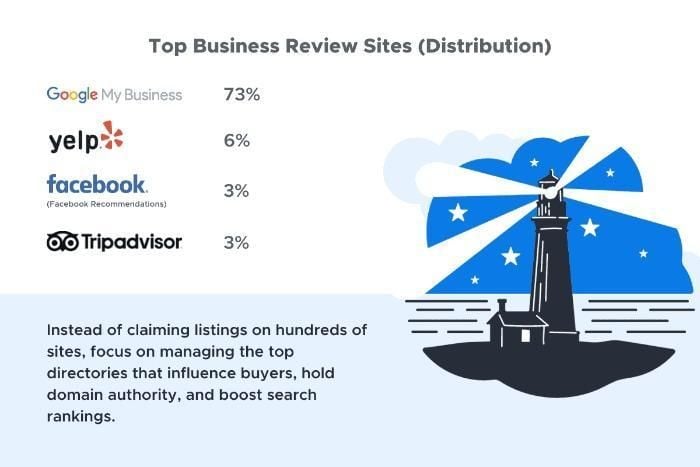
Analysis from Review Trackers estimates that 75 percent of new business is influenced by a handful of business review sites, and you don’t get any prizes for guessing which one dominates.

Yes, it’s Google with 73 percent, leaving others like Yelp! And Tripadvisor trailing far behind.

Top business review sites by distribution.

Now all of that tells me your Google business profile reviews will become even more important than they already are.

With a feature flagging what others are saying about you online when people look for a local business, positive feedback is imperative.

You’ll also want to dedicate more time to managing your profile, and combine this with resources like my guide to managing the SERPs to fully master how your business appears in Google.

Best Practices For Managing Google Business Profile Reviews

In the above section, I stressed how important Google reviews are to your business. Here, I focus on some best practices you can apply.

Respond To Your Reviews

This is review management 101.

I get it. Sometimes you don’t have the time or the energy. Other times, a buyer may have had a bad experience and left a negative review. However, whatever might be going on, you must take time to respond to reviews.

According to research from Uberall, larger global businesses respond to just nine percent of reviews.

However, this research shows that 86 percent of customers surveyed are more likely to buy from brands that do answer.

Want another reason to answer reviews? OK then. How does an increase in conversion rates grab you? Uberall also found that conversion rates (clicks on phone numbers, driving directions, and websites) increased measurably when companies answered.

When responding to reviews, always:

  • Thank your customer for their feedback, even if it’s negative.
  • Don’t use generic responses. Personalize your feedback to the reviewer’s specific points.
  • Reply quickly (more about that later)

Encourage Customers to Leave Reviews

Sometimes customers just need a nudge in the right direction. Make leaving reviews easy with follow-up emails and a link. Just go to your Google Business Profile, choose ‘customers’, then ‘reviews’, then ‘get more reviews’ to get your link. However, don’t be too pushy in getting customer feedback; they won’t appreciate it. Perhaps send an email or message out with orders inviting customers to leave feedback if they’re happy with their experience. Also, add a note encouraging buyers to contact you if they’re unhappy in any way.

Verify Your Business Profile

Without verification, your business won’t appear in online maps, and you can’t answer reviews. If you haven’t done so already, here are some directions to claim your business profile.

Use Google’s Tools

You don’t have to launch your review campaign from scratch. Google’s Business Profile Marketing Kit, gives you free stickers, posters, and social media posts for sharing customer reviews.

Report Fraudulent Reviews

If you suspect fraudulent reviews, report them to Google. You can do this by going to your business profile, clicking on reviews, and selecting the one you want to report. Then, select the ‘more’ option and choose ‘report review.’ Finally, choose the violation you’re reporting.

Signs that a review could be fake/fraudulent include:

  • Limited information or inconsistent statements
  • Generic names, no names, and no images
  • Repetitive statements or generic comments
  • A user leaving numerous reviews

You can also check your database to see if the reviewer is a customer of yours.

Respond To Reviews Quickly

The quicker you respond to reviews, the better. Customers almost always appreciate a speedy response, especially if it’s to their negative feedback.

According to Review Tracker’s research, 53 percent of customers expect a response to negative reviews within a week, while 1 in 3 expects a response within three days or less.

Check your Google My Business account regularly to see what people write, then answer and thank them.

If the review isn’t so positive, don’t worry, there’s plenty you can do.

What To Do About Bad Reviews On Google

Dealing with negative reviews is something every business owner has to face at some point. However, as Google states, responding helps with trust-building, and there’s a simple reason why: it shows there’s a person behind the brand that cares what people think, and it humanizes your business.

Responding politely to negative feedback and offering possible solutions to solve the problem also demonstrates professionalism and that you’re keen to put things right.

Additionally, if you feel the review is unfair, replying gives you the chance to give your side of the story, and if the feedback is justified, responding positively and taking it onboard shows your business is willing to learn and improve.

Google has this advice for replying to negative reviews:

  • Don’t take reviews personally. I know it’s hard, especially when you’ve put your heart and soul into your business. However, remember that most reviews aren’t personal attacks: it’s just business.
  • Ensure you understand the customer’s experience before you answer. If a customer had a problem with your service or product, they’re entitled to share that experience online. Use negative feedback as an opportunity to investigate what happened, own the mistakes you’ve made (if any) and detail the actions you’ve put in place to stop similar problems from happening again.
  • Apologize if appropriate. A simple, genuine ‘sorry’ can go a long way to winning a customer over. However, don’t apologize for things you can’t control.
  • Talk it out. Sometimes people are just venting. We all get angry and frustrated, and sometimes we overreact. Put yourself in your customer’s shoes, understand that they might not be angry at you, just the situation, and offer to talk with them via email, phone, or even face-to-face.
  • These days, shopping is often an impersonal experience. Use your name in emails and phone calls, so your reviewer knows they’re speaking to a real person that cares about putting things right.

Finally, whatever customers say about you, here are some templates to help craft answers.

FAQs

What is Find Places Through Reviews?

It’s a new feature that Google is testing to enable searchers to find a local business through online reviews. 

How Can I Optimize My Reviews?

To get the most from your reviews, encourage customers to leave them, send them a link to make it easier, include relevant keywords in responses, and add the reviews to your website.

Can I Remove Bad Reviews to Show up in Find Places Through Reviews?

If a review is fraudulent, Google has a removal request option where you can report a potential violation.

Conclusion

It seems Google is testing a ‘find places through reviews’ feature. A few SEOs have shared Tweets about it, and the feature appears to be a great addition to local search.

There’s limited information, so it’s hard to tell what this addition would mean for businesses and the impact it would have on them.

However, it’s clear it would put even greater importance on achieving positive reviews, and there’s plenty you can do to prepare.

Ensuring you answer reviews, responding proactively to negative feedback, and using Google’s tool to encourage customers to leave a review are just some of the things you can do.

What would find places through reviews mean for your business?


from Neil Patel's Digital Marketing Blog https://ift.tt/CLbslBX

Tuesday, 4 October 2022

How to Make Your Blog Part of Your Search-Driven Sales Funnel

The majority of business sites have blogs that are updated on a semi-regular basis. But very few of those blogs have a well-defined buying journey a reader could take should they land on a blog post with a buying intent.

In most cases, blogs have very little planning behind them. Businesses have blogs because they have heard they should regularly updated content being published on their sites.

But what should content be?

What could make a blog part of a sales funnel?

Jim Boykin, CEO of Internet Marketing Ninjas, and Ann Smarty, IMN’s analyst, are discussing an effective blogging and content creation strategy that would help commercial landing pages rank and that would take those readers down the sales funnel.


If you have had a blog for a while, start by analyzing search queries that are generating organic search clicks. You can use Google’s Search Console or your rank monitoring

Many of those search queries could have a commercial search intent, or at least semi-transactional intent, i.e. those searchers may well be interested in buying a product that solves the problem they are researching.

Once you identify those queries and your blog posts that are ranking for those:

  • Update those blog posts to bring it back on top of your blog archives
  • Add some calls to action: Make it obvious that there’s a product to be purchased that solves this problem or answers this question
  • Link those blog posts to complimentary commercial landing pages that list relevant products

It is also a good idea to link to those blog posts from those commercial landing pages as well, create a circle of list that caters to one need. This will create a flow of link equity and prevent those blog posts from being lost in the blog archive.

Additionally, consider turning those blog posts into an ever-green content (a how-to, tutorial, etc.) that will never go old or get buried in the archives and will always remain closer to the top of the site architecture.

This should be an on-going effort as your blog grows and starts generating long-tail search traffic.

The nature of any blog is that older content gets buried in the archive, so those opportunities are slower vanishing as the rankings are declining. To prevent that from happening, keep a close eye on your (and possibly your competitors’) blog rankings.

If you need help identifying important SEO opportunities your site is missing, contact ninjas. We are happy to help!

The post How to Make Your Blog Part of Your Search-Driven Sales Funnel appeared first on Internet Marketing Ninjas Blog.


from Internet Marketing Ninjas Blog https://ift.tt/yI8i3uM
via IFTTT

TikTok Shopping: What You Need To Know

TikTok Shopping: What You Need To Know

Not that long ago, it was all about Facebook, Instagram, and Twitter, but now everyone is talking about TikTok.

It seems like every top brand is on there, and even smaller businesses like Elf Cosmetics and start-ups like Vessi are taking the platform by storm.

The social media site is so wildly popular that TikTok total user spending on Google Play and the App Store exceeded $824 million in Q4 2021. With eager buyers already lined up, It shouldn’t be a surprise that TikTok has got on board the social commerce train.

Recently, the social media site announced a new feature called TikTok Shopping; the potential is obvious, given its vast audience of over one billion users.

However, is TikTok Shopping for you, and how does it work? That’s exactly what I’ll talk about here.

What Is TikTok Shopping and How Does It Work?

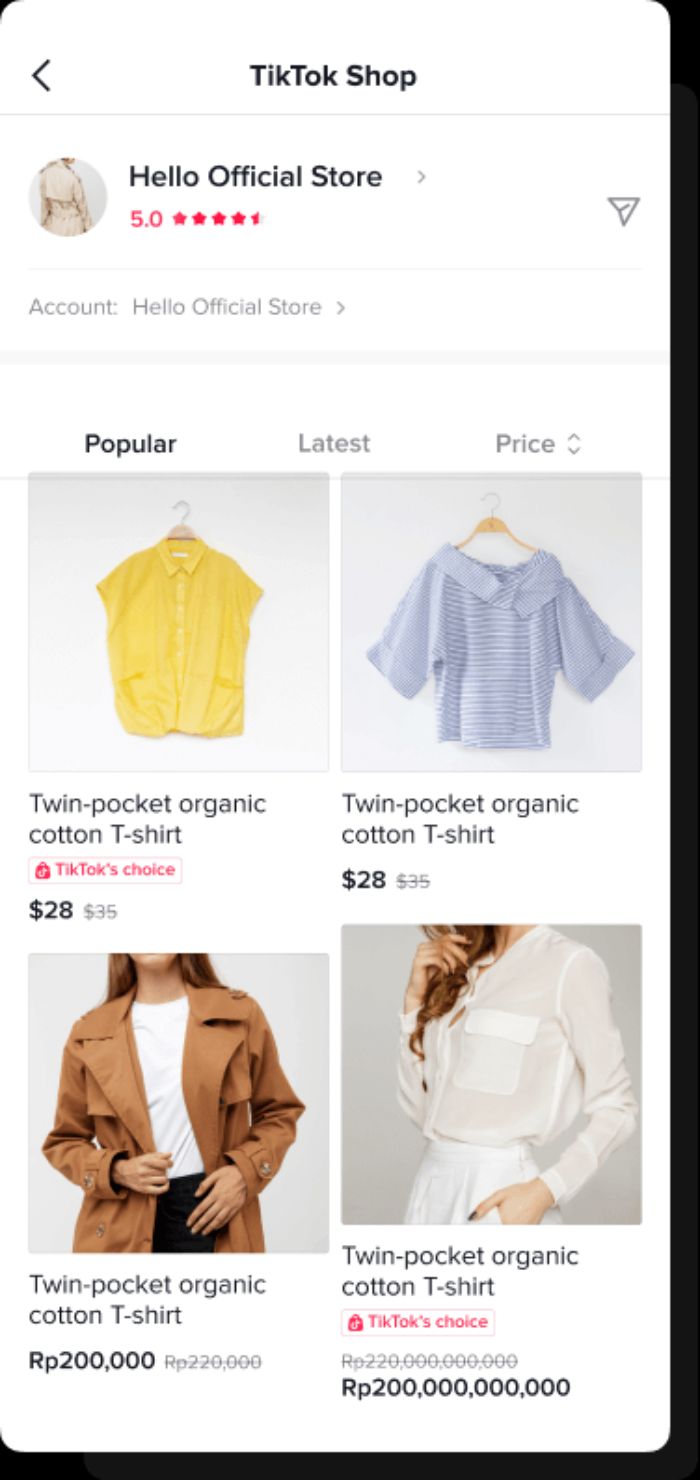
The Hello Official Store Tik Tok Shop.

If you’ve ever been on TikTok and wanted an easy way to buy a product you’ve seen, TikTok Shopping lets you do just that.

In its launch statement, TikTok explained:

“TikTok Shopping is a suite of solutions, features, and advertising tools that give businesses the opportunity to capture the full power of TikTok’s influence on purchase decisions.”

The social media site explains that TikTok Shopping allows merchants to ‘enjoy a full-service commerce solution’ with TikTok managing the retail side, from product upload and purchase to shipping and fulfillment.

Sellers have two options. TikTok’s Shopping Direct Integration creates an e-commerce experience for creators/merchants that want to run their e-commerce stores directly from the TikTok platform. This option provides a full e-commerce experience with everything, including post-payment processes, occurring inside the TikTok app.

Then, there is Partner Integration, where sellers can add product catalogs via a TikTok Business account and buyers can browse and purchase inside the TikTok app. However, post-payment processes like returns occur outside of TikTok on the partner’s app or website.

As a buyer, you find TikTok shops as a tab on a seller’s account. You place your items in the shopping bag, just like regular e-commerce sites. Once you click on it, it takes you to the product catalog.

From there, you browse the store as you normally would and add items to your basket. When you’ve finished shopping, you can check out in the app or go to the company’s website.

To make TikTok shopping possible, the social media site is teaming up with well-known shopping brands, including:

  • Shopify
  • Ecwid
  • Square
  • Prestashop

Additionally, TikTok says the likes of Wix, OpenCart, BASE, and ShopLine are coming on board soon.

Who Can Use TikTok Shopping?

Currently, TikTok shopping is open to business account holders in the following countries:

  • United Kingdom
  • Malaysia
  • Vietnam
  • Thailand
  • Indonesia
  • Philippines
  • Singapore.

If you have a Shopify, Square, Wix, or other TikTok shopping partner account, you should be able to set up a store.

Should Your Business Use TikTok Shopping?

Before you decide if selling on TikTok is for you, it makes sense to look at your overall strategy and your customer base.

First, you must ensure that your target audience is active on the platform. If they’re not, then you’re not going to get much traction selling your products on TikTok.

According to Statista, 24 percent of TikTok’s audience are women aged between 18-24, and men in the same age group account for 18 percent of its audience. Further, women aged between 25-34 make up 17 percent of TikTok’s demographic, while men in the same age bracket account for 14 percent.

Then, it makes sense to look at the most popular categories on TikTok. Fitness and sports, recipes and cooking, fashion, home renovation, and beauty and skincare are among the top categories on the site. You could be a good fit if you have a business in any of those niches.

Next, you need to have an engaging and creative sales strategy. Since TikTok is all about short videos, can you capture the audience’s imagination in minutes while saying what you want to say? You can? Great. Now you just need to ask yourself one more thing.

Is TikTok Shopping worth your while? Or could you be putting your time and energy someplace else? Often, you won’t answer this question until you give it a try. It never hurts to have additional sales channels, and if social media shopping fits with your business strategy, then it might be for you.

How Does Shopping Fit Into Existing TikTok Campaigns?

TikTok Shopping is ideal for use alongside its other advertising solutions. Here’s a look at some of TikTok’s offerings:

In-feed TikTok Shopping Ads for Online Shopping

TikTok provides three in-feed shopping ads, including Collection Ads, Dynamic Showcase Ads, and Lead Generation. Collection ads let brands add custom, swipeable product cards in their in-feed videos to promote products.

Dynamic Showcase Ads lets you advertise thousands of your product SKUs with personalized video ads, and Lead Generation appears inside in-feed video ads, letting your business collect TikTok users’ details with online forms.

TikTok Live Shopping

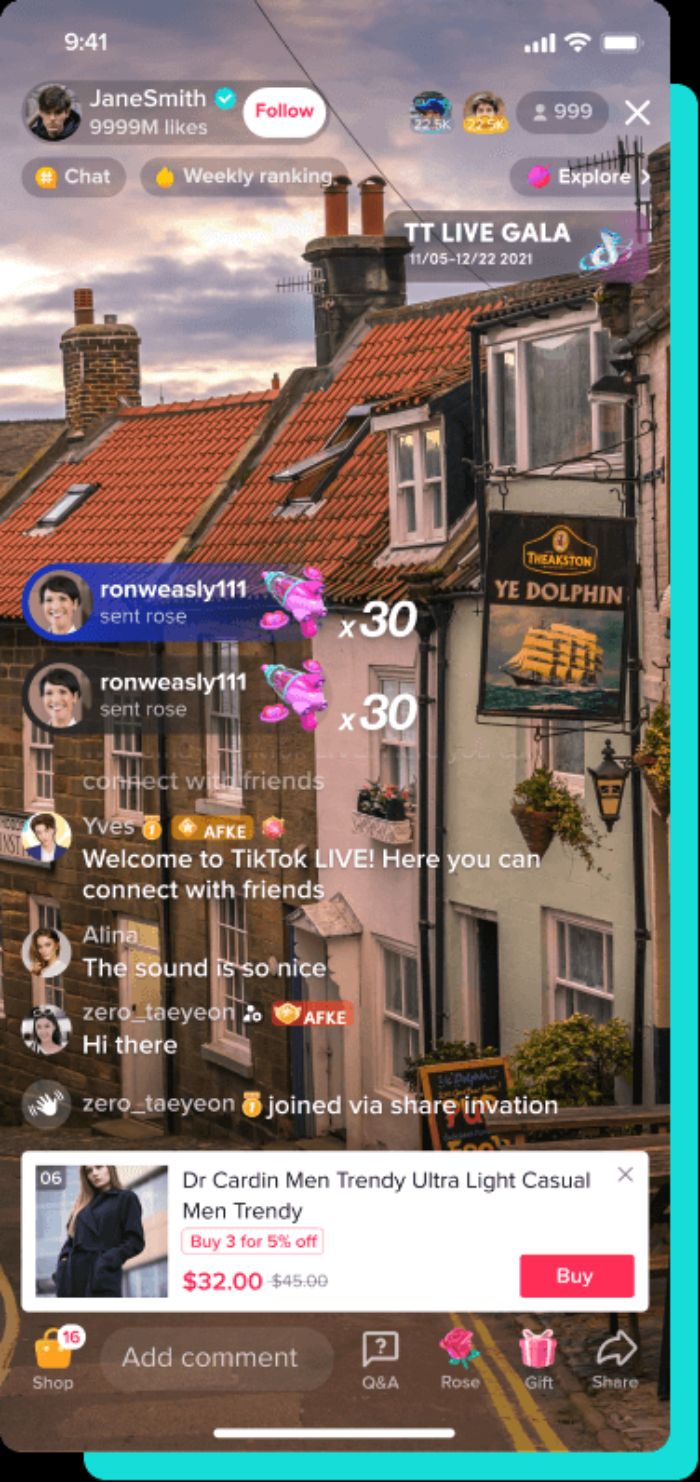
Tiktok live with shopping ads.

(Image: TikTok)

Engage viewers, build relationships, and increase conversions with TikTok LIVE Shopping. With this advertising solution, brands can integrate their products from TikTik Shopping into a LIVE session.

For you as a brand, that means real-time connections with your audience. TikTok users can then buy products they see during a LIVE Shopping stream.

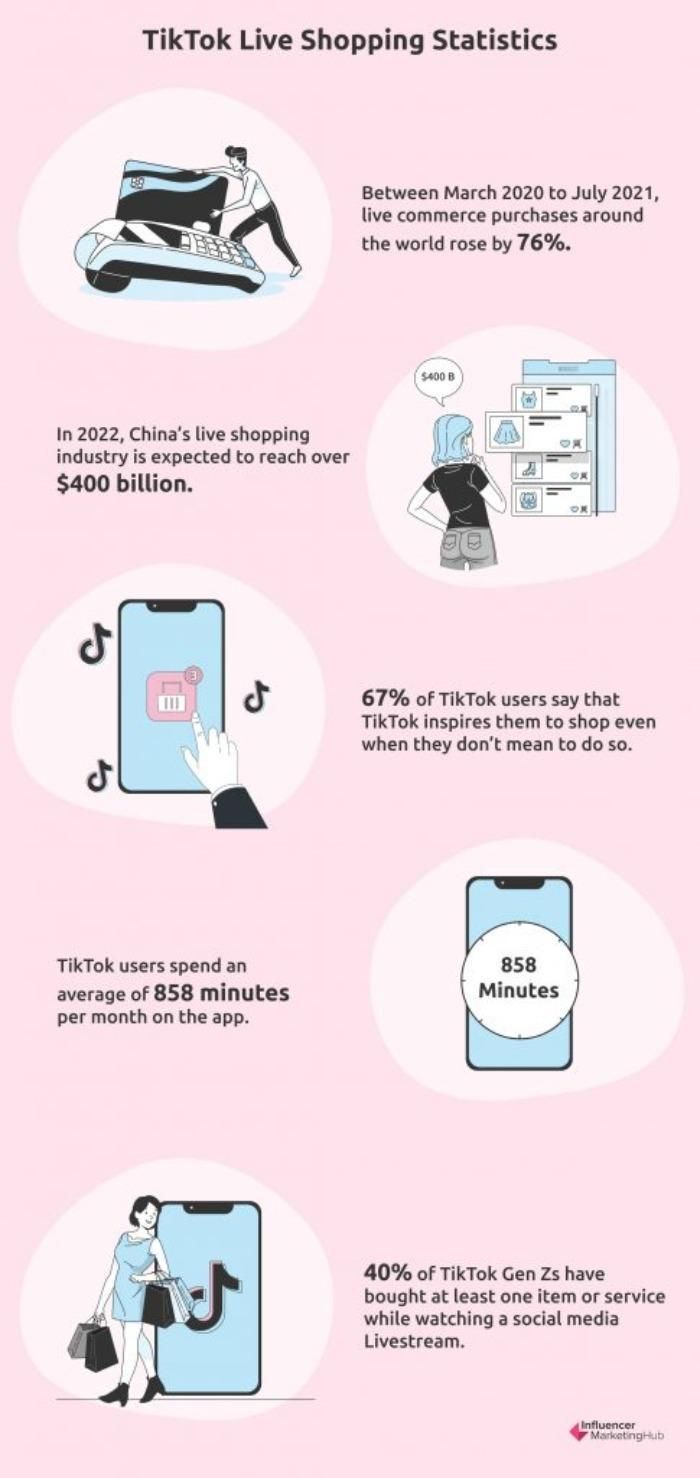
TikTok LIVE Shopping is on the up, with LIVE Shopping purchases increasing 76 percent between March 2020 to July 2021, and it’s available to business sellers.

Graphic showing Tiktok live shopping statistics.

How To Set Yourself Up on TikTok Shopping

Before you can start selling on TikTok Shopping, you need to register. Here’s how to do it:

  • Either log in or sign up.
  • Verify your phone number (only available for the UK) or email address and documents
  • Choose a shop name. It must not include special characters, and TikTok says not to use ‘flagship’ or ‘official’ in your shop name.
  • Upload your passport or driver’s license.
  • If TikTok approves your site, you’ll get an email confirming your registration, or if there’s an issue with any of your documents, TikTok asks you to resubmit them.
  • Then the review process begins and takes up to three days.
  • Link a bank account and add your bank details.
  • You’re registered!

Setting Your TikTok Shop Up for Success

With your TikTok Shopping account set up, it’s time to start getting the news out about your new sales outline. Follow these tips to get started.

Optimize Your Product Pages

Treat your product pages the same way you would any other e-commerce site. Ensure you use high-quality images, use keywords, and keep your branding consistent.

Make sure your descriptions are detailed, tell customers all they need to know, and keep titles within the 34-character limit.

Start Spreading The Word

One of the most important steps of any advertising campaign is getting the news out. That means telling friends and family, sharing the link on your other social media channels, and posting regular videos.

You could also consider teaming up with brand ambassadors and influencers for a wider impact.

Get Tagging Down To A Fine Art

Want to stand out? Then add tags. TikTok Shopping allows businesses to tag products in their videos, making it easy for viewers to learn more about and purchase the products they see. One way to find suitable tags is to see what’s trending. You can do this by going to the ‘Discovery’ tab to view the tags users regularly add.

Offer Discounts

Who doesn’t love a discount? Encourage people to come to your store by offering exclusive discounts or deals. Make discounts time-limited to create a sense of urgency and come up with unique deals shoppers can’t get anywhere else. For instance, if you’re selling cosmetics, create a bundle of branded products.

FAQs

What Is TikTok shopping?

TikTok shopping is an e-commerce platform that lets business sellers create a product catalog. It’s currently running a pilot scheme in several countries, including the United Kingdom.

How Will TikTok Shopping Impact My Business?

It’s difficult to say at this early stage. It depends on which category you’re selling in and whether your target audience is on the platform. However, it does provide a fresh outlet to sell from and a new way to reach consumers. 

How Do I Sell On TikTok?

Business sellers can register for an account, and then they have to wait 2-3 days for approval. Once you get an approval email, you can start selling on TikTok Shopping. 

Conclusion

TikTok has an audience of more than one billion users, and with the growing popularity of social shopping, it makes absolute sense that it would launch into e-commerce at some point.

Like any other platform, it won’t necessarily be right for your business. However, if your ideal customer is likely to use the platform, so consider having a presence there and see how it goes.

It’s easy to set up a store, and there’s only one real way to find out what TikTok Shopping can do for your business, and that’s to give it a go.

Will you be joining TikTok Shopping?


from Neil Patel's Digital Marketing Blog https://ift.tt/4dRvcpG

Monday, 3 October 2022

SEO vs PPC: Pros, Cons, & Everything In Between

“Which is better, SEO vs PPC?”

If there’s one question I get asked more than any other, this is it.

Everyone wants to know who wins in the battle and where they should spend their marketing dollars. And everyone hates when I tell them there isn’t an easy answer.

Like everything else, it depends.

Neither SEO nor PPC is fundamentally better than the other. As you’ll discover in this article, each tactic has its own set of advantages and disadvantages.

What is almost always true is that SEO and PPC work better together. Don’t believe me? I’ll prove it. In this article, I will:

  • Guide you through the positives and negatives of both digital marketing strategies
  • Show how each of them supports your business
  • Show you how PPC and SEO work together

Ready? Then let’s look at my favorite digital marketing strategy first.

How SEO Supports Your Business

If you need a search engine optimization primer, read my guide to SEO before going any further. If you don’t, you should already have a pretty solid understanding of how ranking on a search engine’s result pages can generate awesome traffic that grows your business.

Almost any business can benefit from the free traffic that search engines like Google send their way, but that’s not to say SEO should definitely be the be-all-end-all when it comes to marketing strategies. As you’ll read below, while there are plenty of benefits of SEO, there are also a couple of drawbacks to be aware of.

Pros of SEO

It’s cost-effective. SEO can be one of the cheapest forms of marketing and an incredibly cost-effective way of growing your brand. You don’t have to pay to receive organic traffic, and you can do much of the work yourself. But even using an SEO agency is much more cost-effective than PPC.

It delivers long-term results. If you do SEO correctly, your efforts can pay dividends for years to come. Not only will you avoid Google penalties, but SEO also has a habit of compounding. The top pages get more backlinks by virtue of being the top-ranked pages on Google. In turn, that makes them even more likely to continue ranking high in the future.

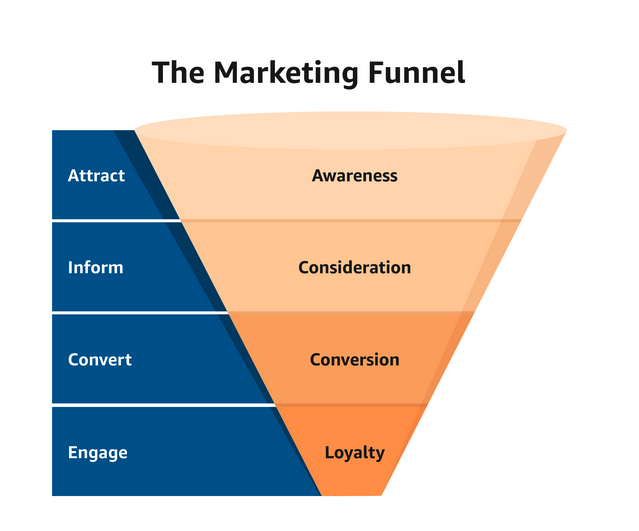
It targets every part of your funnel. Consumers are using Google at every stage of the buyer’s journey. That makes SEO one of the few digital marketing strategies to target every part of the sales funnel. Use SEO to engage customers early in their journey, and you should be able to significantly decrease acquisition costs.

A graphic showing the features of the marketing funnel.

Great brand awareness and trust. The more you appear on Google, the more consumers will trust your brand. And unlike PPC, you don’t have to spend a fortune to dominate the search results. With a focus on content marketing, you can become the go-to resource for your industry, appearing for every relevant keyword and positioning your brand as the trusted authority.

Cons of SEO

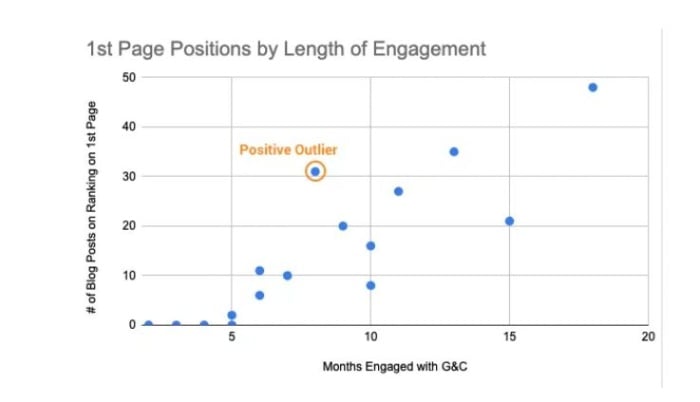
It takes time. Your SEO efforts aren’t going to drive instant results. It can take between six months and a year to see significant traction. As you can see from the graph below from content marketing agency Grow & Convert, there is a direct correlation between the length of engagement and the number of first-page rankings. Results can occur faster, but SEO may not be your best bet if you need to drive traffic now. That doesn’t mean you should avoid it, however. The sooner you start with SEO, the quicker you’ll see the kind of long-term results I described above.

A graph showing SEO 1st page positions by length of engagement.

You need to keep investing. While you can stop all SEO efforts and continue to see excellent results, I wouldn’t recommend it. In order to keep competing with the top brands, you’ll need to continue to publish new content, update existing articles and stay on top of the latest advice from Google.

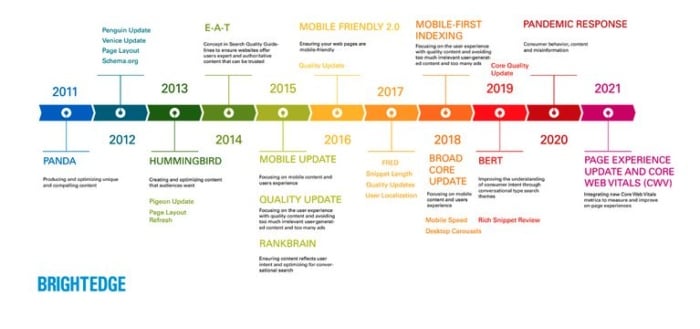
You must be precise. You can’t half-heartedly work on SEO. Because Google and other search engines are constantly updating their algorithms and penalizing sites that use black and gray hat optimization techniques, you need to do SEO the right way. Trying to cheat the system and get quick wins will only see you end up with a penalty. And once you get penalized by Google, it’s far from easy to recover.

A timeline of different SEO changes from Google.

It requires a high level of skill. While anyone can do the work of an SEO in theory, being successful is another thing entirely. Not only is there a lot to know because of the complex nature of Google’s algorithm, but the work can be incredibly time-consuming. So even if you follow my advice, you may not necessarily have the resources to create content, optimize your on-page elements and build links. That’s why most people will look to hire an SEO consultant or an SEO agency, instead of doing the work themselves.

How PPC Supports Your Businesses

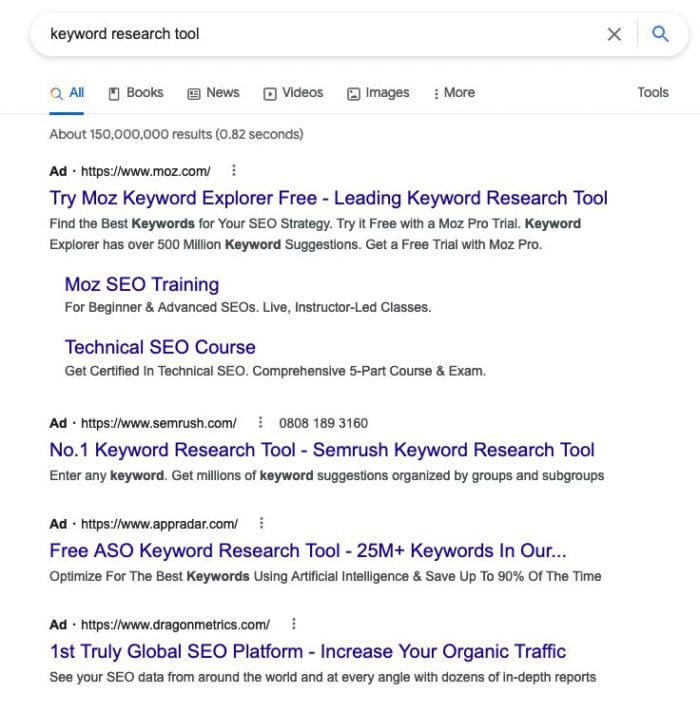
PPC stands for Pay Per Click Marketing. It is the practice of using paid advertising on search engines like Google and Bing to drive targeted traffic to your website. If you need more information on the basics of PPC, check out my overview of PPC before reading on.

Google search results for "keyword research tool"

As you can see from the screenshot above, PPC gives you the opportunity to appear at the very top of search engines. I’ll show you below just how powerful that can be. But don’t think that kind of placement comes for free. Among the biggest cons of PPC is the price you have to pay.

Let’s dig into those pros and cons further.

Pros of PPC

It delivers instant results. PPC is possibly the only digital marketing strategy where you can see results the same day you launch a campaign. The same certainly can’t be said for SEO. Of course, you’ll need to pay a lot to achieve fast results, and you’ll still need to create a great landing page, but it’s certainly possible to see a return on your investment within a week. You can scale results quickly, too. If your ads and landing pages convert, then acquiring more visitors is usually just a case of spending more money on ads.

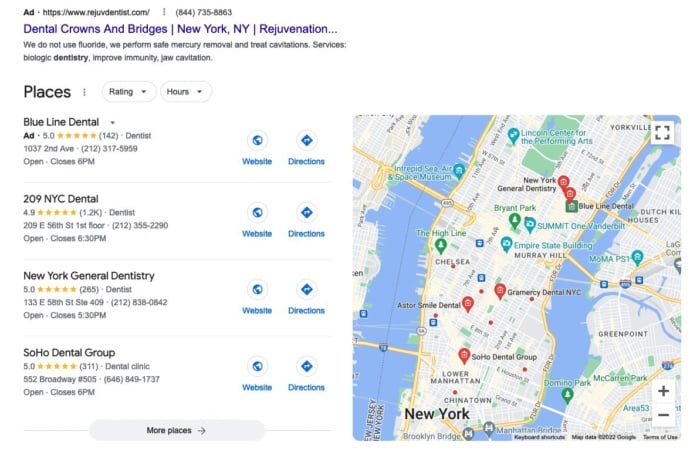
It offers exceptional visibility. PPC ads are the first thing users see on desktop and mobile searches. Better yet, Google now makes it far less obvious that the top results are paid ads. In some cases, there can be as many as four paid ad spots before the organic results, as well as shopping ads. PPC ads also let you highlight key business information like your phone number and site links in a way that SEO doesn’t.

Google map results for dentist offices.

You get high-intent clicks. Most of the users clicking on your PPC ads will be close to making a purchase. That’s because most PPC ads only target high-intent commercial keywords. As a result, conversation rates are much higher for PPC than SEO. It also means it’s much easier to track to what extent PPC ads drive revenue.

Great data. You will generate a serious amount of data when you run a PPC campaign. You’ll see which ads work, which keywords drive the most traffic, and which landing pages convert best. That makes it easy to optimize your campaigns to increase return on ad spend while decreasing costs. It will also give you data you can use to improve your SEO and other digital marketing campaigns.

Cons of PPC

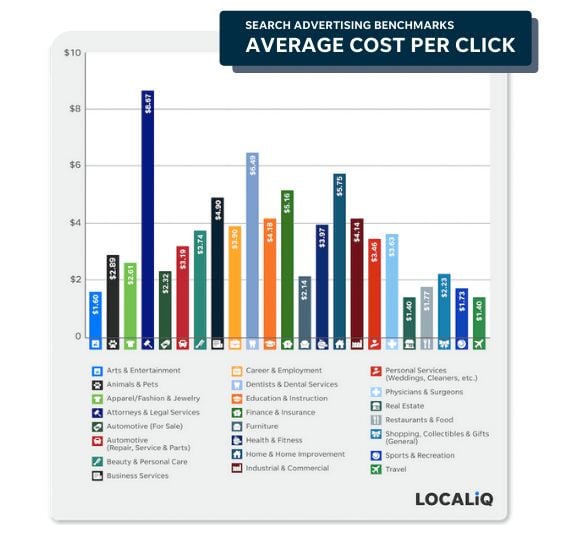
You have to pay to play. Unlike SEO, which can drive traffic for little to no money, you will need to have a pretty significant marketing budget to see results with PPC marketing. When we talk about industry-specific cost-per-click, it gets even higher, especially when talking about the legal and medical worlds. That’s fine as long as your ads are good, your landing pages convert, and you see a return on your ad spend. But that’s not always the case. Often, you can blow through hundreds or even thousands of dollars before achieving a positive ROI. As you can see, PPC cost per clicks can get pretty expensive.

A chart showing the average cost per click.

Constant investment is required. Not only do you need to pay to play, but you also need to keep spending money to drive results. Your traffic and sales stop the moment you turn ads off. That makes it all too easy to become reliant on PPC. It is essential to balance your efforts with SEO and other digital marketing strategies.

There’s a learning curve. While it may seem easy to create an ad and put together a budget, optimizing your PPC campaign takes a lot of skill and knowledge. For one, Google and Bing’s platforms can be tricky for beginner marketers to get their heads around. But you also need to understand how optimizing your bids works, what negative keywords to add, and how to best optimize your landing page. None of these things are simple without the help of a PPC agency.

PPC ads can get stale. You need to constantly refresh your ads to keep them engaging. Any form of paid advertising, PPC or otherwise, can suffer when users become ad-blind. That’s when users notice they are reading an ad and scroll past it without engaging. That means PPC campaigns require more than just an ongoing budget. You need to commit to testing out new ads and landing pages if you want to continue driving sales.

SEO and PPC: How They Work Together

In reality, you shouldn’t be choosing between SEO and PPC. You should do both. PPC is great for achieving quick wins and driving high-intent traffic. SEO is a long-term game, but it should be a much more effective strategy after a year or two. You can rank for dozens of keywords with a single article, unlike PPC, where you can only target one.

What’s more, SEO and PPC are even more effective when you combine them together. Just check out the three strategies below for proof.

Crowd the SERPs on Branded Searches

You always want to appear at the top of the SERPs for your branded terms, right? Unfortunately, this isn’t always possible without combining SEO and PPC. Because companies will often create paid ads for their competitors’ branded keywords, you need to be creating PPC ads for your brand terms, too.

In doing so, you’ll own the first page for your terms and significantly boost brand awareness.


Don’t worry; you won’t have to spend a fortune on these ads. Because your landing page will be highly relevant to the search term, the cost of your ad appearing in the first paid ad position will be significantly less than what it will cost your competitors.

Move Expensive PPC Keywords to SEO

Run a PPC campaign for long enough, and you’ll soon find one or more expensive PPC ads that get a reasonable amount of clicks but almost no conversions. These keywords are a colossal waste of money.

This usually happens when these keywords lack commercial intent or target users at the start of the buyer’s journey.

That doesn’t mean it’s a bad keyword, though. Instead of giving up on it completely, use SEO to target it with an article instead. In doing so, you can introduce your brand to consumers earlier in the buyer’s journey and get the chance to grab their email address with a lead magnet. And because the data shows users click on your ad, you know they will probably click on an organic search result with the same angle, too.

Match Organic Results With PPC Ads

One final way to integrate SEO and PPC is to match your PPC ads to the SEO results. When you start doing both SEO and PPC, you’ll notice that a lot of the time, PPC ads don’t align with organic results.

This is particularly common on non-transactional comparison queries that occur in the middle of the buyer’s journey. Customers aren’t looking to buy at this point. They are looking for the best solution.

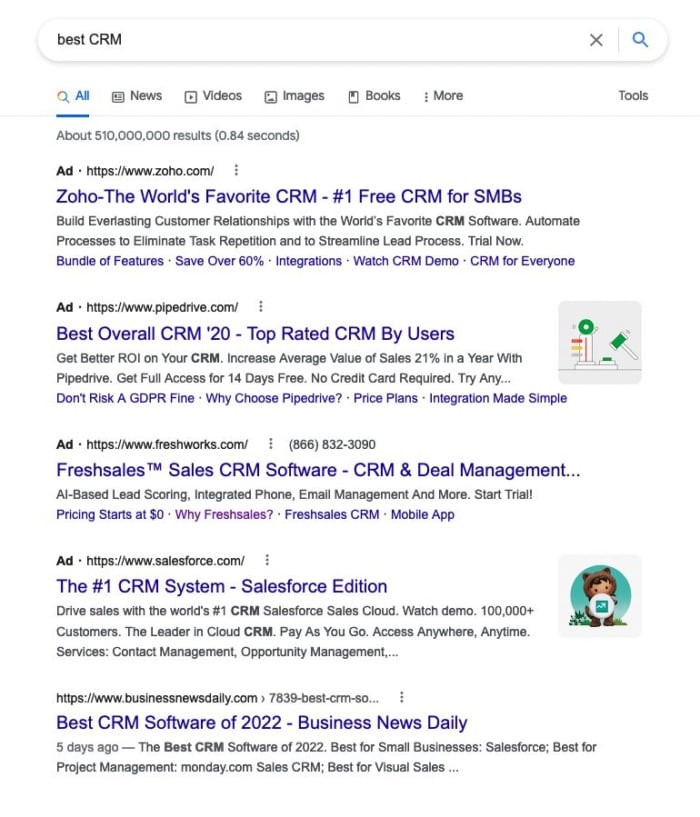
While the organic search results are filled with comparison posts, many PPC ads will only focus on one product. Search for “best CRM” and you’ll see a great example of this. The ads are all focused on single products, but the top organic result is a comparison post.

google search results for "best CRM"


Here’s how you can win big in these cases. Rather than match your PPC ads to existing ads, match your ad to the searcher’s intent.

Instead of creating an ad solely focused on your product, create an ad and landing page that compares the best products in your industry. In doing so, users will be much more likely to click on your ad.

SEO vs PPC Frequently Asked Questions

How is ranking different when comparing PPC vs SEO?

PPC ads appear at the top of search engines ahead of SEO results. Paid ads are ranked depending on relevance, budget, and landing page quality. SEO results are ranked on over 200 factors. 

How does PPC affect SEO?

You can use PPC ads to discover untapped and valuable keywords. PPC also supports your SEO efforts and helps you own the first page of results. 

Is PPC better than SEO?

Neither PPC nor SEO is better than the other. They each have their own advantages and disadvantages. That being said, they always work best when used together. 

What is one key difference between SEO and PPC?

The biggest difference between SEO and PPC is the cost. Traffic from SEO is free, while you need to pay to have a PPC ad appear in search engines. 

SEO vs PPC Conclusion

You can use both SEO and PPC to grow your business. SEO will take time, but it is an incredibly cost-effective strategy in the long run. PPC will give you the customers you need now, even if you have to pay for the results.

That’s why I always recommend marketers don’t choose between them. Do both, and make sure you are using both strategies together to drive even more conversions.

Get started with SEO and PPC today by diving into keyword research before creating your first PPC campaign and an SEO strategy.

Which marketing strategy are you most excited about? Do you prioritize one over the other?


from Neil Patel's Digital Marketing Blog https://ift.tt/fOmSdJj

How To Use Twitter Campaign Planner

How To Use Twitter Campaign Planner

You’ve probably all done it: launched an ad campaign only to find it didn’t quite hit the spot. Perhaps you didn’t quite reach the audience you wanted to, and the ads didn’t convert the way you hoped.

It’s a waste of time and money, isn’t it? So wouldn’t it be good if there was a simple tool that could help you forecast your ad campaigns before putting them out there?

Well, there is.

It’s called the Twitter Campaign Planner, and it could make all the difference to your success if you want to grow your business with Twitter.

How does the Twitter campaign planner work? Read on, because I will talk you through it and explain what it could do for your marketing plans.

What Is Twitter Campaign Planner?

Twitter’s campaign planner lets you forecast your advertising results before going live with your ads by using a set of estimation tools.

You can use Twitter’s campaign planner to estimate:

  • Forecast reach
  • Impressions
  • Average frequency
  • CPM

It also takes into consideration your:

  • Audience
  • Campaign duration
  • Frequency setting
  • Ad placement
  • Budget for auction-based campaigns

It’s not open to everyone, though.

Currently, Twitter is only offering it to managed partners (official companies that Twitter partners with), and it’s available only in the United States, United Kingdom, and Japan. However, it does have expansion plans.

With this said, although the campaign planner isn’t widely available yet, by finding out more about it now, you can understand other users’ experiences and the potential this could have for testing your own ads.

How Does Twitter’s Campaign Planner Work?

As I’ve mentioned, the new feature could be a game changer for advertisers who want to test campaigns before launching live.

As Jon Morgenstern, Senior Vice President and Head of Investment, VaynerMedia, who has trialed the planner, said:

‘With Campaign Planner, our teams are better able to forecast campaign performance outcomes prior to going live, helping ensure our Twitter activations are set up for measurable success out of the gate…’

Want to test it out for yourself?

To try it, you can find the Twitter campaign planner under your Twitter account.

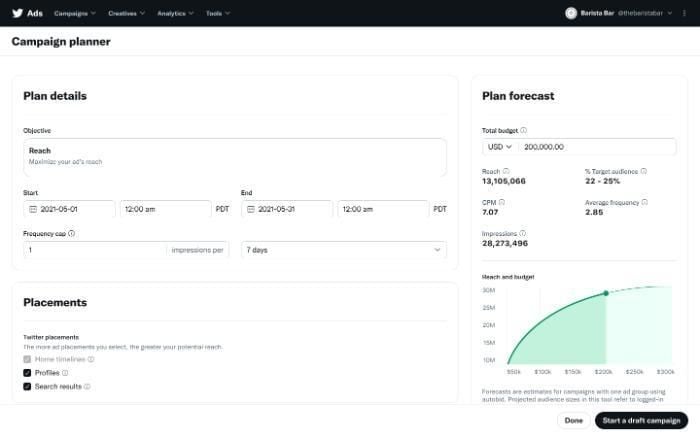
Twitter's Campaign Planner Tool.

Here, you enter the details of your campaign, such as:

  • Objective(optimizing your campaign’s reach)
  • Your start and finish dates
  • Frequency cap (How many impressions/days)
  • Placements (search results or Twitter profile)

You then get a forecast predicting:

  • Reach
  • Target audience
  • CPM (cost per mille, or cost per thousand impressions)
  • Average frequency
  • Impressions (how often advertisements get served on a page)

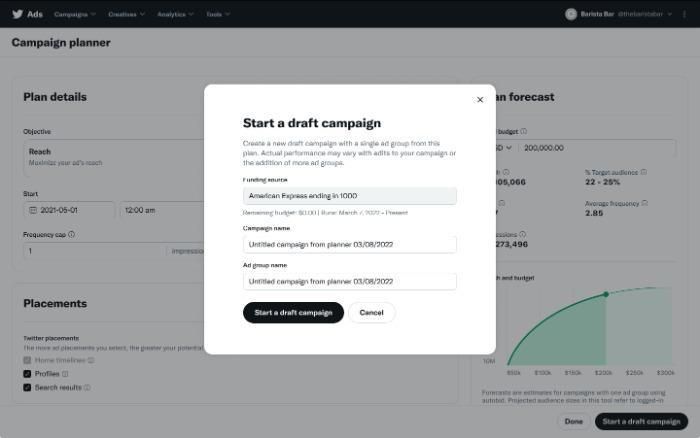
As pictured below, you can also set up a draft campaign.

Starting a Twitter Campaign draft.

Is Twitter Campaign Planner a Good Fit for Your Business?

It depends on several factors, including the stage of your business. However, you should also consider that the results are merely estimates, and you won’t necessarily see the predicted results.

That aside, here are a few scenarios that might make this new tool a good fit for you:

  • If you’re a new company with a limited budget, you may want to use the Twitter campaign planner before committing money to live ads.
  • An established business looking to break into a fresh niche. You could use Twitter’s campaign planner for a test run before launching any ads.
  • Perhaps you’re new to Twitter advertising and unsure where to place your ads or how to long run your campaign. You can test out advertising in your profile and search advertising to view your potential results and vary lengths to get an idea of the likely results; if you are new to all this, my guide to Twitter ads will get you off to a running start.
  • Do your ads reach your target audience? That’s something else you can establish with the new tool.

If it works, you keep spending on those areas. If it doesn’t, you would go back to the Twitter campaign planner and try a different strategy.

However, because this Twitter tool is still in the early stages of rollout and isn’t available to vast numbers of advertisers, it’s probably a good idea to watch and wait. See how others are using the tool, what it’s doing for their success rates, and learn from case studies.

As the campaign planner reaches a wider audience and is more accessible, then you can start to get a better idea of how it could work for you and ways to apply it.

How To Set Up Twitter Campaign Planner

Are you ready to get started with Twitter’s campaign planner? It’s simple. All you’ve got to do is follow these step-by-step instructions.

Go to the campaigns drop-down menu in the left-hand corner and find the ‘Campaign planner’ option.

  1. Fill out your Plan Details, including your aims, budget, beginning and end dates, and a frequency cap (how often people can see your ads).
  2. Next, go to placements to choose where you want your ads to appear. Twitter sets ‘Home Timelines’ as a default, so you can’t move it. You can also choose to include your ads in profiles and search results.
  3. Now, select your demographics. Which group(s) of people are you trying to reach? You can choose from demographics like age, language, gender, and location. However, the Twitter campaign planner ‘only supports country-level targeting in the United States, United Kingdom, and Japan,’ and language targeting is optional.
  4. Next, it’s time to choose your devices. This step is optional, and you can select from the operating system, carrier, and device model.
  5. Customizing your audience is another optional step. Custom audiences allow you to focus on existing followers to develop re-marketing campaigns. You can target people by website or app activity, app activity combination audiences, and lists.
  6. Targeting features (optional) Here, you can target by keywords, interests, look-alikes, etc.
  7. With all your information completed, select the ‘Start a draft campaign’ button and choose a funding source. You also need to give your new campaign and ad group a name. With that done, click on ‘Start a draft campaign’ to save everything and to copy your settings over.

When you look at the plan forecast, you can:

  • Make adjustments to your budget.
  • Select another currency.
  • Adjust the reach and budget curve. This is done by hovering along the pictured curve to see your estimated impressions and the potential reach that is possible if you change your budget. If you click on the curve, it moves the selected point to that budget level.
Twitter's Campaign Planner budget tool.

Integrating Planner Into Your Twitter Campaigns

Perhaps you’re an e-commerce company specializing in bridal flowers and want an efficient way to run campaigns. Trialing ads with Twitter’s campaign planner could be just what you’re looking for.

Here are some potential ways you could use it.

  • The first thing you could view is whether advertising on Twitter would increase your reach and impressions. From there, you could determine if launching a live ad may be the way forward.
  • Then you could test location or maybe interests and keywords to analyze whether this could get your ads in front of your ideal audience.
  • Frequency and reach are other elements you could try to see how this might increase brand awareness or campaign lengths to see if you could build further awareness of your business.

However, as I stressed in the last section, you don’t need to start making decisions about using the campaign planner yet. Learn all you can from others’ success, and when the tool becomes available to you, use their experiences as a guide.

FAQs

What Is The Twitter Campaign Planner?

The Twitter campaign planner allows you to test your advertising campaigns before launching them live. It forecasts the likely results, and you can test core areas, including impressions and reach. Twitter released the tool in late 2021 to a limited audience and it plans a wider release at some point.

How Do I Edit My Campaign?

You can edit the campaign while it’s in draft.

What Are the Minimum Budget Requirements For Twitter Campaign Planner?

The Twitter Campaign Planner has a minimum budget of $1,000 or the equivalent in the marketer’s chosen currency.

What Is the Minimum Campaign Length For Twitter Campaign Planner?

The minimum length is three days.

Conclusion

Even if marketers have an ample budget, they don’t want to waste their time or money on ineffective ads that don’t grow their business.

However, unless you’re familiar with Twitter ads and how to run them, there’s always a chance your ads will fall flat.

The Twitter campaign planner hopes to change all that by giving advertisers a prediction of the possible results.

With a better idea of what to expect, marketers can launch their ads confidently or tweak them and try again.

Although the Twitter campaign planner isn’t open to everyone at the moment, you’ve got plenty of opportunities to learn from others and how it works for them.

Would you use the Twitter campaign planner?


from Neil Patel's Digital Marketing Blog https://ift.tt/QnZyiBE

Saturday, 1 October 2022

5 Rules for Your Sub-Brand Keyword Strategy

If you’ve tried Coca-Cola, you’ve probably had a Diet Coke.

If you use Google as your preferred search engine, chances are you have a Gmail account.

What’s the link between the two? Both are high-profile companies with high-profile sub-brands.

Think of a sub-brand as a room in a house and the house as your brand. Successful sub-branding means targeting the right audience with the right product.

If sub-brands are part of your company’s brand architecture, a well-defined sub-brand SEO strategy helps keep the lines clear.

Brands like Coca-Cola and Google do this well, making it clear how their sub-brands are related to but different from the parent brand. From an SEO perspective, this makes for an ideal keyword strategy.

I want to help you do the same with your brand architecture.

These five rules will help keep your sub-brand SEO keyword strategy true to your brand image while allowing your sub-brands to uniquely stand out.

Why Do Businesses Create Sub-Brands?

To sub-brand or not to sub-brand?

That is the question.

As you build your business’ brand, it’s tempting—and often strategic—to widen your footprint over time.

Companies across all industries have portfolios with multiple brands. Sometimes they develop these brands themselves. Sometimes they acquire them.

There are a lot of good reasons to create a sub-brand. Here are a few:

To Target Specific Audiences

In some cases, a business might want to distinguish between its flagship brand and sub-brands that target more specific audiences.

Take the car brand Toyota and its luxury sub-brand Lexus, for example. The brands operate independently under the Toyota umbrella, but they market to different target audiences. Having separate brands allows them to connect with each on a deeper level.

To Tap Into New Markets

Sub-brands are an opportunity to reach new audiences. Appealing to a new niche allows the parent brand to:

  1. Build a stronger bond with their current customer base
  2. Attract new customers
  3. Expand into a new, profitable revenue stream

Another approach might be for product expansion. Companies can use sub-brands to test a product on the market under a different brand name.

Who can say where they might end up?

To Uniquely Market Different Products

Whatever the motivations, sub-brands should stay true to the parent brand’s mission as they develop.

Each product has its own personality, feel, and set of features even though they are all separate items under the same umbrella company. This also means each sub-brand needs a separate budget for marketing and promotion.

So, of course, your sub-brand SEO keyword strategy needs to be sharp to support it.

Influencing search engines will take time, but it pays off when the conversions your strategy drives show up in audience and revenue.

#1: Think About the Audiences for Your Main and Sub-Brands

Look at the demand of your audience and prospective audience. How are you going to meet their needs with a sub-brand?

To answer this question, you must determine their search intent. Use keyword research to formulate this strategy.

Your content needs to provide them with the information they need. From your branding to your content, you want to spark a unique relationship with your target audience.

As I’ve said in the past, brand-loyal people want to find a brand to be loyal to.

The company’s business goals should serve as the cornerstone of the choice to expand. How you go about your sub-brand SEO strategies is unique to your desired outcome.

For example, I bet you didn’t know Converse was a sub-brand of Nike.

Well, if you’re on Converse’s marketing team, using “running shoe” as the sub-brand’s SEO keyword would be “off brand.” A more fitting keyword for the strategy would be “high top sneakers.”

So, while Converse is a sub-brand of Nike, their keyword strategy sets them apart from the parent company to see self-sustaining conversions.

You’ll notice when the right combination of keywords serves the company and sub-brand’s goals.

How will you know you hit that sweet spot?

Your audience will tell you.

Insights from your content performance metrics and ROI will reveal a wealth of resources. Then, you can sustain those wins by following that same strategy, adjusting as needed.

#2: Keep an Eye on Your Competition

You’ll need to keep an eye out for the competition as you expand. A strong sense of your audience and competitors will help differentiate your sub-brand.

Say you want to step into a market and challenge the industry norms.

Think of some of your favorite parent companies. Now, think of some of their spin-off ideas that have been successful.

Who did you think of?

I thought of Apple.

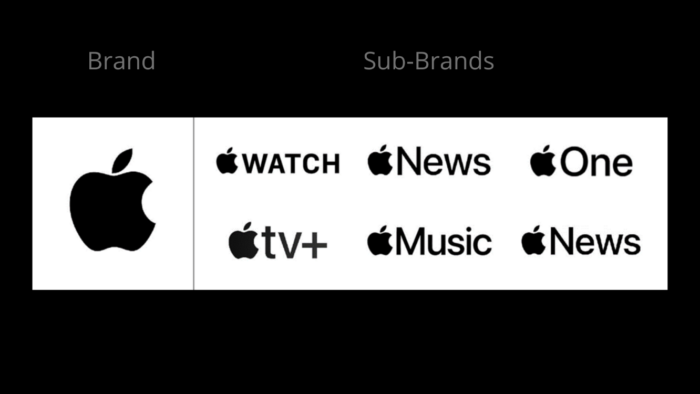
Apple's parent brand and some of its sub-brand companies.

For instance, Apple offers a variety of tech products. These products bear the Apple logo and support the parent company.

Apple is not a product in and of itself, but each sub-brand leverages Apple’s brand value and appeals to various market niches.

When Apple first started, they wanted to be perceived as the alternative to the mainstream. Sub-brands help carry out this plan. Think about how users proudly declare their loyalty to Apple products: “No PCs for me; I am a Mac guy.” “I don’t have an MP3 player; I have an iPod.” “It’s not a Blackberry; it’s an iPhone.”

Sub-brands allow Apple to stand out from the competition in completely different markets. Google’s algorithm favors domain diversity, meaning that you’re not likely to see a ton of pages from the same domain in a given SERP. This means that when talking sub-brands, you want to use as many domains as possible.

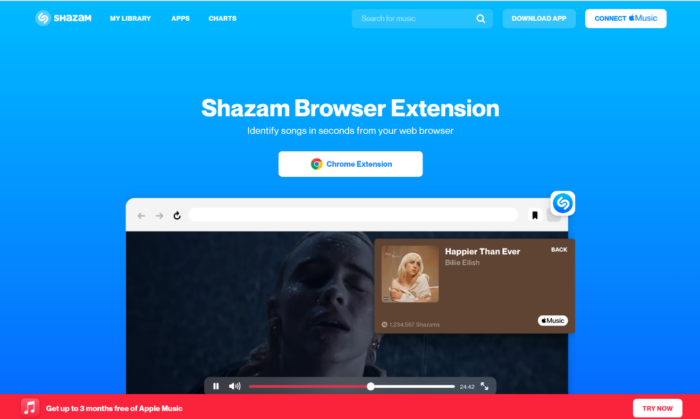
The homepage of Shazam, a sub-brand under the Apple the brand.

While the previous examples leveraged Apple’s brand equity, the company has also had success with sub-brands that stand alone.

A multi-domain SEO strategy, not to be confused with subdomain, helps them market Shazam as a sub-brand under the Apple brand. While branded as an individual product, Shazam is set up as a separate domain that drives traffic back to Apple’s domain. It feeds in users through Apple Music.

While it’s not a go-to SEO technique like keyword optimization, a multiple-domain SEO strategy is an out-of-the-box play that doubles your chance to rank for multiple domains.

With sub-brand SEO, you can implement a multiple-domain strategy without devaluing the brand by strengthening its approach to their audience and against competitors.

#3: Avoid Keyword Cannibalization at All Costs

Before you make your way down sub-brand SEO street, don’t take a wrong turn with your content due to keyword cannibalization.

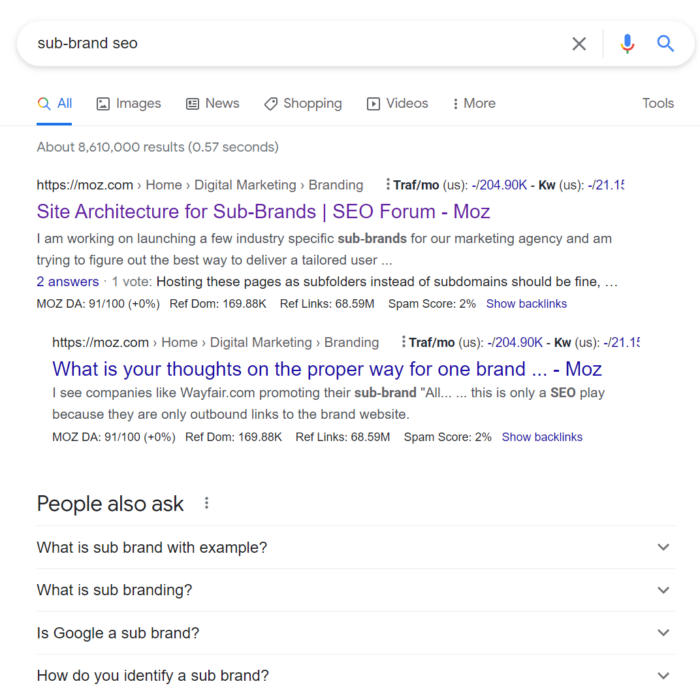
If more than one of your pages pop up for the same search query, you’re competing against yourself. Because they target the same keywords, your pages eat into each other’s performance (hint: why we call it cannibalization).

Be mindful of keyword cannibalization when developing a sub brand SEO strategy.

Keyword cannibalization problems don’t come with a “one-size-fits-all” solution. There are unique approaches to address different cannibalization issues.

Those approaches include:

  • Merging Page Topics: Try to merge pages with similar topics that are getting in the way of how the page is competing among others.
  • Page Re-optimization: Taking another stab at the topic by re-optimizing pages helps set clear intentions for the page.
  • Redirect lesser-performing content: Once you determine which of the cannibalizing pages is the strongest, remove other pages and broken links you no longer need. From here, you can perform regular content audits. You’ll want to make your topics come first and have your keywords work for them.

Fix cannibalization issues and you’ll pull in your audience, further establishing brand authority in your industry.

#4 Be Realistic About Keyword Difficulty

Estimating keyword difficulty reveals how hard it will be to rank first on Google. As you brainstorm the “keyword bank” you want to use for your sub-brand, remember it needs to be realistic and profitable.

The difficulty of a keyword is determined by variables like domain authority, page authority, and content quality. So, use these points to guide you toward the ones that fit your sub-brand best.

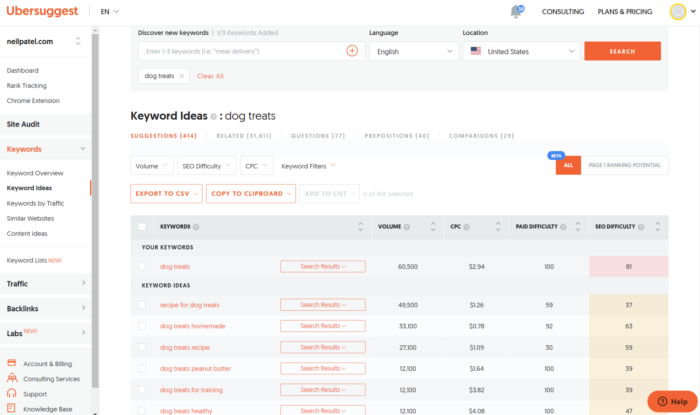
Say your sub-brand is a dog treat expansion from your main dog food line:

Use the SEO tool Ubersuggest to find strategic keywords for sub brands.

An SEO tool like Ubersuggest tells you which keywords are most difficult to rank for. An easy keyword difficulty score lands between 0 and 29. From the list above, you can see they all rank over 30, meaning the competition is tough. This report also gives you a sense of the keywords your competition is targeting.

Another helpful highlight is user search intent. Before stepping into a particular market, this helps see how your potential audience might benefit from using your sub-brand as their solution.

Sub-brand SEO optimization is like a marathon and may not reach its full potential overnight.

However, targeting a term with a high keyword difficulty like “dog treats” is still worthwhile. If the ROI is good enough and the potential conversion rate is acceptable, go for it!

Even if a keyword has a low difficulty rating, is it really worth targeting if the ROI shows that there is little chance of making money from it and that it is not frequently searched for?

#5: Think About Brand Architecture at All Times

You are placing your company in danger if you don’t keep a sub-brand in step with its parent company. You’re not taking full advantage of the parent brand’s equity if you implement a sub-brand’s strategy in isolation.

This could potentially hurt the parent brand’s credibility. We saw this when Old Navy overtook the Gap as a sub-brand by strategizing in isolation.

A crucial component of the brand architecture “home” is the strategy it takes to build out a room (a sub-brand). Remember the house example I explained to you earlier? With a sub-brand, you have to think about the layout and how it fits within the parent company, or “home.”

Examine the brand strategy of your parent company while keeping in mind the prospect of future sub-brands. How can you expand to offer more solutions to your audience? What new markets do you want to conquer?

FAQs

What is a sub-brand?

A sub-brand is formed when a brand extends to one or more new individual product categories. Based on the outcomes of this expansion, sub-brands can be an effective marketing tool.

A sub-brand uses a unique name to develop its own brand, though that name sometimes complements or plays off the name of the parent brand. A sub-brand also has its own client expectations and personalities distinct from the parent company.

What does a sub-brand mean?

A sub-brand is created when a primary brand expands. Take Diet Coke for instance. It has a unique color code, yet it incorporates the iconic Coca-Cola logo with the recognizable bottle shape.

Sub-brands are frequently developed as a way to connect with untapped markets. Sub-brands can then establish themselves in the new market on behalf of the parent company.

Conclusion

The idea of sub-branding is not new.

Through sub-branding and brand extensions, iconic companies have discovered how to increase brand recognition and “go global” over the years.

Maintaining your parent brand’s vision for the future is easier if you map out how the sub-brand’s growth will affect it, and vice versa.

Your brand is only as strong as your brand architecture. So, be strategic about how you build out your “home”—from parent company to sub-brand(s).

Sub-brand SEO helps you be deliberate with how you build out this idea.

The more in-tune you are with your long-term goals, the easier it is to figure out your initial direction for a new product line.

Keep your intentions clear at all times, making sure that each new entity has a stand-alone personality and functions within the larger framework of your parent company.

Are you considering launching a sub-brand? Do you need to review your brand architecture so your SEO efforts work in your favor? Get in touch with my team and we will help you brainstorm your options.


from Neil Patel's Digital Marketing Blog https://ift.tt/OToRYvi